No-KYC Virtual Cards (2026): 13 Providers and the Real Risks

Edward Taylor

Quick Answer: For private payments without the risks of no-KYC cards, a verified card like Halocard is the safer choice. No-KYC virtual cards are crypto-funded prepaid cards you can open with just an email, no ID or selfie. They work for online payments and subscriptions, but they carry real risks: frozen or forfeited balances, weak consumer protection, sudden shutdowns, high fees and merchant declines.
No-KYC virtual cards promise something most people would like: a card number you can create in minutes, fund with crypto and use without handing over a passport scan. Search for one and you will find dozens of providers, comparison lists and Telegram bots offering exactly that.
What those lists rarely explain is what sits behind the card. Every Visa or Mastercard card is issued by a regulated bank, and someone in that chain has to know who is spending the money. When the person spending it is not that someone, the card becomes fragile, and the balance on it is only as safe as the weakest company in the chain.
This guide gives straight answers on what no-KYC virtual cards are, how they work, and what 13 of the most popular providers actually say on their own websites. It then covers why these cards are extremely risky, and why a verified card that still protects your privacy is the better choice for most people.
Key Takeaways
-
No-KYC virtual cards are prepaid cards funded with crypto that you can sign up for with just an email address.
-
Several popular providers listed as "no KYC" on comparison sites say on their own pages that identity checks or AML screening still apply.
-
US rules let card issuers skip liability limits and error resolution on prepaid accounts whose holder has not been verified.
-
Recent reporting found no-KYC programs running on corporate card setups at US banks, one of them already under an FDIC consent order.
-
Fees on no-KYC cards often run higher than traditional cards, with 4% to 5% top-up fees and issuance fees up to $99 per card.
-
A verified card such as Halocard keeps your identity away from merchants while giving you stable accounts, dispute rights and higher limits.
What Are No-KYC Virtual Cards?
KYC stands for "Know Your Customer," the identity checks that banks and card issuers run before opening an account. A typical KYC check asks for your legal name, address, date of birth, a government ID and often a selfie.
No-KYC virtual cards enable online purchases without traditional identity verification: you create an account, deposit crypto, and receive card details (a number, expiry date and security code) you can use online.
Most no-KYC cards share the same traits:
-
Email signup. Users create no-KYC accounts with just an email address or, on some platforms, a crypto wallet that acts as a decentralized identifier.
-
Crypto funding. No-KYC virtual cards are typically funded using cryptocurrencies like Bitcoin or stablecoins such as USDT and USDC.
-
Prepaid balances. Each one is essentially a virtual prepaid card. These cards function as prepaid or virtual debit cards without the ability to receive deposits, so you can spend the balance but nobody can pay money into it.
-
Digital only. No-KYC cards are often issued as digital-only cards without physical counterparts, though a few providers sell physical versions.
-
Online use. They are marketed for online shopping, streaming services, software tools, ad platforms and recurring subscriptions.
Is a No-KYC Card a Bank Card?
No. None of the providers in this guide is a bank. Each one describes itself as a technology company that resells cards issued by licensed partners. A no-KYC card has a Visa or Mastercard logo and a 16-digit card number, so it looks like a bank card at checkout, but the account behind it is held by an intermediary, not by you at a bank.
That distinction drives almost every risk covered later. A bank card comes with a named account holder, a regulated issuer you can complain to, and legal protections tied to your identity. A no-KYC card has none of those by design.
How No-KYC Virtual Cards Work
Using a no-KYC card follows a similar pattern across most providers. The details differ in fees, limits and which networks they use.
Signing Up With Just Your Email
Most providers advertise email only signup. SiraPay, CasherCard, SolvoCard and Kripicard's basic tier all say you can sign up with email and skip ID uploads, selfies and face scans. Laso Finance lets you connect a crypto wallet you already control.
"No KYC" rarely means "no data." SolvoCard's privacy policy, for example, lists your email, your IP address and browser type, and your card transactions, deposits and balance changes as data it collects. Providers may collect user information like IP addresses and transaction history despite no-KYC policies, and they can use it to block accounts.
How Crypto Funded Balances Work
Once you sign up, you fund an account balance by sending crypto to a deposit address. Popular options include USDT on Tron, USDC, Bitcoin and Ethereum. The provider converts your crypto deposits to US dollars or euros at the time of loading and charges a top-up fee, often 4% to 5%. You then move money from that balance to a card and start spending.
Card Type, Networks, Apple Pay and Google Pay
Most providers let you pick a card type at creation: a Visa or Mastercard, sometimes in USD or EUR, sometimes reloadable and sometimes single-load. Some no-KYC platforms provide single-use card options to enhance transaction security. Several also let you add the card to a digital wallet, so no-KYC cards often support mobile payment options like Apple Pay or Google Pay for tapping in stores.
The Chain Behind Your Card Number
The card number you receive comes from a bank, through a chain of companies. In March 2026, Fintech Business Weekly reported on a no-KYC program that worked like this, as summarized by FinanceFeeds:
-
A company passes the business checks (KYB) needed to open a corporate card program.
-
A US bank issues cards to that company through a BIN sponsor and a program manager.
-
An intermediary hands those cards to individual users as "authorized spenders."
-
Users fund the cards with stablecoins, and no party in the chain verifies who they are.
Card issuer Wirex describes the same pattern in its own analysis of no-KYC cards, calling many of them corporate programs resold to consumers. A user on r/CryptoTechnology put it bluntly: "real issuer-level no-KYC barely exists."
Quick Comparison Table
The table below uses each provider's own figures. Where a provider does not publish a figure, we say so rather than fill the gap with third-party estimates.
| Provider | Signup per Its Own Site | Card Type | Funding | Key Fees (Own Site) | Limits (Own Site) |
|---|---|---|---|---|---|
| SiraPay | Email, "no forced KYC" | Visa, issued by Standard Chartered | USDT via Binance Pay, 8 networks | $0.99 monthly or $4.99 yearly per card on Gold; 1.5% FX | Shown in app |
| Kripicard | Email on basic tier; homepage lists identity verification | Visa or Mastercard | USDT, USDC, BTC, ETH, 150+ coins | $5 per card, 4% funding, $1 processing | $25,000 per day, $150,000 per month |
| WaldenPay | Not stated; "subject to AML" | Visa and Mastercard | 135+ cryptos, 35+ networks | $10 per card, 5% top-up (3% at volume) | Not stated for cards |
| CasherCard | Email only, "Zero KYC" | Visa and Mastercard | BTC, ETH, USDT, USDC and more | $4 per card, 5% top-up | $5,000 per transaction, $50,000 per month |
| SolvoCard | Email and a card name | Mastercard EUR, Visa USD | BTC, ETH, USDT, USDC, XMR and more | $99 per virtual card, $199 physical | €50,000 per month (EUR card) |
| Ezzocard | No ID or address | Non-reloadable prepaid Visa and Mastercard | BTC, ETH, USDT, LTC and more | Price shown at checkout | $10 to $10,000 per card |
| Laso Finance | Wallet connection | US single-load and international prepaid | USDC, USDT, DAI | 6.8% per load (short-form disclosure) | US cards $5 to $1,000 |
| BingCard | Site says full identity verification is required | Virtual and physical | 17 cryptos incl. BTC, USDT | 0% to 1% transaction fee by BIN | Not stated |
| SolCard | No ID on Virtual tier; KYC on Platinum | Visa | SOL, USDC, USDT | $10 issuance, 5% top-up (Virtual) | $10,000 per month (Virtual) |
| Goblin Cards | Invitation link via Telegram or SimpleX; no ID for Physical | Mastercard physical (MXN), Visa virtual (USD) | BTC, ETH, SOL, XMR, USDT | $350 for both cards; 3.5% deposit (4% XMR) | Physical $5,000 per day; Virtual $200,000 per day online |
| Agora Cards | Not stated on its site | Network not named on its site | USDT, USDC | $90 Virtual Basic; 2% top-up; $0.35 + 1.5% per transaction | Virtual Basic $240,000 per day, $900,000 per month |
| Trocador | Email to buy; name, phone and address to activate | Prepaid Mastercard (Obsidian) | Stablecoins direct; BTC, XMR and more via AnonPay | 3% + $2 issuance; $0.60 per purchase; $5 monthly after month two | $25 to $1,500 per card |
| Offgrid | Not shown on readable pages | Virtual card | Crypto | Not shown on readable pages | Not shown on readable pages |
13 Popular No-KYC Virtual Card Providers
These thirteen providers appear repeatedly on no-KYC comparison lists and in user discussions. This is not a recommendation list: we include them because they are popular, and we report what each one says about itself, followed by what users report and what to watch for.
1. SiraPay
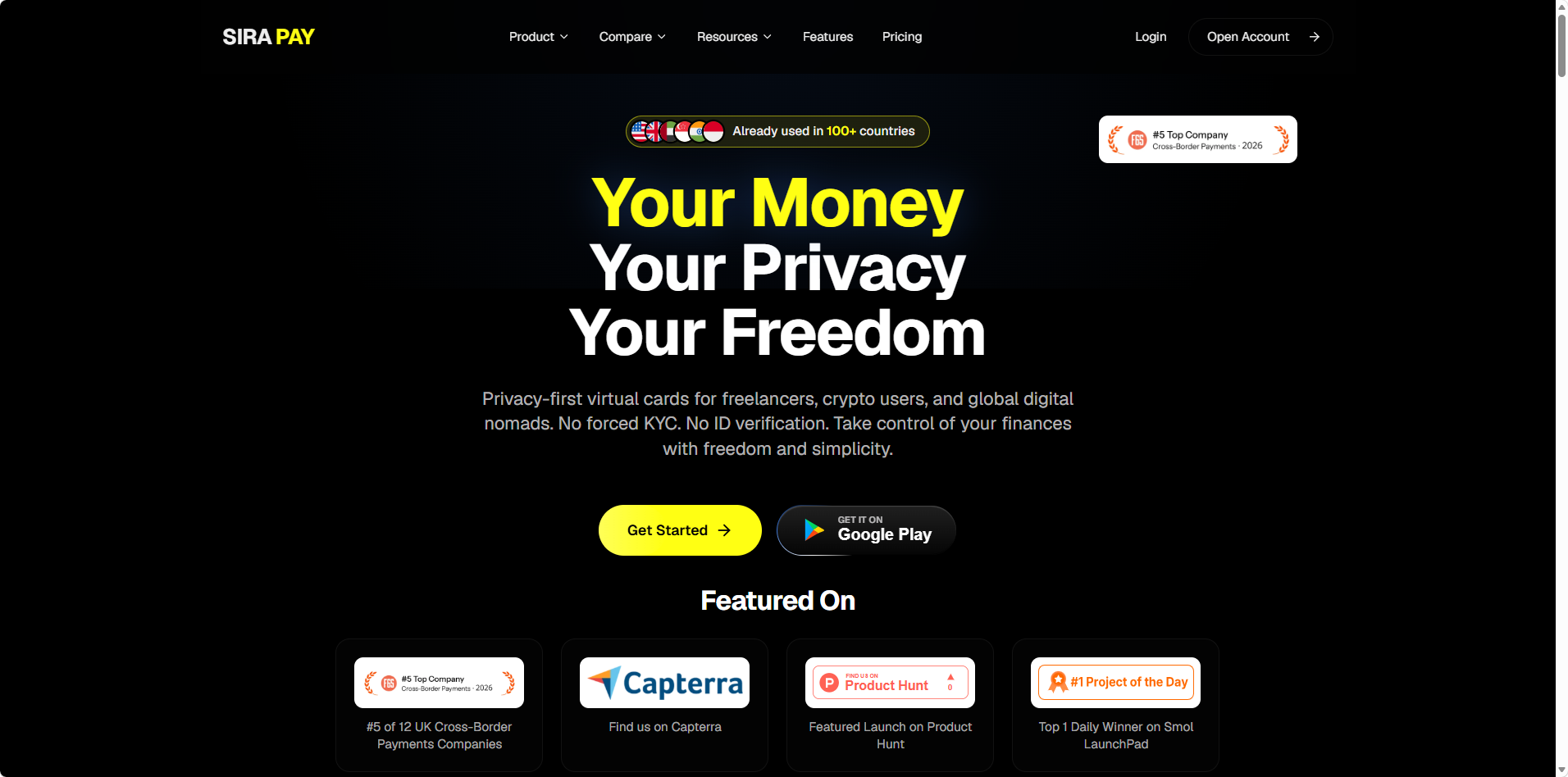
SiraPay markets itself as a privacy-first virtual card that you can open without forced ID checks.
How SiraPay Works
SiraPay allows signup with just an email address and says there is no ID upload, selfie or face scan to sign up and spend. Its homepage also notes that basic user information is collected to meet regulatory obligations.
SiraPay cards work at 150M+ merchants online, according to the company, and each one is a Visa virtual card issued by Standard Chartered Bank. You start with 5 cards and get more by upgrading, and each card comes with a US billing address.
SiraPay cards can be funded with cryptocurrencies like USDT, either through Binance Pay or on networks including Tron, BNB Smart Chain, Solana, Polygon, Avalanche and TON. The company says the card is spend-only and cannot receive money, so it is not a bank account.
SiraPay Fees and Limits
According to SiraPay's pricing page, Binance Pay deposits are free, the Monthly Card costs $0.99 and the Yearly Card $4.99 on the Gold plan, and payments in a currency other than USD carry a 1.5% FX fee. Plan prices, card top-up fees and spending limits are shown only inside the app. A physical card is listed as coming soon.
What SiraPay Users Say
SiraPay's Trustpilot profile shows 4.0/5 from only 3 reviews, which is far too few to draw conclusions. Trustpilot also displays a notice that the company may be associated with high-risk investments.
SiraPay: Watch Out For
Key costs and limits are hidden until you sign up, and the "no forced KYC" wording sits alongside a statement that user information is collected for regulatory reasons.
2. Kripicard
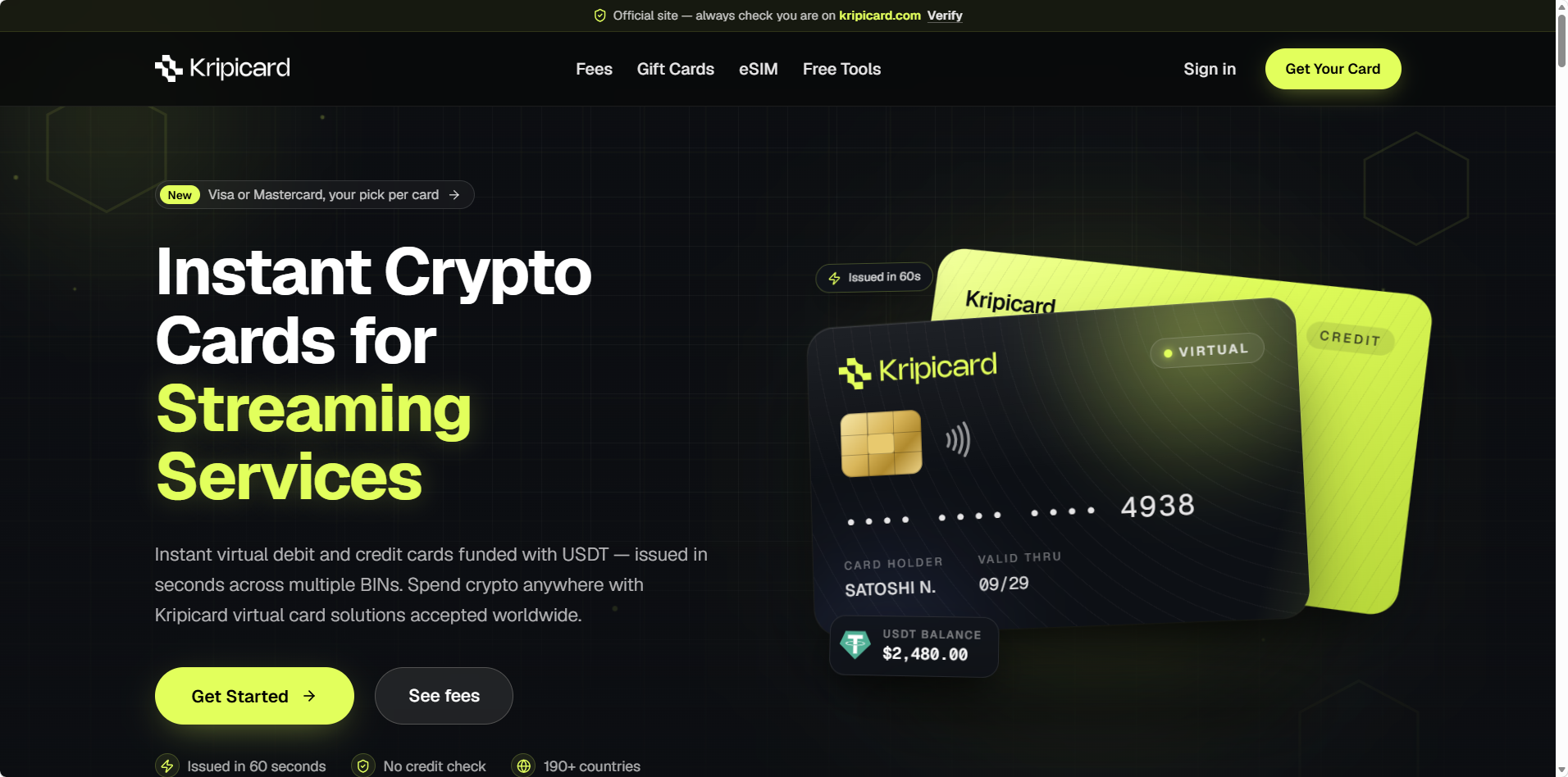
Kripicard is a crypto card platform that lists headquarters in Rio de Janeiro and a US address in Dover, Delaware.
How Kripicard Works
Kripicard's no-KYC landing page says you can sign up with just an email on the basic tier, and Kripicard requires no ID uploads for its basic tier. Kripicard allows users to issue a card in about 60 seconds, and Kripicard allows funding with USDT without KYC verification, according to the same page, which also lists 150+ accepted coins.
You can create multiple cards, choosing Visa or Mastercard for each one, along with single-use burner cards, and you can freeze cards instantly and add cards to Apple Pay, Google Pay or Samsung Pay.
Kripicard's homepage tells a different story. Its compliance section lists identity verification, sanctions screening and AML monitoring with regulated partners. The two pages do not explain how these fit together, so confirm what applies to your account before funding it.
Kripicard Fees and Limits
Kripicard's fees page lists a $5 issuance fee per card, a $10 minimum to create a card, a 4% funding fee and a $1 processing fee, with no monthly fee and no FX fee. Limits are $25,000 per transaction, $25,000 per day and $150,000 per month, and cards are valid for five years. On a $100 first load, the issuance, funding and processing fees come to about $10, roughly 10% of the money you put in.
What Kripicard Users Say
Kripicard holds a Trustpilot score of 2.6/5 from 24 reviews. A September 2026 reviewer said cards were being blocked frequently, each $15 replacement adding cost, and Kripicard replied that restrictions follow its terms. Another reviewer was still waiting for a balance to return after deleting a card.
Kripicard: Watch Out For
Conflicting KYC statements, frequent card blocks reported by users, and fees that weigh heavily on small loads.
3. WaldenPay
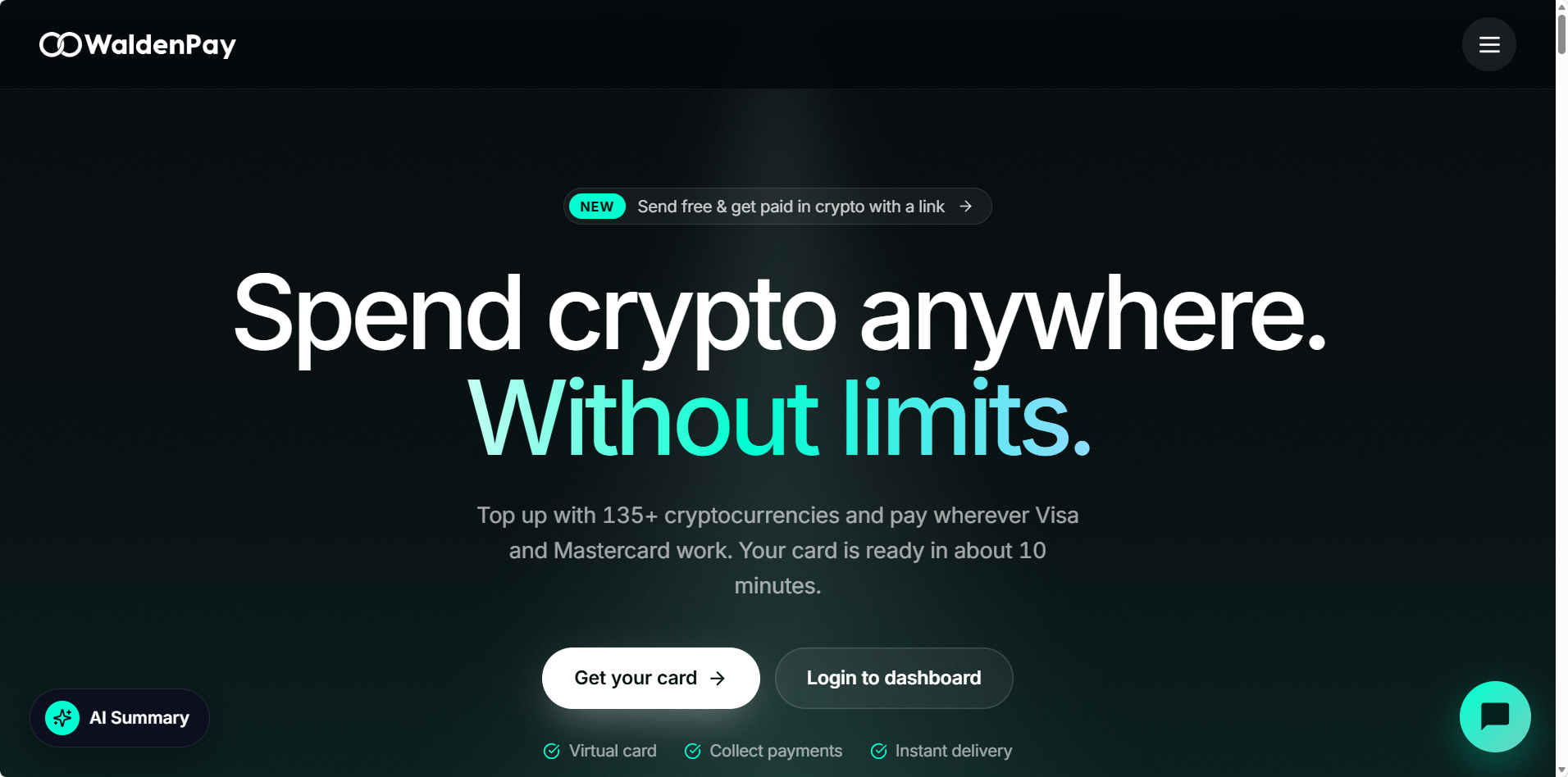
WaldenPay is operated by BlueHouse Software B.V., a company registered in Rotterdam, Netherlands.
How WaldenPay Works
WaldenPay issues a virtual card in about 10 minutes, by its own count: two minutes to register, three to fund and five to top up and spend.
WaldenPay accepts 135+ cryptocurrencies for funding across 35+ networks, including USDT, USDC, BTC, ETH and SOL, and converts deposits to card balance at loading time. Its cards run on Visa and Mastercard, which WaldenPay says are accepted at 150M+ merchants, and work online, in store and with Apple Pay and Google Pay.
Comparison directories list WaldenPay as no-KYC, and third-party guides describe it as issuing cards without document verification for standard use. WaldenPay's own site does not say that. It states that services are subject to AML and regulatory requirements and depend on onboarding and eligibility checks, and it says partners may provide accounts and cards.
WaldenPay Fees and Limits
WaldenPay charges a one-time $10 card issuance fee and a 5% top-up fee that drops to 3% at $100,000 or more in 30-day volume, with no monthly fee. It does not publish card spending limits on its homepage.
What WaldenPay Users Say
WaldenPay has a Trustpilot score of 4.6 from 39 reviews, mostly praising fast support and easy Apple Pay setup. The one recent one-star review said the deposit fee is high and the card does not work for some services.
WaldenPay: Watch Out For
A 5% top-up fee on most users' volume, and a gap between how directories describe it and what its own site commits to.
4. CasherCard
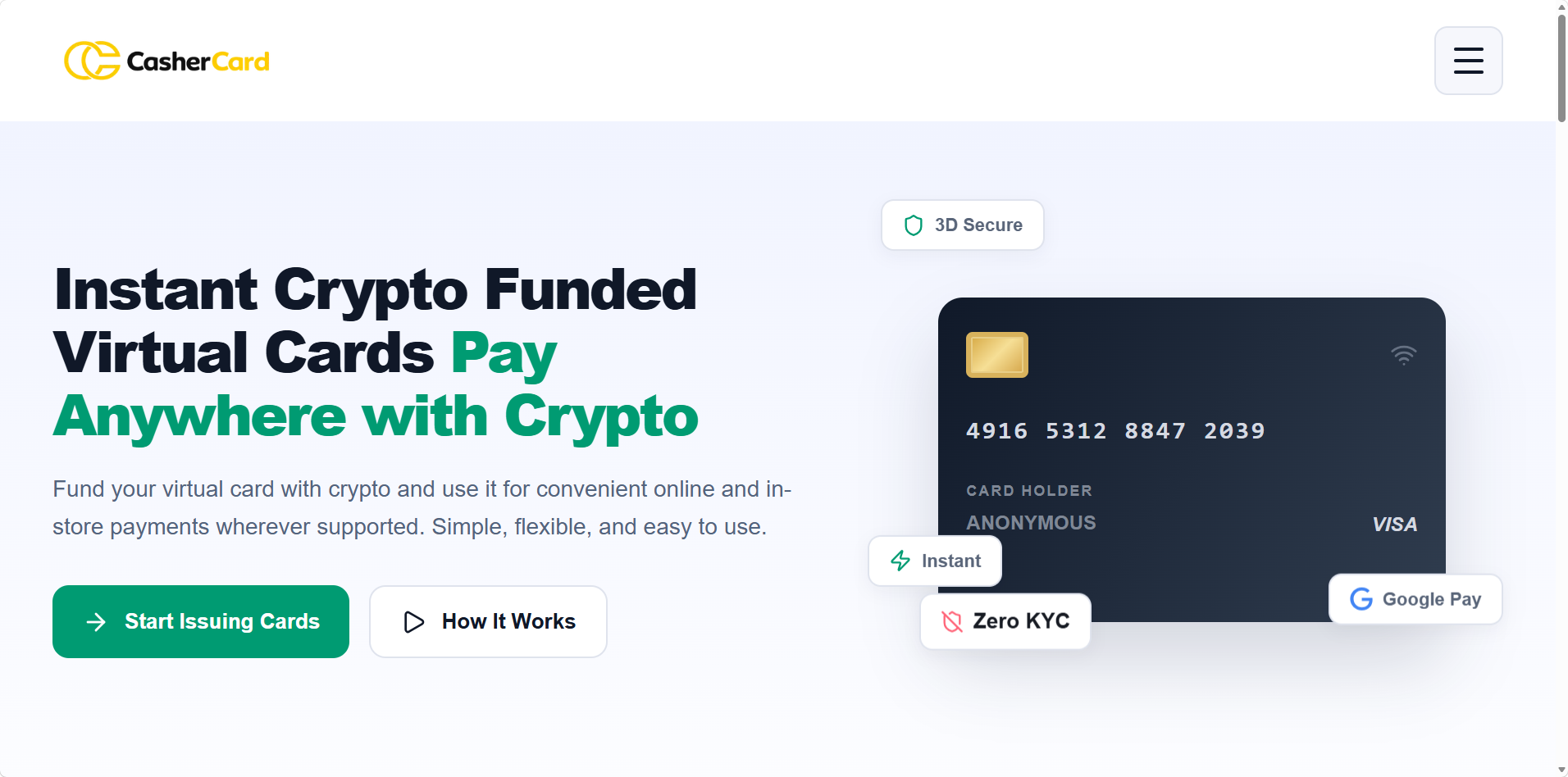
CasherCard describes itself as a registered technology company, not a bank, with cards and wallets provided by regulated third parties.
How CasherCard Works
CasherCard offers email-based registration without document verification. Its homepage says you can sign up with email, no phone and no personal data, and calls its cards "Zero KYC." CasherCard supports crypto funding for virtual card services, listing Bitcoin, Ethereum, Solana, USDT, BNB and others. It issues a reloadable virtual card on Visa or Mastercard, supports Google Pay and 3D Secure, and lets you set daily, weekly or total spending limits on each card.
CasherCard supports online shopping and subscriptions, with Netflix, Spotify, Amazon and Shopify listed as examples, along with ad platforms such as Meta Ads, Google Ads and TikTok Ads.
CasherCard Fees and Limits
CasherCard charges a $4 fee per card issued and a 5% fee when you top up your wallet, with no monthly subscription and no decline fee. Limits are $5,000 per transaction and $50,000 per month, and the site says unused balances are refundable.
What CasherCard Users Say
CasherCard has a Trustpilot score of 3.9 from eight reviews. One reviewer reported reliable international payments, another said prices are a bit high and they could not check their card balance for weeks, and a third called the site fraudulent.
CasherCard: Watch Out For
CasherCard's homepage does not state where the company is registered, and it reserves the right to change its card partners.
5. SolvoCard
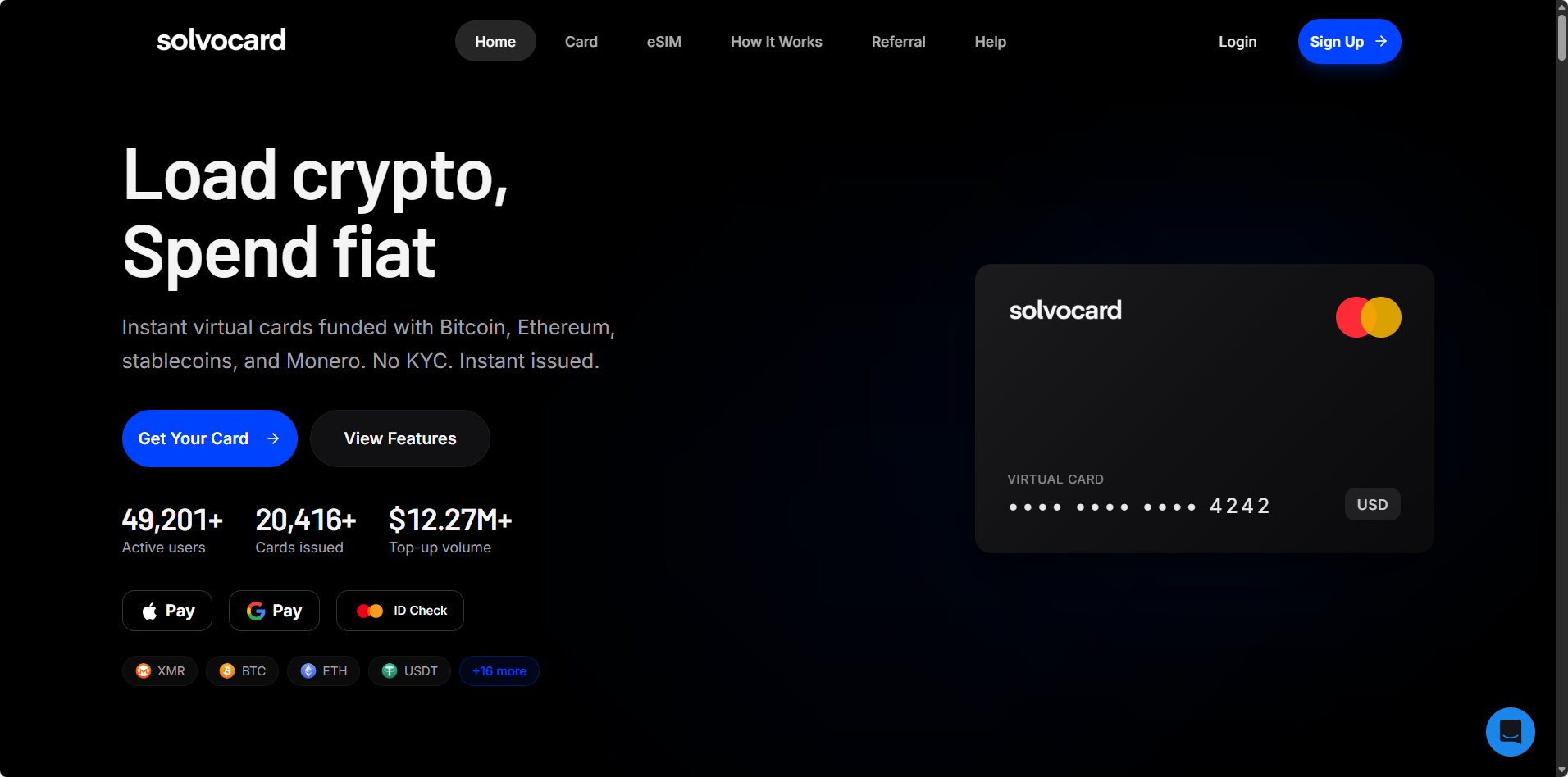
SolvoCard says in its terms that it is a Hong Kong-registered company, CARD TECH DLRT SERVICES Pye, Ltd.
How SolvoCard Works
SolvoCard allows online shopping without identity verification, and SolvoCard allows spending without identity verification in store through Apple Pay and Google Pay.
Its homepage says no identity documents and no selfies are required. You sign up with an email, enter a name for the card and make a first crypto deposit. It offers a Mastercard in euros with an EU billing address and a Visa in US dollars with a US billing address, both with 3D Secure, plus a physical card.
SolvoCard's privacy policy says it collects your email, IP address, browser type and transaction records. It says its card-issuing partners receive only the transaction data needed to process payments and no identifying information beyond that. In other words, SolvoCard does not share user data with banks or credit bureaus beyond that, and as a prepaid card it does not report to credit bureaus.
SolvoCard Fees and Limits
Each virtual card costs a one-time $99, and the physical card costs $199. The EUR card has a €50,000 monthly limit and no FX fee, while the USD card charges 2% on foreign currency transactions.
What SolvoCard Users Say
SolvoCard's Trustpilot profile has three reviews, all one-star, from September 2026. Two reviewers said they deposited money but could not create a card, and one said they could not withdraw their funds.
SolvoCard: Watch Out For
SolvoCard's terms say all crypto deposits are final and non-refundable, and that violating its policies can lead to forfeiture of any remaining balance.
6. Ezzocard
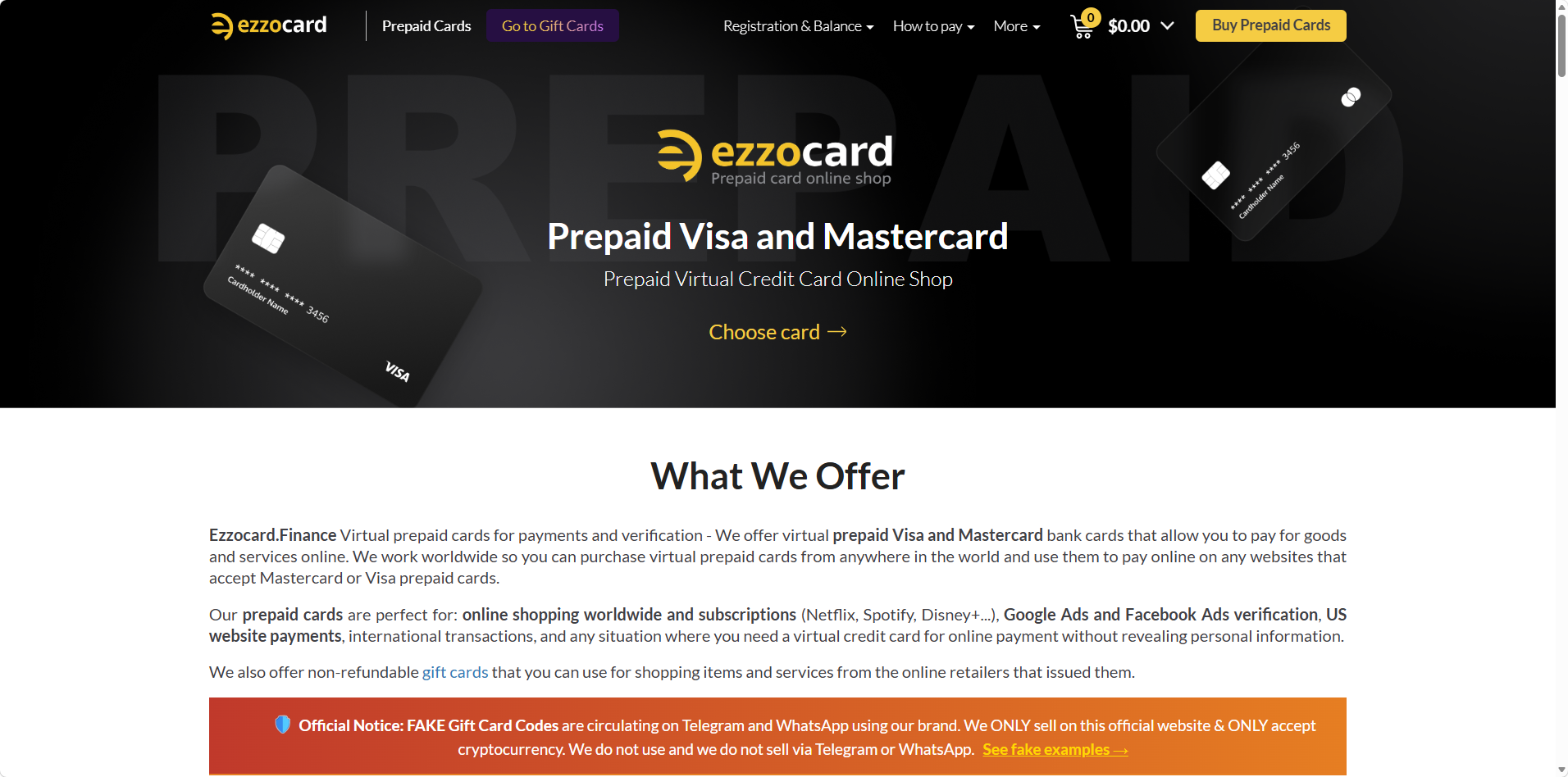
Ezzocard sells anonymous prepaid cards for crypto and now operates from ezzocard.finance, its former domain being ezzocard.com.
How Ezzocard Works
Ezzocard says you will not be asked for your identity or documents and that cards can be registered in any name and address. Its cards are prepaid and non-reloadable, so each one holds a fixed amount and is retired when the balance runs out. Products range from Gold Visa and Mastercard cards to single-use Lime cards and Canadian-dollar options. Gold and Lime cards support Apple Pay and Google Pay, and Gold supports 3D Secure.
Ezzocard Fees and Limits
Ezzocard shows each card's price at checkout rather than publishing a flat fee. Card values range from $10 to $10,000 depending on the product, and some cards carry a $3 monthly fee or 2.5% on non-CAD purchases. Unused eligible cards can be refunded at 90% of face value within one month.
What Ezzocard Users Say
Ezzocard's original Trustpilot profile shows 2.5/5 from 368 reviews, and its current profile has two one-star reviews from 2026, both saying cards did not work.
Ezzocard: Watch Out For
Ezzocard warns that fake Ezzocard gift codes circulate on Telegram and WhatsApp. It also says some cards need a US or EU IP address and may be blocked without refund otherwise, and that payments sent on the wrong blockchain are not credited.
7. Laso Finance
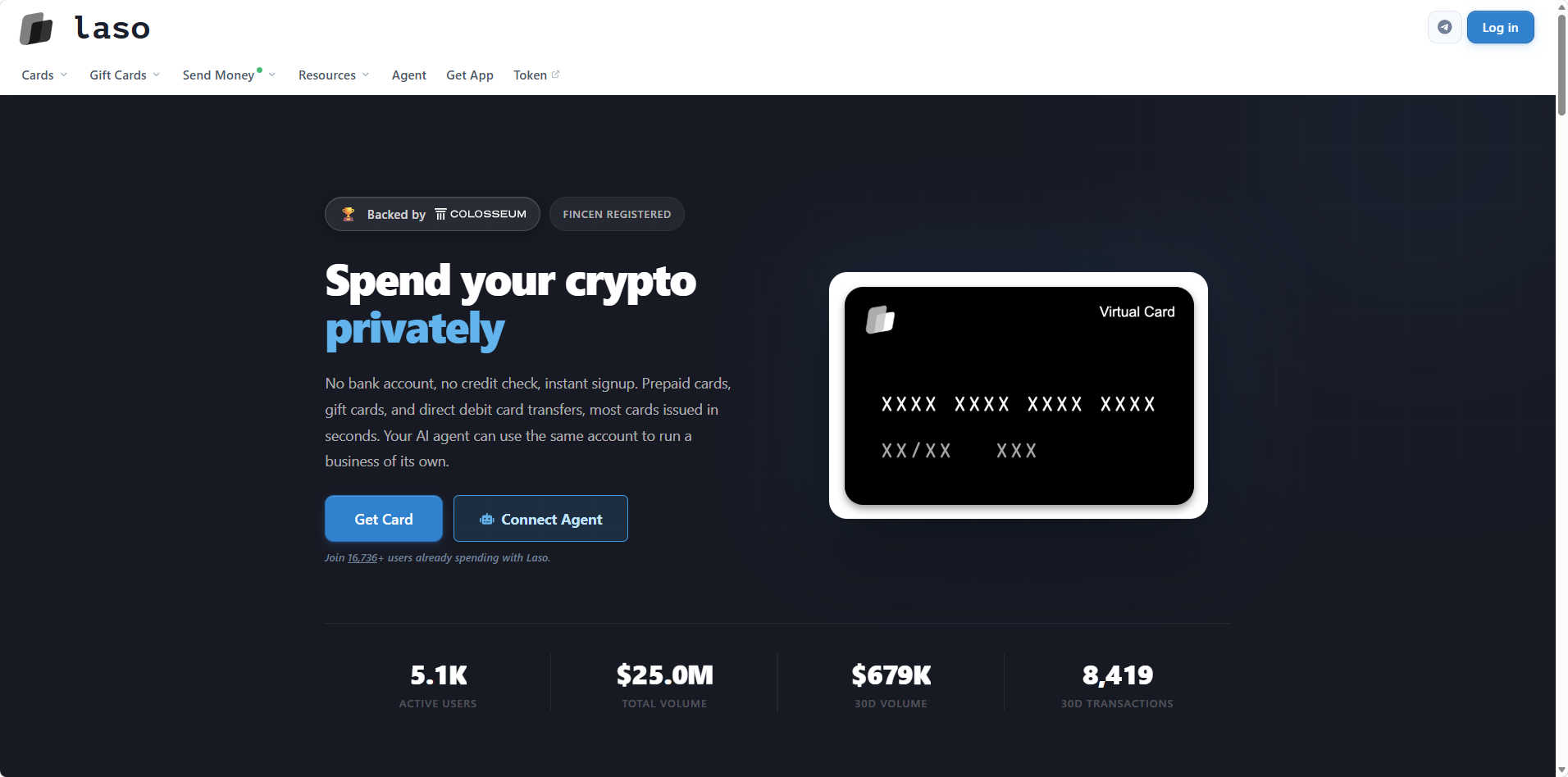
Laso Finance is run by Laso Finance LLC, a FinCEN-registered Money Services Business based in Austin, Texas.
How Laso Finance Works
Laso Finance lets you connect a crypto wallet and fund prepaid cards with USDC, USDT or DAI on networks including Ethereum, Solana, Base and Arbitrum. It advertises "No bank account, no credit check." It offers single-load US cards for US merchants and shipping addresses, international prepaid cards, and gift cards, and says its cards work online, in stores and with Apple Pay, Google Pay and Samsung Pay.
Laso does not lay out its identity rules on the homepage, but it notes that identity verification stays with an account's human owner when AI agents use its API.
Laso Finance Fees and Limits
Laso says it charges no monthly, authorization or decline fees, typically one fee per card load. US cards take a single load of $5 to $1,000. Its fees page lists loading a US card as free, while its short-form disclosure lists 6.8% on the load.
What Laso Finance Users Say
Laso holds a Trustpilot score of 4.0/5 from 21 reviews, with praise for support. In one August 2026 reply, Laso told a user their account was blocked because device-fingerprinting data indicated a sanctioned location. Another reviewer said Apple Pay was promised but only Google Pay was available.
Laso Finance: Watch Out For
Laso shows how much a "no KYC" provider can still know about you: device and location data were enough to close an account.
8. BingCard
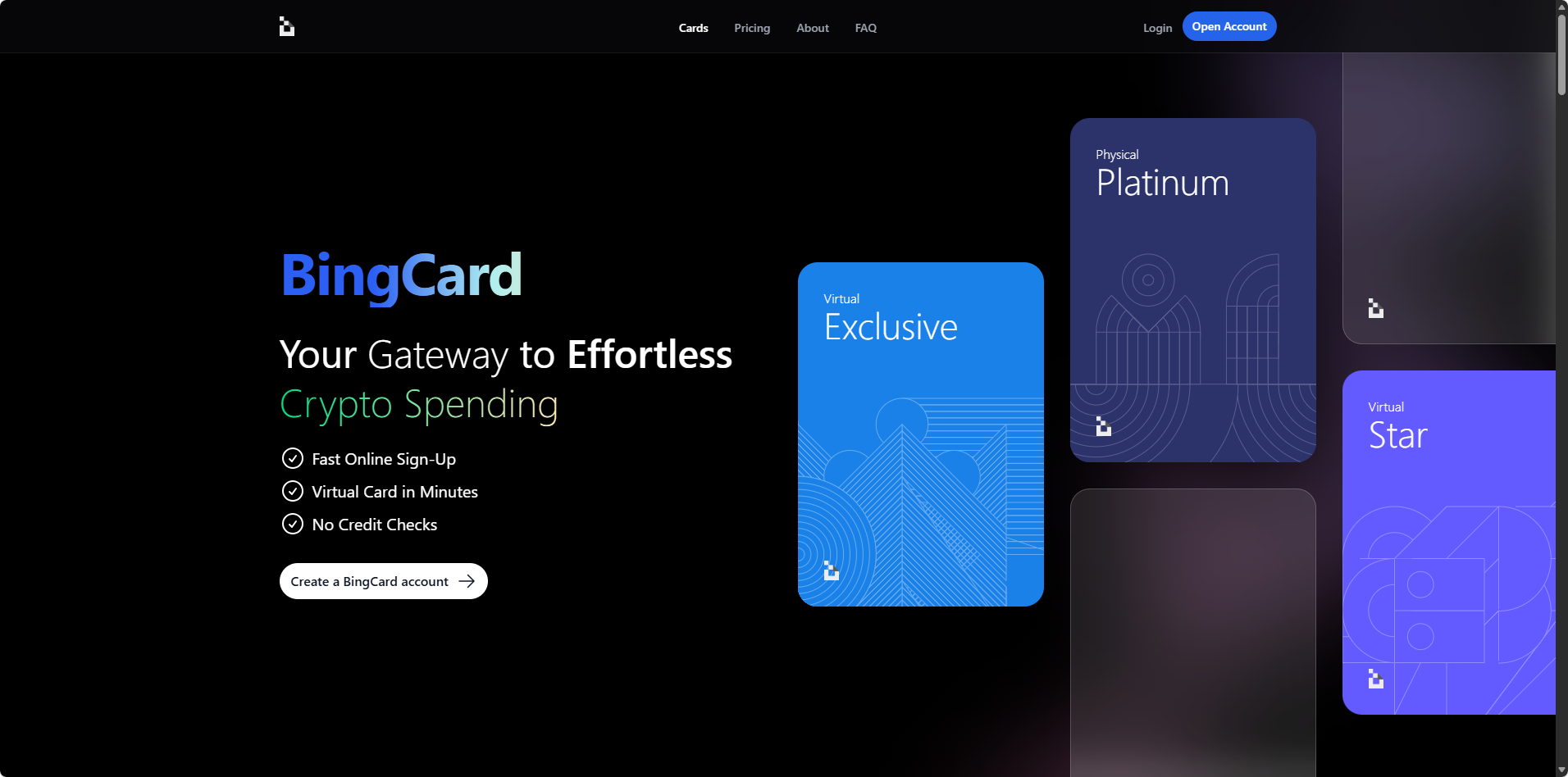
BingCard appears on several no-KYC directories as a crypto-funded virtual card issued in minutes.
How BingCard Works
BingCard's own site advertises "No Credit Checks" and says a virtual card is issued within minutes. It accepts 17 cryptocurrencies, including BTC, ETH, USDT, USDC and SOL, and says virtual cards can be linked to PayPal and WeChat Pay. A physical card is available after online KYC.
The site also says all clients must complete full identity verification. It describes BingCard as an intermediary between card issuers, not a bank, and says it holds no licenses, is not registered in the United States and provides its services from outside the country.
BingCard Fees and Limits
BingCard charges a transaction fee of 0% to 1% depending on the card BIN. It does not publish spending or top-up limits on its homepage.
What BingCard Users Say
We could not load BingCard's Trustpilot profile, so we have no review data to report.
BingCard: Watch Out For
A provider listed as "no KYC" that states full identity verification on its own site, with no license and no named operating company.
9. SolCard
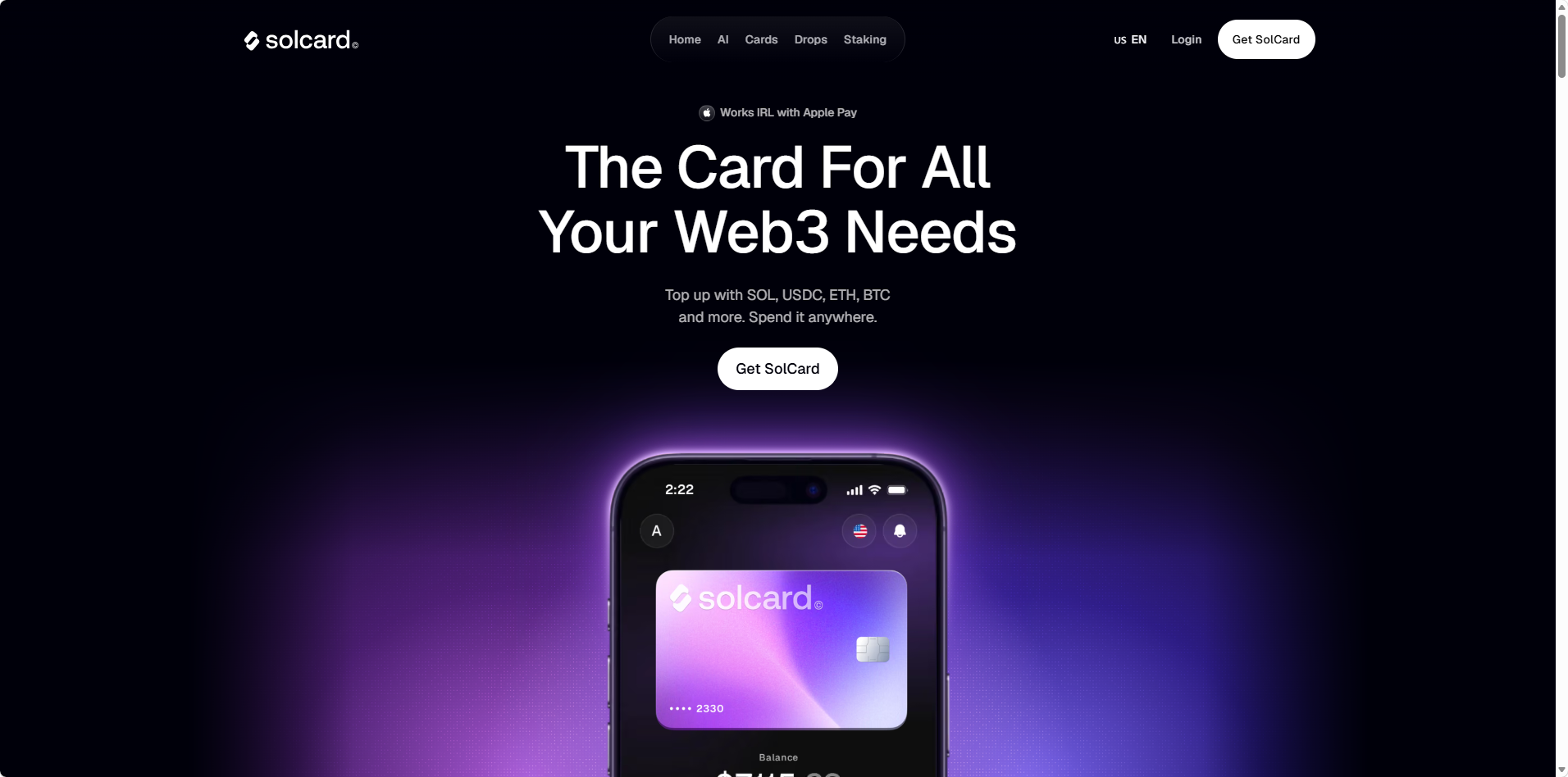
SolCard is a Solana-focused crypto card operated by SC PAYMENTS LIMITED, a Hong Kong company, according to the footer of SolCard's own review page.
How SolCard Works
SolCard offers a Virtual tier with no identity verification and a Platinum tier that requires KYC. You fund it with SOL, USDC, USDT or its own SOLC token, and the card converts the balance at the point of sale. Only the Platinum tier is described as supporting Apple Pay and Google Pay. SolCard says additional verification may be required for certain tiers, features or spending limits.
SolCard Fees and Limits
The Virtual tier costs $10 to issue, charges a 5% top-up fee and about 1% to 2% FX, with a $10,000 monthly spending limit. The Platinum tier has no top-up fee and higher limits, in exchange for verification.
What SolCard Users Say
In July 2025, The Defiant reported that some unverified SolCard users lost access to their virtual cards, with a company representative saying a no-KYC option would be reinstated.
SolCard: Watch Out For
SolCard is a clear example of how the regulatory environment for no-KYC cards can change, impacting provider requirements and leaving unverified users without access overnight.
10. Goblin Cards
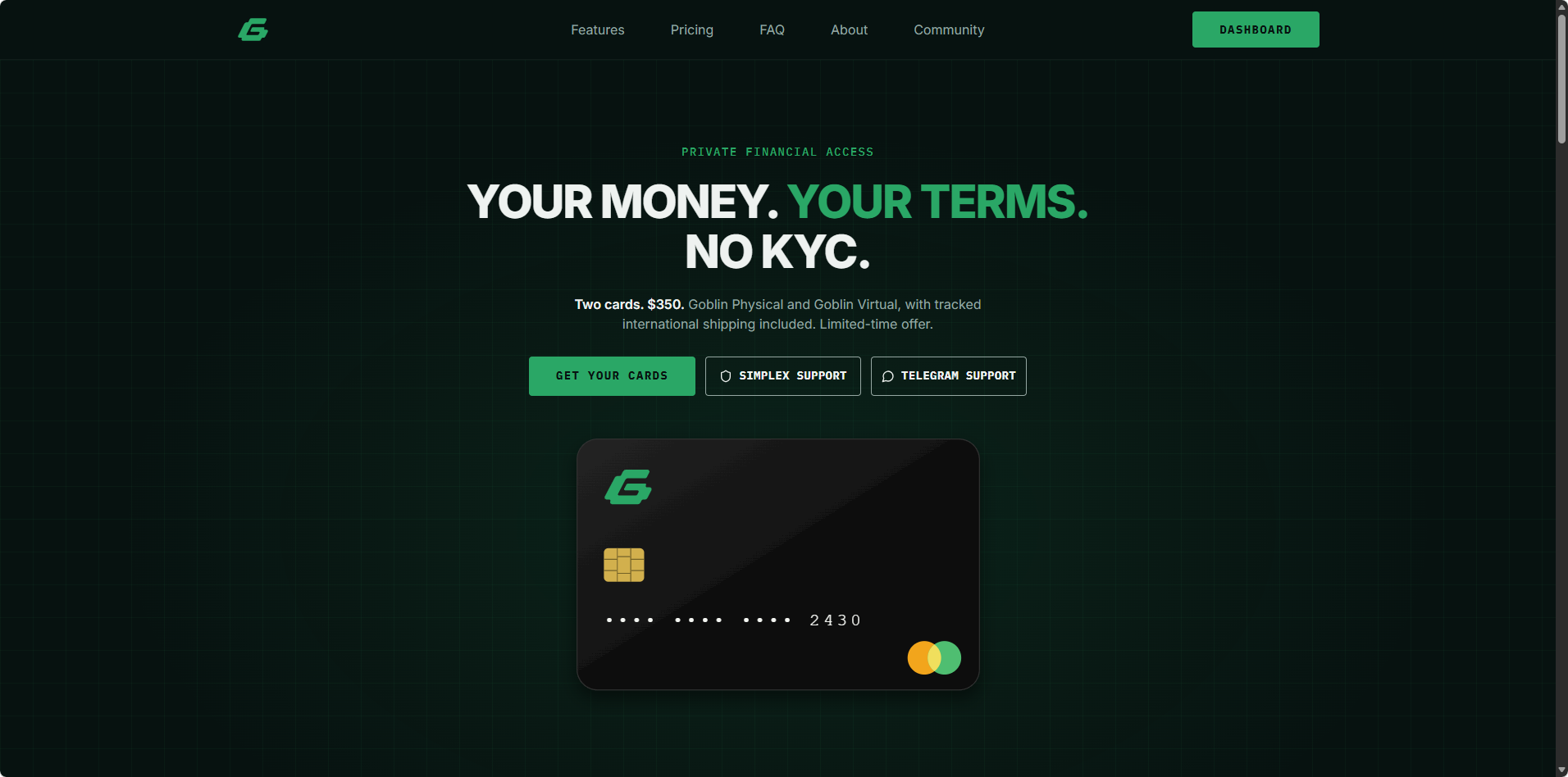
Goblin Cards is run by Goblin Solutions LLC, according to its terms, which do not say where the company is registered or which bank issues the cards.
How Goblin Cards Work
Goblin Cards sells two cards as a bundle: Goblin Physical, a Mastercard with a balance in Mexican pesos, and Goblin Virtual, a Visa with a balance in US dollars. Its homepage headline promises "No KYC," and its FAQ says Goblin Physical needs no passport, driver's license or other identity documents.
You can't simply sign up. Account setup needs a unique invitation link, which you request from support on Telegram or SimpleX. The FAQ also says the two cards aren't sold separately for now, and that Goblin Virtual goes only to existing, trusted users.
You fund Goblin Physical by sending BTC, ETH, SOL, XMR or USDT to a deposit address shown in the web portal or Telegram bot. Goblin Virtual works with Apple Pay and Google Pay and supports 3D Secure for online payments. The physical card ships worldwide with tracking in about seven days, or to an EU parcel locker without customs clearance.
Goblin Cards Fees and Limits
According to Goblin's pricing page, both cards together cost a one-time $350, including tracked shipping, activation and support, with no subscription. Deposits to the physical card cost 3.5%, or 4% in XMR, with a $100 minimum. The physical card has no FX fee and no Goblin ATM fee, while the virtual card charges about 1.5% FX, which includes a 1% markup on the conversion rate.
The physical card is capped at $2,500 per transaction, $5,000 per day and $500 a day at ATMs. The virtual card allows up to $20,000 a day on tap payments and $200,000 a day online, and it can't be used for cash withdrawals. A replacement for a lost card costs $100.
What Goblin Cards Users Say
Goblin Cards holds a Trustpilot score of 4.5 from 15 reviews, all five-star and all posted in January 2026, praising fast support, quick shipping and fewer declines abroad. Trustpilot notes that the company hasn't invited reviews recently and may be associated with high-risk investments.
Goblin Cards: Watch Out For
Goblin's terms let it suspend or terminate access at any time and don't say what happens to your balance if it does. Sharing a card's BIN publicly leads to indefinite suspension with no refund, and the card order itself stops being refundable once the card has been used.
11. Agora Cards
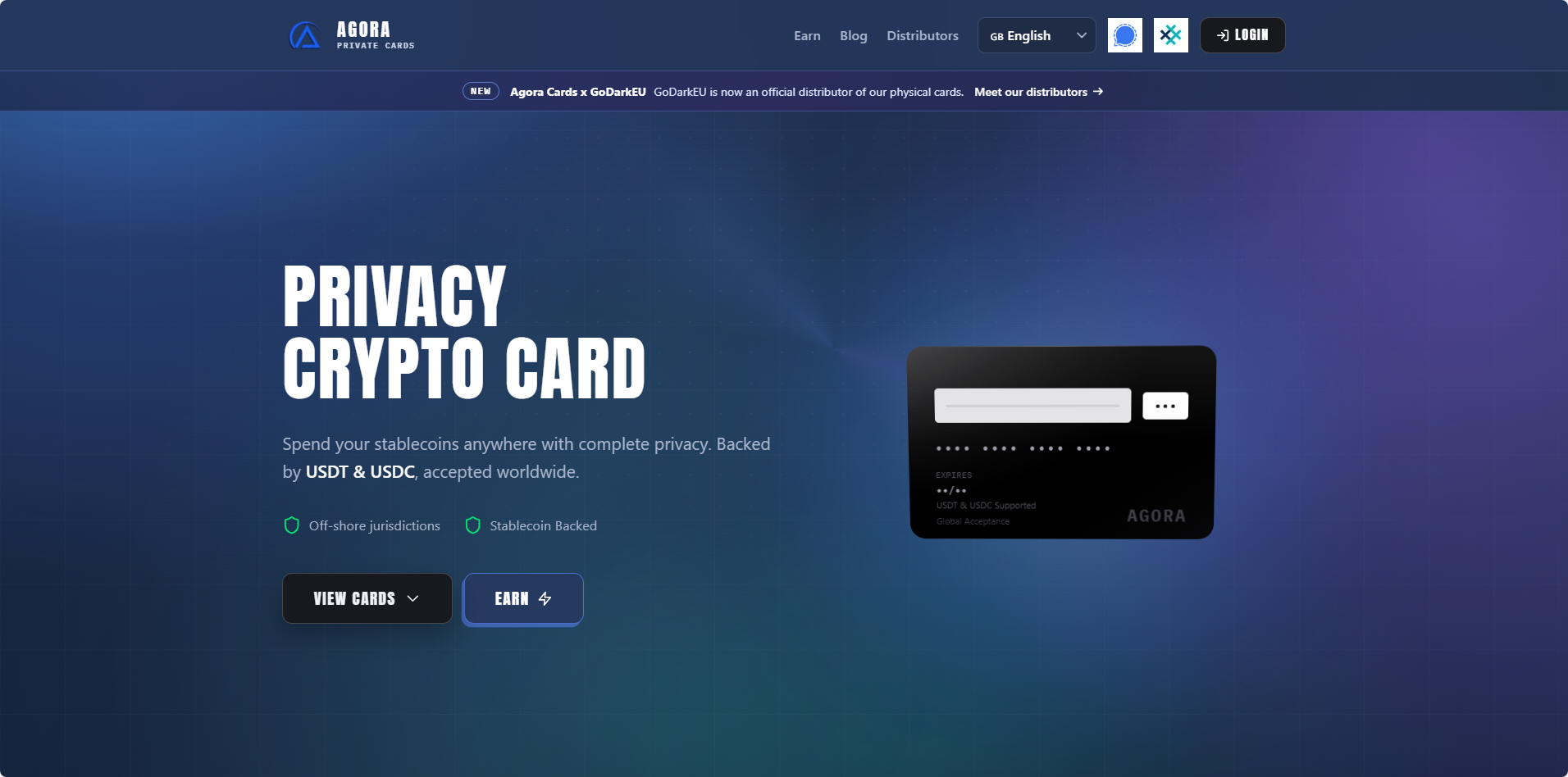
Agora Cards is a crypto card brand that names no company, no registered address and no terms of service on its website. CryptoCards.so dates the brand to April 2026.
How Agora Cards Work
Agora sells three cards: Virtual Card Basic, Virtual Card Plus and Physical Card Plus. You fund them with USDT or USDC from your own wallet, the cards are issued in US dollars and convert to the local currency at checkout, and reloads are usually spendable within minutes. Agora says all its cards support Apple Pay and Google Pay, subject to the wallet provider's rules, and that loaded funds are held by licensed and regulated custodian partners it does not name.
Agora's site doesn't say what you need to register or which card network it uses. CryptoCards.so lists the Agora virtual card as an email-only Visa with no identity checks, while one Trustpilot reviewer described the signup as "easy kyc." Check what Agora asks for before you pay.
Agora Cards Fees and Limits
Agora's homepage lists these prices and fees:
| Virtual Card Basic | Virtual Card Plus | Physical Card Plus | |
|---|---|---|---|
| One-time price | $90, including $10 credit | $100, including $10 credit | $550 |
| Top-up fee | 2% | 2.5% | 2.5% |
| Transaction fee | $0.35 + 1.5% | $0.35 + 1.5% | $0.10 + 1.5% |
| FX fee | 1.5% | 1.5% | 1.5% |
| Per transaction limit | $20,000 | $60,000 | $60,000 |
| Daily limit | $240,000 | $900,000 | $900,000 |
Agora puts the total percentage fees at 5% on Virtual Card Basic and 5.5% on the Plus cards. The physical card adds a 2% ATM fee, with ATM limits of $3,000 a day and $80,000 a month, and the virtual cards can't be used at ATMs.
Agora lists the US, Morocco, Bangladesh, India and Turkey among its unsupported countries. Its FAQ says the Plus cards are unavailable there while Virtual Card Basic still works, so confirm your country before buying. Gambling, crypto purchases, gaming credits and petrol are among the prohibited uses.
What Agora Cards Users Say
Agora has a Trustpilot score of 4.4 from 10 reviews, all five-star and posted between June and July 2026, praising easy deposits, helpful support and privacy. Trustpilot notes the company hasn't invited reviews recently.
Agora Cards: Watch Out For
Agora's own Telegram channel shows how quickly its lineup changes: posts announce that Virtual Card Plus was discontinued in the US, that the previous physical card is no longer issued, and that its email delivery went down several times. With no published terms, nothing on the site says what happens to your balance if a card stops working.
12. Trocador
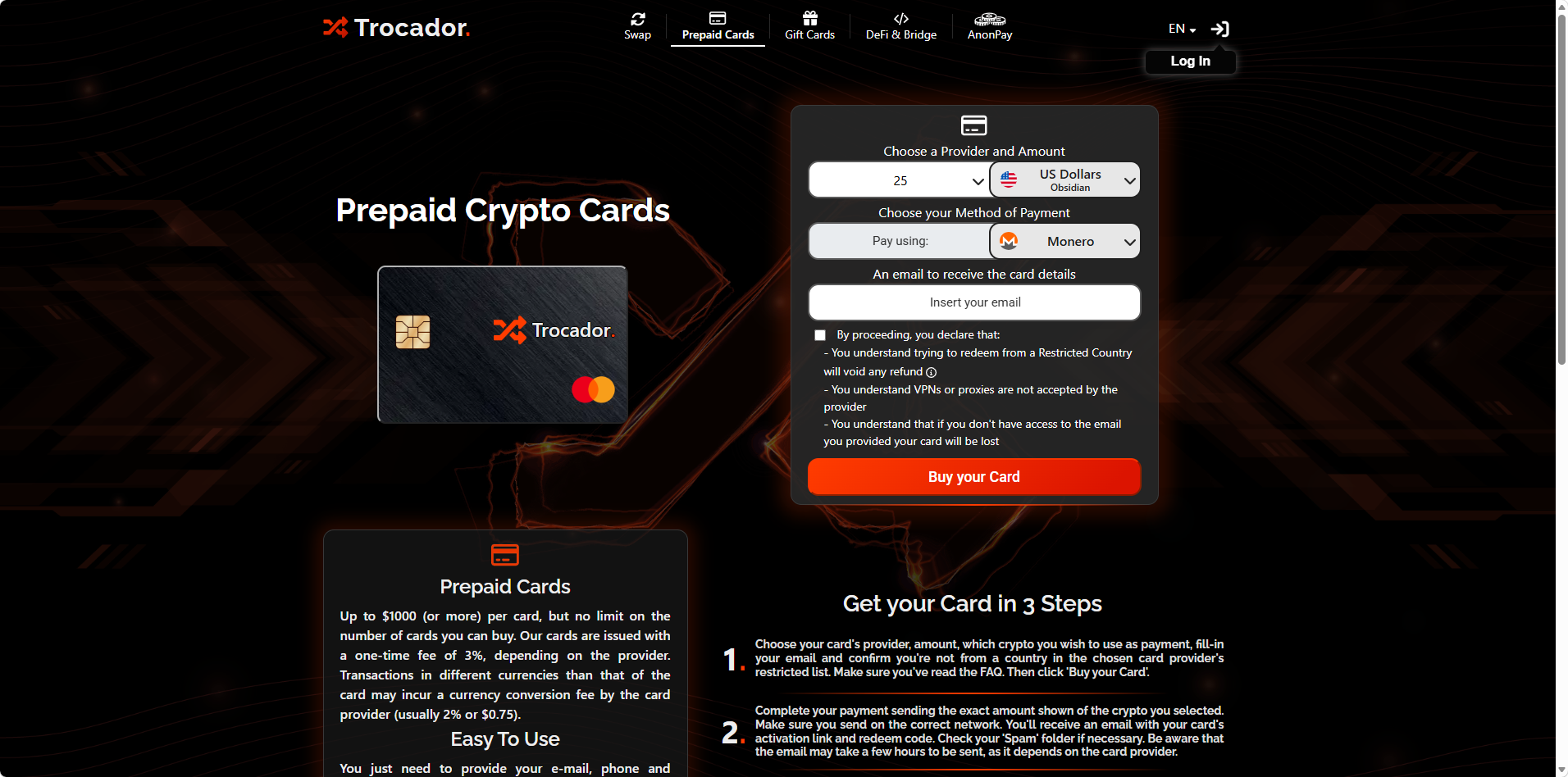
Trocador is best known as a crypto swap aggregator. Its prepaid card store resells fixed-value cards from partner providers, including an international Mastercard provided by Obsidian.
How Trocador Works
You pick a card amount, enter an email address and pay in crypto. Trocador accepts stablecoins such as USDT, USDC and DAI directly on several networks, and BTC (including Lightning), ETH, LTC, XMR and other coins through its AnonPay service, which may add a conversion charge. The activation link and redeem code arrive by email, sometimes hours later.
To activate the card, you give a name, email address, phone number and address. Trocador says no document upload is needed, but the information must be truthful or the card may be blocked. Its FAQ says cards are either Mastercard or Visa and can usually be added to Google Pay, Samsung Pay or Apple Pay, though Obsidian cards cannot go into Apple Wallet.
Trocador Fees and Limits
The Obsidian card comes in fixed amounts from $25 to $1,500. Trocador's FAQ gives a general one-time issuance fee of 3% of the card amount plus $2, depending on the provider, and the Obsidian listing adds $0.60 per purchase, 2.75% on non-USD purchases and $5 a month starting after the second month. Trocador puts no cap on how many cards you can buy.
If that general rate applies, a $100 card costs about $5 to issue before you spend anything. Leave $20 on the card for six months and the monthly fee takes all of it.
What Trocador Users Say
Trocador holds a Trustpilot score of 4.8 from 264 reviews, but those reviews are about crypto swaps, not prepaid cards. One March 2026 reviewer described a swap held in a prolonged AML and KYC review by a partner exchange, with repeated document requests, which shows that identity checks can still appear later in a "no KYC" flow.
Trocador: Watch Out For
Obsidian cards don't work at merchants that require 3D Secure or refuse prepaid cards, and Trocador warns against using a VPN, proxy, Tor or ad blocker when redeeming. Residents of restricted or sanctioned countries can't use the cards, and redeeming from one voids any refund. Bitcoin.com's review also reports phishing copies of Trocador's site and recommends typing trocador.app directly.
13. Offgrid
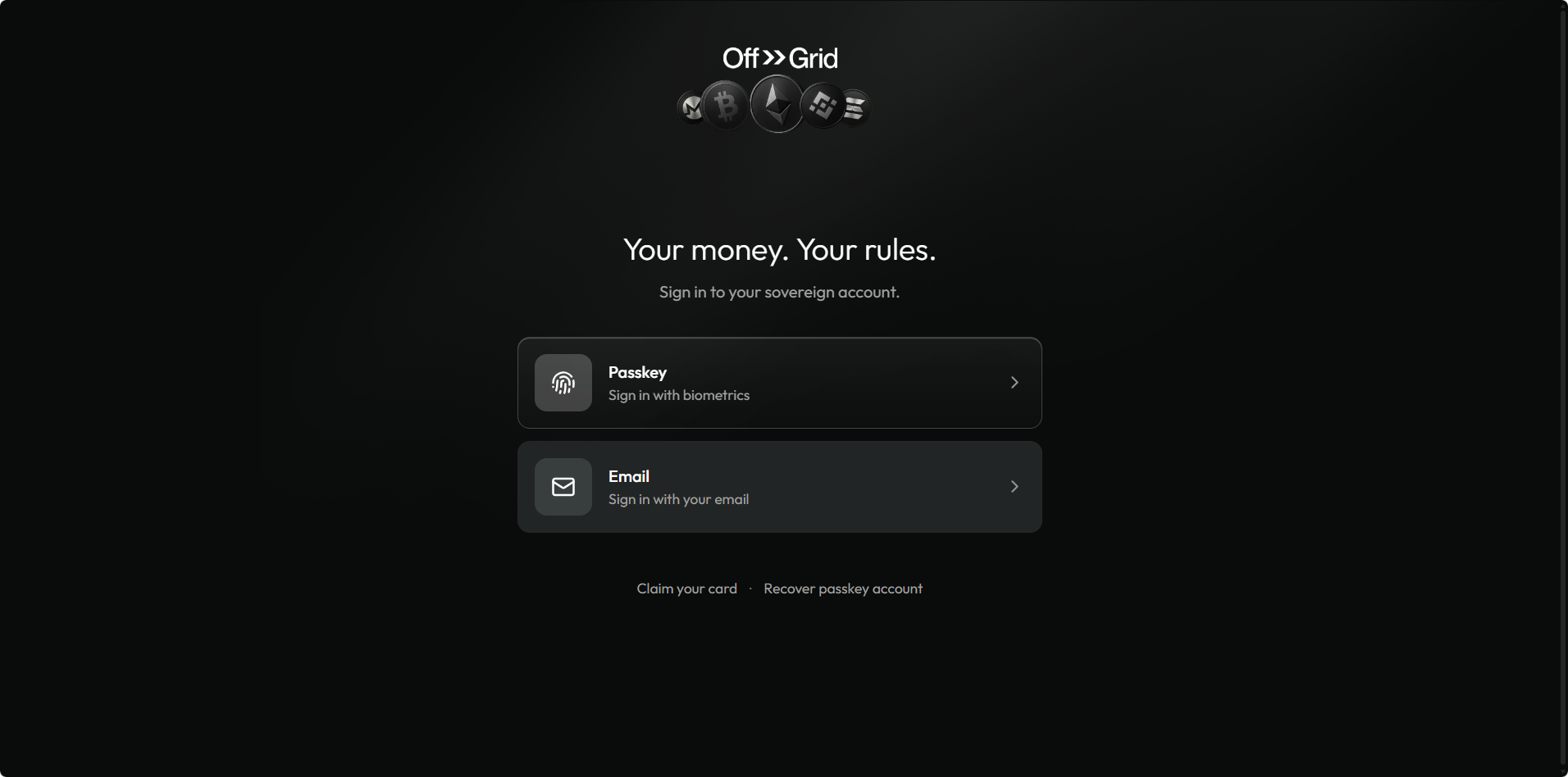
Offgrid describes itself on its web app as a way to "deposit crypto, get a virtual card," and operates from offgrid.cash and app.offgrid.cash.
How Offgrid Works
Offgrid publishes its signup steps, fees, limits and terms only inside its web app, which would not load for us. Because we couldn't check them on Offgrid's own pages, we have left its figures out of this guide rather than repeat them secondhand.
What independent reviewers report is useful context. Bitcoin.com's November 2026 review says access needs an invite code plus a passkey or email, that no ID is requested at any published step, and that Offgrid sells paid annual memberships whose load fees and monthly spending caps vary by tier. It also says the card runs on Visa through an unnamed issuing partner, with Google Pay support but no Apple Pay.
Offgrid Fees and Limits
Offgrid's fee schedule and limits sit inside its app. Bitcoin.com notes that Offgrid's help center and top-up screen showed different conversion fees, so check the figure on the screen before you deposit.
Offgrid: Watch Out For
Bitcoin.com reports that Offgrid names no company, jurisdiction or card issuer, that money loaded onto the card can only be spent, not withdrawn, and that its terms let it forfeit the card balance if an account is terminated. It also flags offgridcash.com as a clone site that asks visitors to connect a wallet, so check the address carefully.
Crypto.com and Privacy.com Are Not No-KYC
Two well-known names often come up in these searches. Crypto.com requires identity verification for its card services, and in Europe it also asks card users for their expected transaction volume, income bracket and occupation before they can top up, citing EU Directive 2018/843. Privacy.com requires identity verification for account setup, asking for your name, residential address and date of birth, and it may request a driver's license. For crypto-funded cards that verify you, see our roundups of cards like the Crypto.com Card and cards like RedotPay.
Why No-KYC Virtual Cards Are Extremely Risky
No-KYC cards can feel like the private option. In practice, they swap one risk (a company holding your ID) for several bigger ones, most of which land on your money.
1. You Lose Most Consumer Protection
The lack of traditional consumer protections can lead to difficulties in recovering lost funds with no-KYC cards. In the US, the rules for prepaid accounts are explicit: under 12 CFR 1005.18(e)(3), an issuer does not have to apply the liability limits or error resolution requirements to a prepaid account whose holder it has not verified. If someone drains an unverified balance, the protections that normally cap your loss may not apply.
Identity also protects you when something breaks. KYC provider KYCAID points out that if an unverified card is hacked or frozen, the issuer may be unable to prove the account is yours and restore access. The verification you skipped is the same verification that would get your money back.
2. Cards and Balances Can Disappear Overnight
No-KYC programs depend on partners that can pull out at any time. Wirex describes shutdowns of these programs as abrupt and high-impact for end users, with little time to move funds. The provider pages back this up:
-
SolvoCard's terms make crypto deposits final and allow forfeiture of remaining balances for policy violations.
-
Kripicard reviewers describe frequent card blocks and slow balance returns.
-
Ezzocard says some cards can be blocked without refund if used from the wrong country.
-
SolCard cut off some unverified users and asked them to verify.
A commenter on r/defi summed it up: "a frozen prepaid balance is just a bank problem with worse support." The same thread notes that "no KYC" usually means preloading money into someone else's balance, so you are trusting that company's solvency.
3. "No KYC" Usually Means Someone Else's KYC
Visa and Mastercard require issuers to know their customers. Major card networks like Visa and Mastercard ban anonymous card issuances in many cases, and payments firm Verestro notes that schemes allow anonymous issuance only for certain non-reloadable prepaid programs, and only with specific scheme approval.
So how do reloadable no-KYC cards exist? Reporting points to corporate card programs at US banks. FinanceFeeds, summarizing Fintech Business Weekly, named five banks whose BINs appeared on reviewed no-KYC services, including Sutton Bank, which has been under an FDIC consent order over BSA/AML and third-party risk failures since February 2024.
Sutton told reporters it has no tolerance for any version of "no KYC" programs and is remediating. In July 2026, Fintech Business Weekly reported that one no-KYC card had been marketed for use where Iranian bank cards are declined due to sanctions.
When a bank finds its cards being resold this way, it shuts the program down. Your card goes with it.
4. Regulators Keep Tightening the Rules
Increased anonymity attracts illegal activities, leading to crackdowns by regulators. In the EU, the Fifth Anti-Money Laundering Directive cut the threshold for skipping due diligence on prepaid cards to €150 and capped anonymous remote payments at €50 per transaction, as The Paypers explains.
It also requires acquirers to accept anonymous prepaid cards from outside the EU only if the issuing country has equivalent rules. No-KYC cards generally carry strict spending limits to comply with regional regulations, and the providers that offer high limits are often the ones regulators look at first.
KYCAID cites Europol identifying anonymous payment instruments as a preferred tool of organized crime, and global AML and KYC fines of over $10 billion in 2023. Rules that change after you fund a card can leave you holding a balance you are no longer allowed to spend.
5. Higher Fees Than Almost Any Bank Card
No-KYC cards can have higher fees than traditional banking services due to the regulatory environment. Based on the providers' own pages:
| Provider | Cost to Load $100 on a New Card |
|---|---|
| Kripicard | $5 issuance + $4 funding + $1 processing = about $10 |
| CasherCard | $4 issuance + $5 top-up = about $9 |
| WaldenPay | $10 issuance + $5 top-up = about $15 |
| SolCard (Virtual) | $10 issuance + $5 top-up = about $15 |
| SolvoCard | $99 issuance before any spending |
Wirex adds that distributors of resold cards typically add a 3% to 7% margin on top-ups, and that unspent balances on single-load cards are a source of profit for the issuer.
6. Merchant Declines and BIN Blocks
Users of no-KYC cards might face merchant rejections due to bank identification number restrictions. Merchants and payment processors track BINs (the first digits of a card number) linked to prepaid and resold programs and block them, especially for subscriptions, ads and digital goods. That is why several providers offer many BINs to choose from, and why WaldenPay's only recent negative review says the card does not work for some services.
7. Less Privacy Than You Expect
Using no-KYC cards enhances online privacy by not linking to personal banking information, but it does not make you anonymous. Providers collect emails, IP addresses, device data and transaction histories. Laso closed an account based on device fingerprinting.
The crypto you deposit leaves a public trail on the blockchain, and the card network sees every purchase. If authorities ask, that data exists, only without the account protections that come with a verified identity.
8. Scams and Clone Sites
Unclear ownership makes fraud easier. Ezzocard warns of fake Ezzocard codes sold through messaging apps, and several providers in this guide have Trustpilot reviews alleging scams after deposits disappeared. KYCAID points to the 2024 collapse of Synapse, after which more than 100,000 customers were temporarily cut off from their funds, as an example of what blurred accountability across intermediaries can do.
No-KYC vs KYC Virtual Cards
| No-KYC Virtual Card | KYC Virtual Card (Halocard) | |
|---|---|---|
| Signup | Email only | ID and selfie, usually under 3 minutes |
| Who the merchant sees | Any name you enter | Custom name and billing address you set |
| Account recovery | Hard to prove ownership | Verified identity proves the account is yours |
| Disputes | Depends on the reseller | Visa dispute process through the issuer |
| Program stability | Often resold corporate programs | US issuer, registered with FinCEN |
| Typical top-up fees | 4% to 5% plus issuance fees | Flat subscription; no fee on USD purchases |
| Limits | Often capped, may change | Up to $1M per day |
Why a KYC Card Is the Safer Choice
KYC sounds like the opposite of privacy, but it protects you as much as it protects the bank. With a verified card:
-
The issuer knows the account is yours, so you can recover access if you are locked out.
-
You can dispute unauthorized or incorrect charges through the card network.
-
The program is less likely to be shut down by a sponsor bank, because it was built for the people actually using it.
-
You can get higher limits, because the issuer is allowed to trust you with them.
Most people looking at no-KYC cards want control, not anonymity. One poster on r/CreditCards described annual renewals of $99 and $169 hitting their card without warning, and an Adobe plan they could not stop because the site would not let them remove the card.
What you really want to protect is your identity from merchants, data breaches and data brokers, and your money from charges you never approved. A good KYC virtual card does that without putting your balance at risk.
The scale of card fraud shows why this is worth getting right. Security.org's 2026 fraud report puts the number of Americans hit by fraudulent card charges over the past year at roughly 61.3 million, and in just 5% of cases had the physical card been stolen. Complaints about credit card and check fraud to the FBI rose to 18,774 in 2025 from 12,876 a year earlier, according to its IC3 annual report.
Halocard: A KYC Virtual Card Built for Privacy
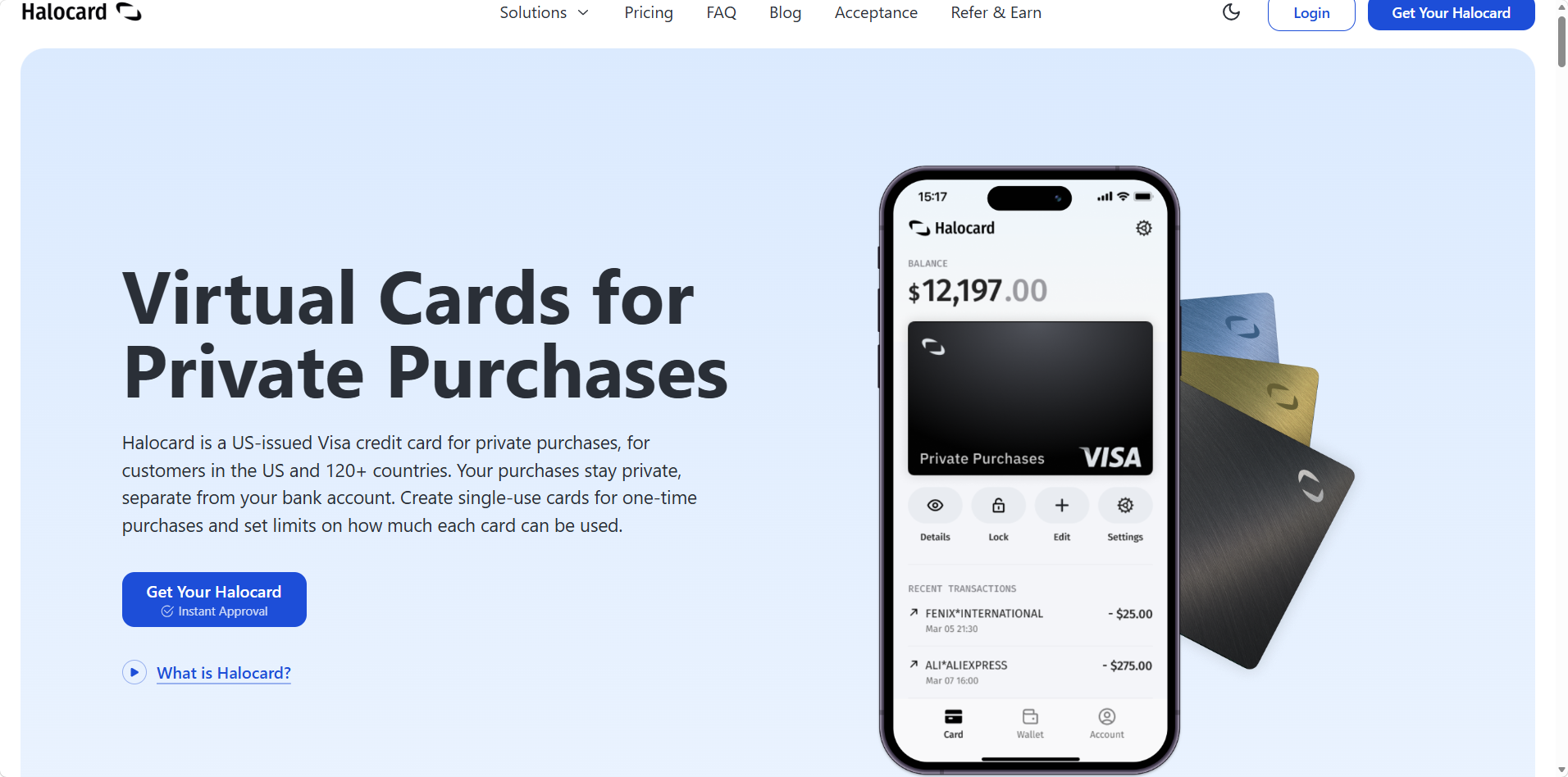
Halocard issues US-issued Visa credit cards to verified customers living in the US or any of 120+ countries. Halocard does not offer anonymous or unverified cards. As its support team explains, your identity is verified, but your spending stays private.
What Halocard Asks For, and What It Keeps
To sign up, you provide your legal name, residential address, date of birth, a government ID and a selfie. Visa also asks about your occupation, approximate income, main reason for using the card and expected spending, to spot unusual activity.
The check is handled by Sumsub and usually takes under 3 minutes. Halocard doesn't store your ID documents, which are held by its verification provider as banking laws require.
After that, merchants see only the custom name and billing address you choose for each card. Your personal details and funding source are not shared with merchants, and your spending is visible only inside your Halocard account. Halocard runs no credit check, and Halocard never sells your data to third parties.
Instant Virtual Cards With No Bank Account Needed
Halocard is built for financial privacy without anonymity. Once you pass verification, new cards are issued instantly and there is no US bank account to link. You can top up by debit/credit card, Apple Pay, Google Pay, bank transfer, stablecoins, or crypto, so crypto and stablecoins work just as they would with a no-KYC card.
What you get with each account:
-
Caps you control on every card, whether per purchase, per day, per month or as a lifetime total (how limits work)
-
One-tap freezing or cancelling, and single-use cards that close themselves once a purchase goes through
-
Your choice of cardholder name and address on each card, so merchants never see your real details
-
Tap-to-pay support through Apple Pay and Google Pay, with a physical Halocard on offer too
-
Nothing charged on dollar purchases, with a 1.5% fee on other currencies
-
Acceptance anywhere Visa is accepted, which Halocard puts at 175M+ merchants
-
A shared balance that can spend as much as $1M in a day
-
Refunds credited to your Halocard balance, even after the original card is cancelled
-
Cards issued by Third National, which is a Non-Bank Principal Member of the Visa Network
Halocard LLC is registered with FinCEN. Funds deposited at SSB are eligible for FDIC insurance up to $250,000 per depositor, per insured bank, subject to applicable limitations and FDIC rules. Halocard is especially popular for AI and cloud tools, advertising accounts, subscriptions and private purchases, and you can check a specific store on its merchant acceptance pages.
Weighing a specific provider? See how Halocard compares as a Kripicard alternative, a SiraPay alternative, an Ezzocard alternative, a Laso Finance alternative, a Crypto.com Card alternative or a Privacy.com alternative.
No Credit Check, but Not Free: What Halocard Doesn't Do
Being upfront about Halocard's limits:
-
It requires identity verification, so it is not for anyone who wants an anonymous card.
-
There is no free plan, though Essential+ is free with 3 referrals. Plans start at $15 a month for 3 cards, $20 for 15 cards and $75 for 50 cards (up to 10 extra a month on annual plans), with a minimum first deposit of $30 to $300.
-
You earn no cash back or rewards, and since Halocard isn't a bank, it offers no loans or bill payments.
-
Some merchant categories are off limits under Visa's rules, among them gambling, buying crypto and money transfers.
-
The first dispute in any 12 months is free.
-
Halocard's rating on Trustpilot is 4.2/5 (11 reviews), a sample too thin to rely on, and we would rather say so.
How to Get Your First Card
-
Sign up at Halocard in your browser. No app download is needed.
-
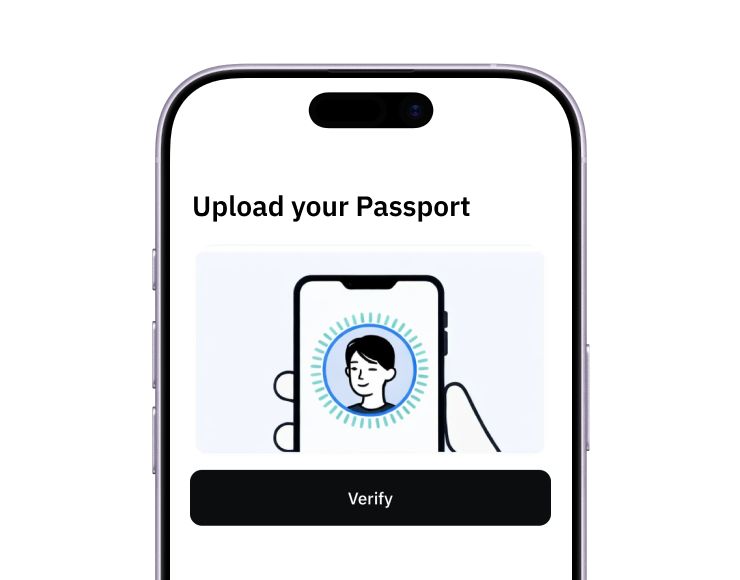
Verify your identity with an ID and a selfie, usually in under 3 minutes.
-
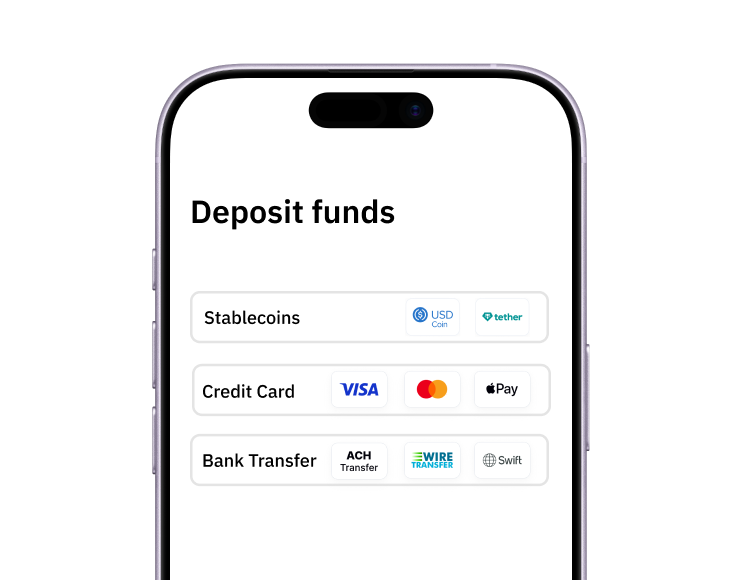
Choose a plan and fund your balance by debit/credit card, Apple Pay, Google Pay, bank transfer, stablecoins, or crypto.
-
Create your first card, then set its limits, name and billing address.
-
Add it to Apple Pay or Google Pay if you want to pay in stores.
For more background, read our guide to virtual cards, whether virtual cards are safe, how to check your digital footprint, and how the best prepaid Visa cards compare.
Frequently Asked Questions
Are No-KYC Virtual Cards Legal?
Buying one is not illegal in most places, but issuing one often breaks card network rules or AML laws, which is why many programs run through resellers and get shut down. In the EU, anonymous prepaid cards are limited to €150 and €50 per remote payment. The legality of the provider's setup affects whether your balance survives.
Can I Get a No-KYC Crypto Card With Apple Pay?
Some no KYC card providers say yes. WaldenPay, Kripicard and Laso Finance list Apple Pay support, and SolvoCard lists it for its Visa USD card. Support can vary by card and device, and Laso users report that only Google Pay was available at times.
Is There a Truly Anonymous Crypto Card?
Not really. Even providers that skip ID collect your email, IP address, device data and transactions, and your crypto deposits are traceable on the blockchain. The bank at the end of the chain must also meet KYC rules, so someone is always responsible for knowing who the cardholder is.
What Happens to My Balance If a No-KYC Card Is Shut Down?
It depends on the provider, and many make no promises. SolvoCard's terms say crypto deposits are non-refundable, Ezzocard offers refunds only within one month on eligible cards, and Wirex says shutdowns of these programs often give users little time to move funds.
Can I Get a Virtual Card With No Bank Account Needed?
Yes. Most no-KYC cards and Halocard can be funded without a bank account, using crypto or stablecoins. Halocard accepts debit/credit card, Apple Pay, Google Pay, bank transfer, stablecoins, or crypto.
Do No-KYC Cards Run a Credit Check?
No. They are prepaid, so you spend only what you load. Halocard runs no credit check either, even though it verifies your identity.
Why Was My No-KYC Card Declined?
The most common reasons are a merchant blocking the card's BIN, a mismatch between your IP address and the card's country, an insufficient balance after fees, or a missing 3D Secure step. Subscriptions and other recurring payments are the most likely to fail. Some providers also block cards used for prohibited categories.
Is Halocard a No-KYC Card?
No. Halocard verifies every customer's identity, and Halocard doesn't store your ID documents, which are held by its verification provider as banking laws require. It keeps your privacy at checkout instead, with a custom name and billing address on each card and no personal details shared with merchants.
Does Halocard Require an SSN?
Only US residents may be asked for an SSN or ITIN. Everyone else verifies with a government ID, such as a passport or national ID card, plus a selfie.
Can a Virtual Card Be Traced?
Yes, any card can be. A no-KYC card hides your name from the merchant but still leaves records with the provider, the bank and the blockchain. A verified card like Halocard hides your details from merchants too, while giving you a legitimate account you can recover and dispute charges on.
Sources
-
SiraPay. Homepage
-
SiraPay. Pricing
-
SiraPay. No-KYC Virtual Card
-
Kripicard. Homepage
-
Kripicard. Best Non-KYC Virtual Card
-
Kripicard. Fees
-
WaldenPay. Homepage
-
CasherCard. Homepage
-
SolvoCard. Homepage
-
SolvoCard. Privacy Policy
-
SolvoCard. Terms of Service
-
Ezzocard. Homepage
-
Laso Finance. Homepage
-
BingCard. Homepage
-
SolCard. Is SolCard Legit?
-
Goblin Cards. Homepage
-
Goblin Cards. Pricing
-
Goblin Cards. FAQ
-
Goblin Cards. Terms of Service
-
Agora Cards. Homepage
-
Agora Cards. Telegram Channel
-
CryptoCards.so. Agora Cards Virtual Card
-
Trocador. Prepaid Cards
-
Bitcoin.com. Trocador Card Review
-
Offgrid. Web App
-
Bitcoin.com. Offgrid Card Review
-
Crypto.com. Additional KYC for Card Users
-
The Defiant. SolCard KYC Change
-
KYCAID. Why No-KYC Cards Are Risky
-
FinanceFeeds. The No-KYC Card Loophole
-
Fintech Business Weekly. No-KYC Cards and Sanctions
-
Verestro. No-KYC Prepaid Card Rules
-
The Paypers. AMLD5 and Prepaid Cards
-
Cornell Law School. 12 CFR 1005.18
-
Reddit. No-KYC Cards Thread (r/defi)
-
Reddit. Resold Cards Thread
-
Reddit. Virtual Cards Thread (r/CreditCards)
-
Trustpilot. Kripicard Reviews
-
Trustpilot. WaldenPay Reviews
-
Trustpilot. Laso Finance Reviews
-
Trustpilot. Goblin Cards Reviews
-
Trustpilot. Agora Cards Reviews
-
Trustpilot. Trocador Reviews
-
Trustpilot. Halocard Reviews
-
Security.org. 2026 Credit Card Fraud Report
-
FBI. 2025 IC3 Annual Report
All sources checked and current as of November 3, 2026.
*Please see Halocard's Terms of Service or Pricing for the most up to date pricing and fee information. This publication is provided for general information purposes and does not constitute legal, tax or other professional advice from Halocard LLC or its subsidiaries and its affiliates, and it is not intended as a substitute for obtaining advice from a financial advisor or any other professional. We make no representations, warranties or guarantees, whether expressed or implied, that the content in the publication is accurate, complete or up to date.
Halocard Virtual Cards
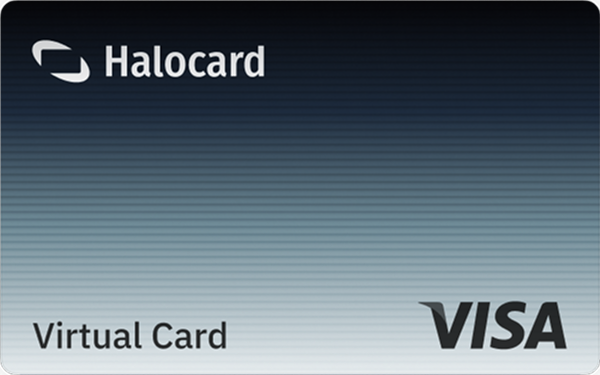

Instant approval
Create your first card in under 5 minutes.

Private purchases
Purchases never appear on your bank account.

Powered by Visa
Accepted at 175M+ merchants globally.
3 steps to create your virtual credit card
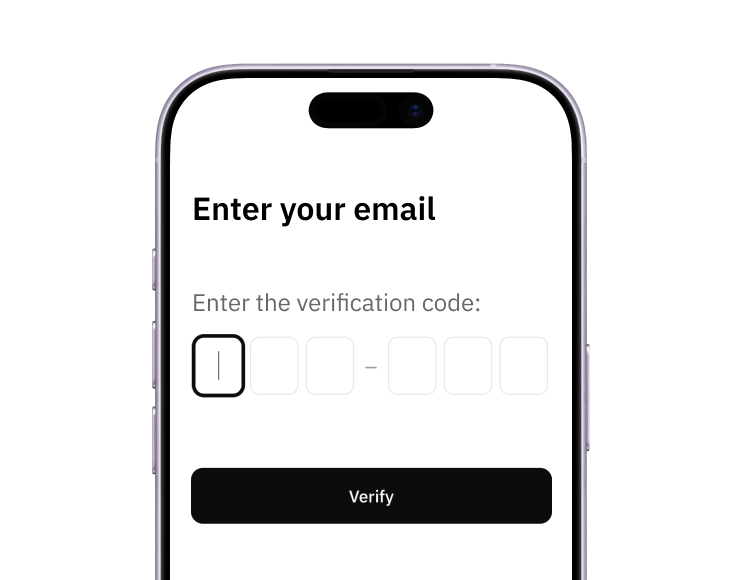
1. Sign up
Create your account from a web browser. No need to download an app.
3. Fund
Add funds by debit/credit card, Apple Pay, Google Pay, bank transfer, stablecoins, or crypto.
Pay with Halocard
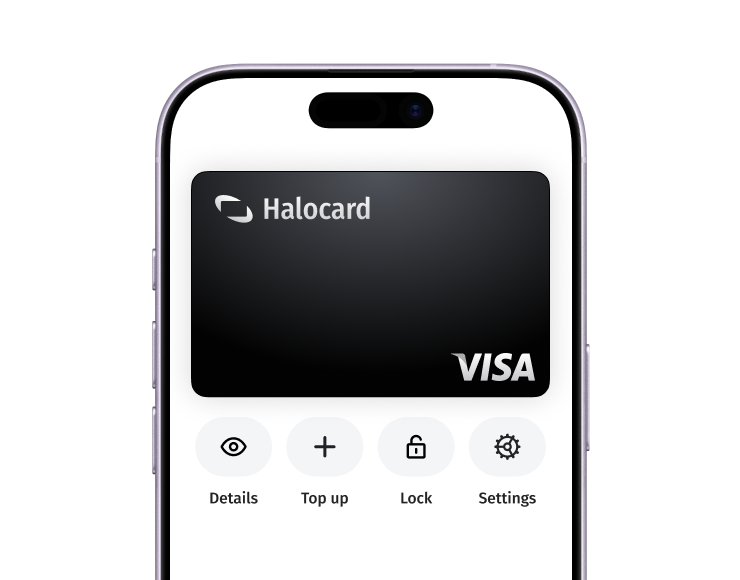
Pay online and in-person wherever Visa is accepted. You can also order a physical Halocard if you prefer.