

Quick Answer: Halocard is the strongest RedotPay alternative if privacy and reliable acceptance matter more than cashback: a virtual US-issued Visa credit card for customers in the US and 120+ countries, funded with debit/credit card, Apple Pay, Google Pay, bank transfer, stablecoins, or crypto, with per-card limits and a custom billing address. KAST leads on reach, Gnosis Pay on self-custody, and Oobit or Solid Card on rewards.
The RedotPay crypto card is one of the largest programmes of its kind, with more than 9 million global users managing digital assets and converting them into dollars for everyday spending at Visa merchants. It facilitates high-value transactions, up to $100,000 each, and links to Apple Pay and Google Pay.
But its Trustpilot rating sits near 3.3/5, with specific complaints: declined-transaction fees charged even after a card was frozen, support conceding that freezing cannot stop merchants initiating authorisation, and a widely cited case of a roughly €697 balance held for 87 days until the customer escalated to Hong Kong authorities.
There is a second reason people search for alternatives, and it is simpler: US residents cannot open a RedotPay account at all. The United States sits on RedotPay's unsupported-countries list, which spans roughly 42 markets, so American users cannot complete KYC no matter how much they like the product.
Context matters here too. The FBI's Internet Crime Complaint Center logged $17.6 billion in cyber-enabled fraud losses in 2025, with more than $11.3 billion tied to cryptocurrency, a 22% year-on-year rise. When you hold a spending balance on any custodial crypto platform, that is the environment it operates in. This guide compares 10 options, all issuing usable cards, weighted toward virtual cards.
Key Takeaways
-
Halocard is the best privacy-focused RedotPay alternative. A virtual US-issued Visa credit card across 120+ countries, stablecoin funding, per-card limits and a custom billing address, with fraud protection built around merchant-specific cards.
-
Match the alternative to your priority. KAST covers 170+ countries, Gnosis Pay offers genuine self-custody, Oobit and Solid Card lead on crypto cashback, and Privacy.com or Revolut suit users wanting less crypto exposure.
-
Headline cashback rarely survives the fine print. Advertised rates of 8% or 10% usually require staking a volatile token, and effective returns land two to four points lower.
-
Custody is the real dividing line. Custodial platforms like RedotPay hold your funds, which is what makes frozen-balance disputes possible; self-custodial cards keep the keys with you.
-
Fraud is why per-merchant cards matter. Global card fraud losses hit $33.41 billion in 2024, with card-not-present fraud the dominant channel, so a different number per merchant is the strongest control you have.
Quick Comparison Table
| Provider | Card Type | Availability | Funding | Rewards | Best For |
|---|---|---|---|---|---|
| Halocard | US-issued virtual Visa credit | US and 120+ countries | Card, Apple Pay, Google Pay, Bank Transfer, Stablecoins & Crypto | None | Privacy and reliable US acceptance |
| KAST Card | Stablecoin Visa, virtual + physical | 170+ countries | USDC, USDT, SOL on Solana | 1.5%–3% by tier | Global stablecoin spending |
| Gnosis Pay | Self-custody Visa debit | EU, UK, LATAM | EURe, GBPe, bridged USDC | 1%–5% tied to GNO | Self-custody and onchain settlement |
| Oobit | Crypto payments app + card | Broad international | Crypto and stablecoins | Up to 10% in OOB, 5% USDT | Consistent cashback on everyday spend |
| Solid Card | Crypto rewards card | Varies by region | Crypto balance | 3%, no annual fee | Flat rewards without staking |
| Rizon Card | Crypto rewards card | Varies by region | Crypto balance | 2.5%, no annual fee | Simple crypto rewards |
| Wirex | Crypto debit card | UK, EEA, wider | Crypto and fiat | 0.5%–8% by tier | Established multi-asset card |
| Crypto.com Card | Prepaid Visa | Broad international | Crypto and fiat | 1%–5% with CRO stake | Deep regional coverage |
| Privacy.com | US virtual payment cards | US residents, US bank | Linked US checking account | 1% on top tiers | Merchant-locked US card privacy |
| Revolut | Multi-currency account + cards | UK, EEA, US, more | Bank, card, balance | Varies by plan | Fiat-first spending with virtual cards |
Best RedotPay Alternatives for Crypto and Virtual Cards
Below are the 10 best alternatives, starting with the privacy-focused option, then crypto-native cards, then fiat platforms for anyone wanting less token exposure.
1. Halocard
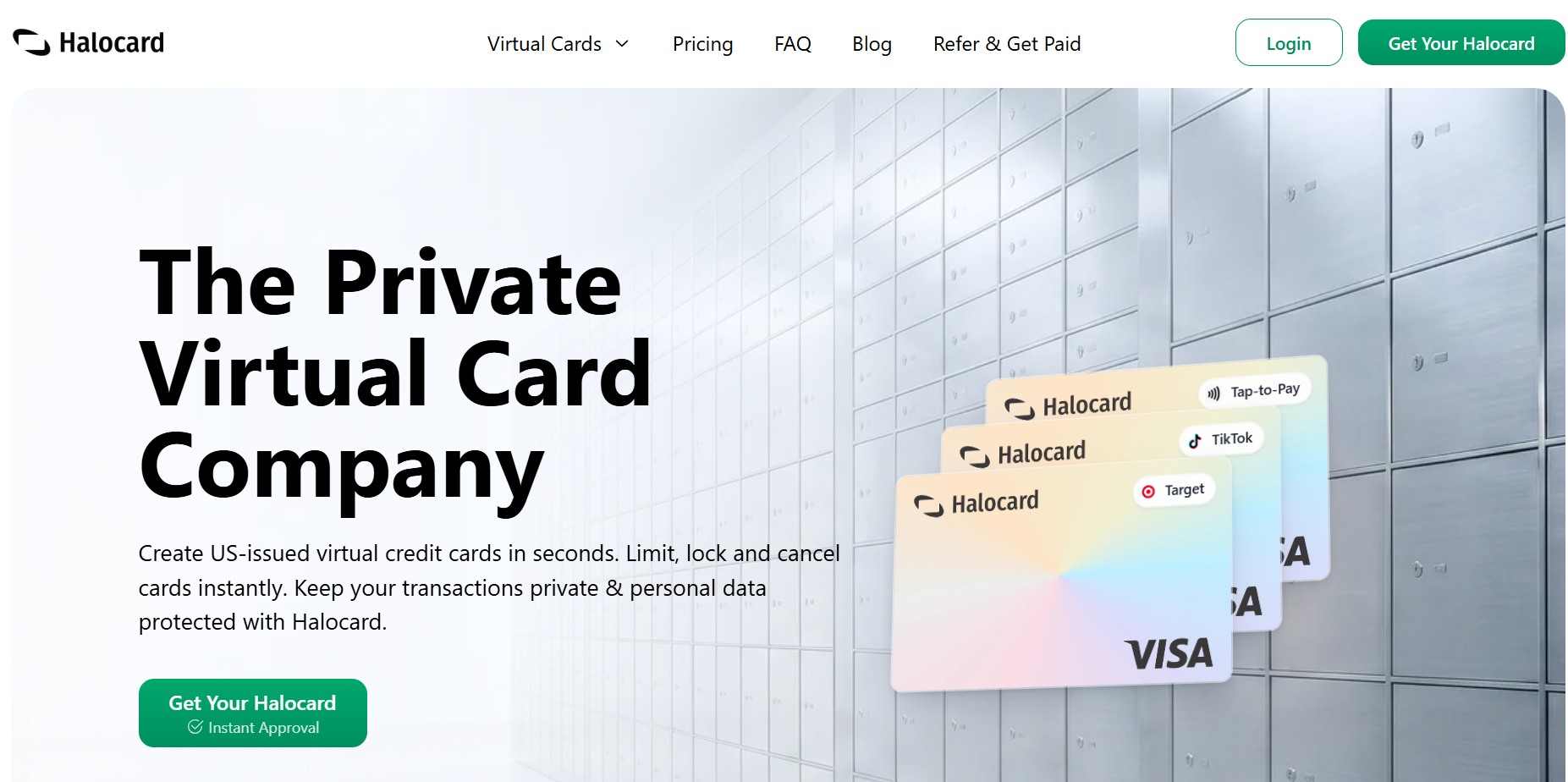
Halocard is a US-based fintech platform offering virtual payment cards, approaching the problem from the opposite end to RedotPay. Where RedotPay is a crypto platform that added a card, Halocard is a card platform that takes crypto as one funding route among several.
How Halocard Works
You sign up in a browser, verify with a passport or national ID in under three minutes with no SSN for non-US residents. Cards are issued under the Visa network through Halocard's financial partners, carry 3D Secure by Visa, and work online and offline via Apple Pay and Google Pay at 175 million-plus merchants.
Halocard Costs & Fees
Plans run $12/month (3 cards), $15 (12 cards) and $75 (60 cards), with business tiers from $29. USD purchases carry 0%, non-USD 1.5% + $0.30. You can fund it with debit/credit card, Apple Pay, Google Pay, bank transfer, stablecoins, or crypto.
Halocard Spending Limits and Funding
You load funds through multiple methods including cryptocurrency, then spend what you deposited, so there is no credit check. Each card takes its own per-transaction, daily and monthly spending limits plus instant freeze, a meaningful difference from RedotPay's fees continuing after a freeze.
Merchant-specific virtual cards are the core of the privacy case. Card fraud losses reached $33.41 billion worldwide in 2024, heading for $41.06 billion by 2030, and FICO projects card-not-present losses near $49 billion globally by 2030. At the consumer end, Security.org's 2026 survey found 61.3 million Americans hit by fraudulent transactions in a single year, totalling roughly $6.1 billion, with only 5% involving a physically stolen card.
The same research found 51% of cardholders use one card for both autopay and everyday spending, creating a single point of failure, and that recurring fraud from the same merchant has nearly doubled since 2024. Its own recommendation is to separate daily-use cards from cards used for recurring payments. A card per merchant that spends nowhere else does exactly that, and one crypto card cannot.
Halocard Key Advantages
-
A US-issued BIN and custom billing address that clear US checkout checks a Hong Kong-issued card fails
-
Stablecoin funding
-
Per-card limits and transaction anonymity from the merchant's view
Halocard Specific Drawbacks
-
No crypto rewards or cashback
-
A monthly subscription rather than a free card
-
No self-custody, since you fund a balance
Who Halocard Is Best For
Users who value privacy and security over rewards, and who need cards that reliably clear US platforms. See our guide to virtual cards with a US billing address.
Why Choose Halocard Over RedotPay
You trade cashback for control: no frozen-balance disputes over a large stored balance, per-card freezing that actually stops spending, and a US card profile RedotPay does not offer. Our RedotPay vs Halocard comparison goes deeper.
2. KAST Card
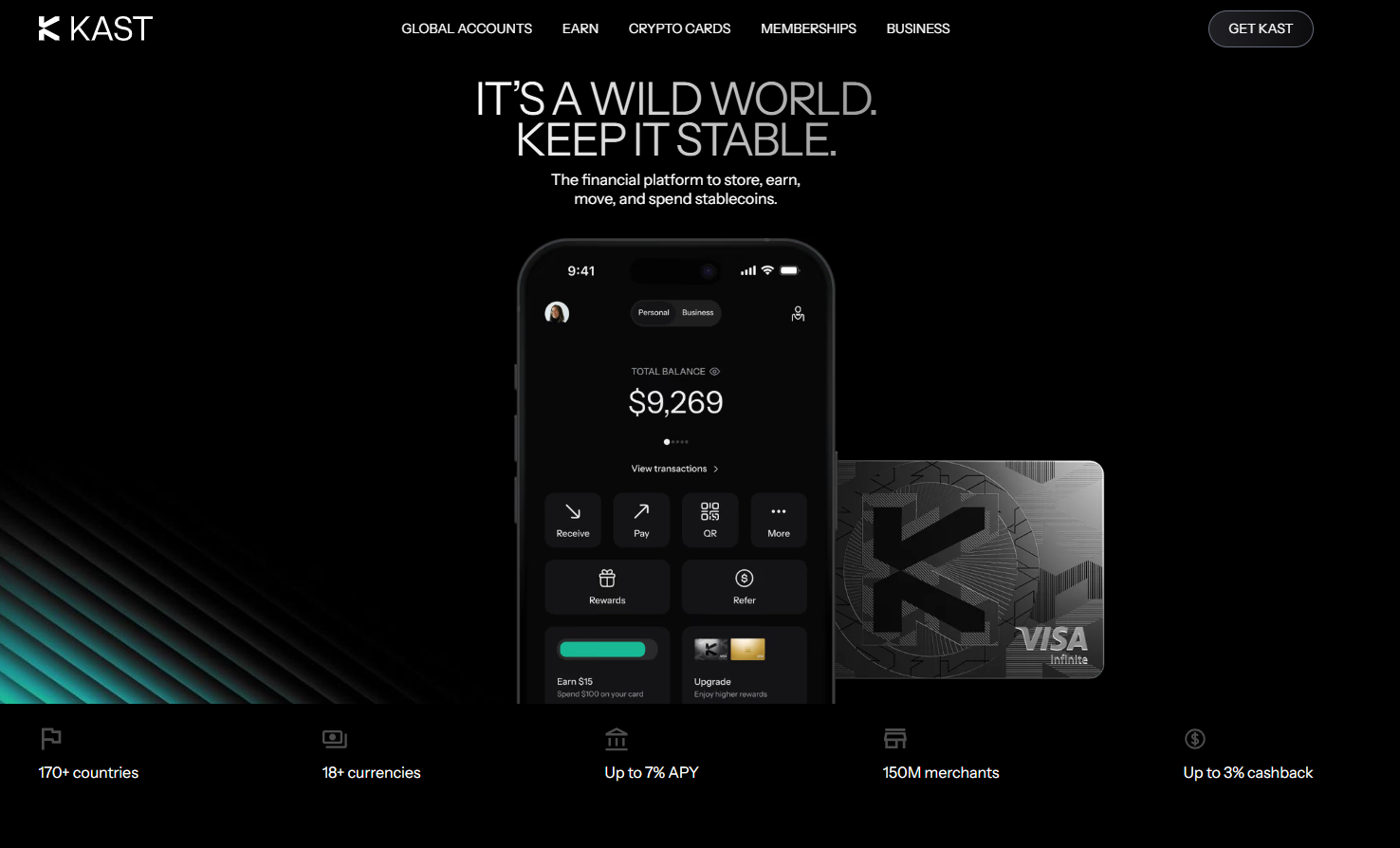
KAST is the closest crypto-native swap for RedotPay, built Solana-first and reporting over 1 million users with roughly $5 billion in annualised volume.
How KAST Works
You deposit USDC, USDT or SOL and a virtual card is ready within minutes, with a physical card on higher tiers. Top-ups settle on Solana, so funding is near-instant with negligible gas.
KAST Costs & Fees
A free Standard tier, with Premium at around $1,000 a year and higher metal tiers above that. Cashback runs 1.5% to 3% depending on tier, paid as KastPoints.
KAST Spending Limits and Funding
Funded entirely from stablecoins and SOL, with idle balances earning yield in built-in vaults on some tiers.
KAST Key Advantages
-
170+ country coverage, the widest here
-
Near-instant Solana settlement
-
Virtual card ready in minutes
KAST Specific Drawbacks
-
Custodial, so the same structural risk as RedotPay
-
High annual fees on the tiers that pay real cashback
-
KastPoints mechanics have shifted since launch
Who KAST Is Best For
Stablecoin holders who want the broadest country coverage available.
Why Choose KAST Over RedotPay
Wider reach, faster settlement and clearer reward mechanics, though you remain in a custodial model.
3. Gnosis Pay
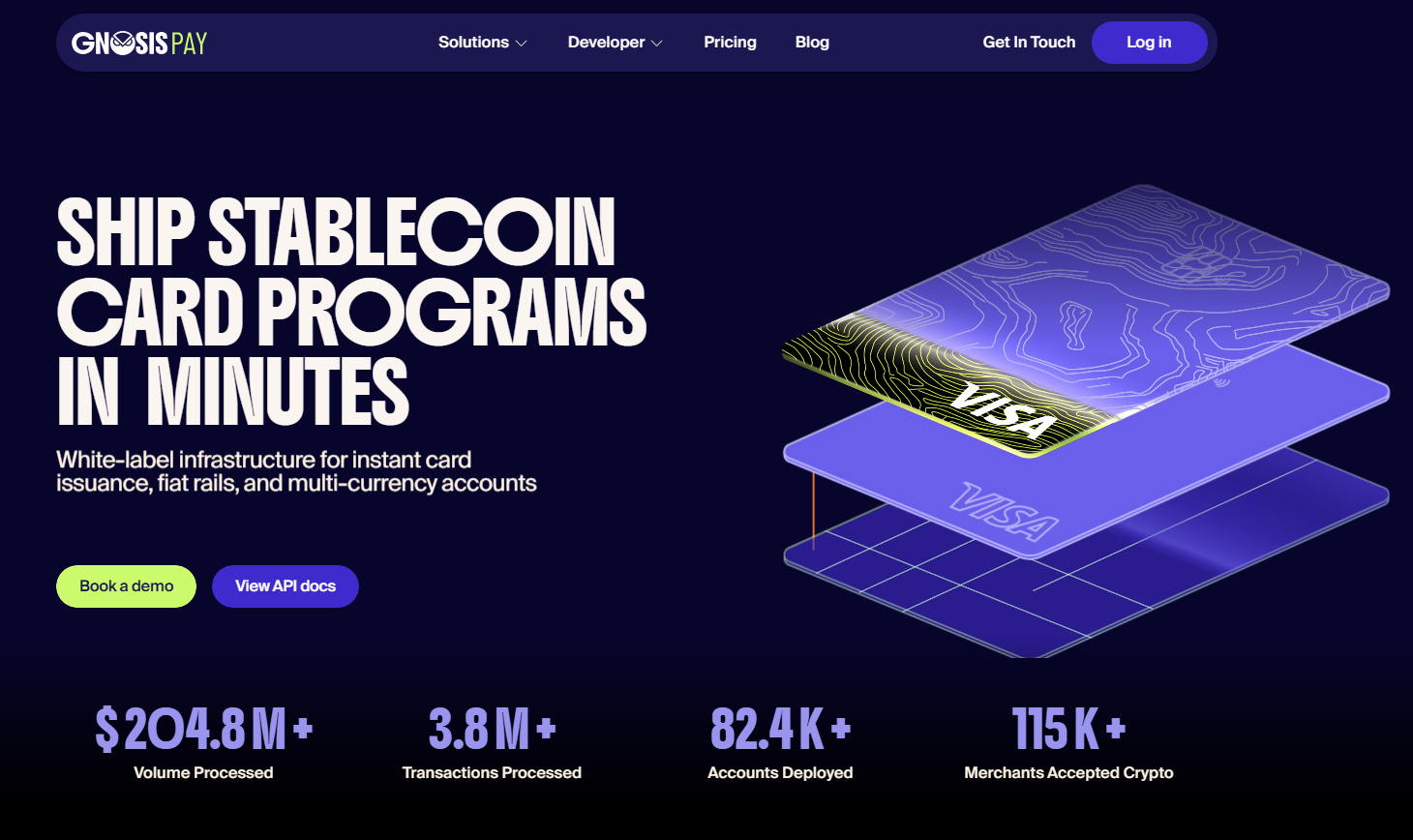
Gnosis Pay is the self-custody option, attaching a Visa card to a Safe smart account so purchases settle onchain without a platform holding your funds.
How Gnosis Pay Works
You fund a Safe with EURe, GBPe or bridged USDC, and merchant authorisations settle onchain through regulated e-money rails. The keys stay with you.
Gnosis Pay Costs & Fees
A one-time card fee of around €30, with 0% on FX, conversion and gas, among the lowest total fee stacks in the category. Rewards run 1% to 5%, tied to holding GNO tokens.
Gnosis Pay Spending Limits and Funding
Limited to what sits in your Safe, funded from Gnosis Chain.
Gnosis Pay Key Advantages
-
Genuine self-custody removes the counterparty that makes frozen balances possible
-
The lowest fee stack here
Gnosis Pay Specific Drawbacks
-
Not available in the United States
-
Rewards require holding a volatile token
-
Tied to one chain and a specific wallet setup
-
A June security incident affected some card accounts, though the company said affected balances were restored
Who Gnosis Pay Is Best For
DeFi users in Europe or LATAM who will not accept a custodial platform.
Why Choose Gnosis Pay Over RedotPay
It removes the structural risk behind RedotPay's worst reviews entirely, at the cost of US availability and setup simplicity.
4. Oobit
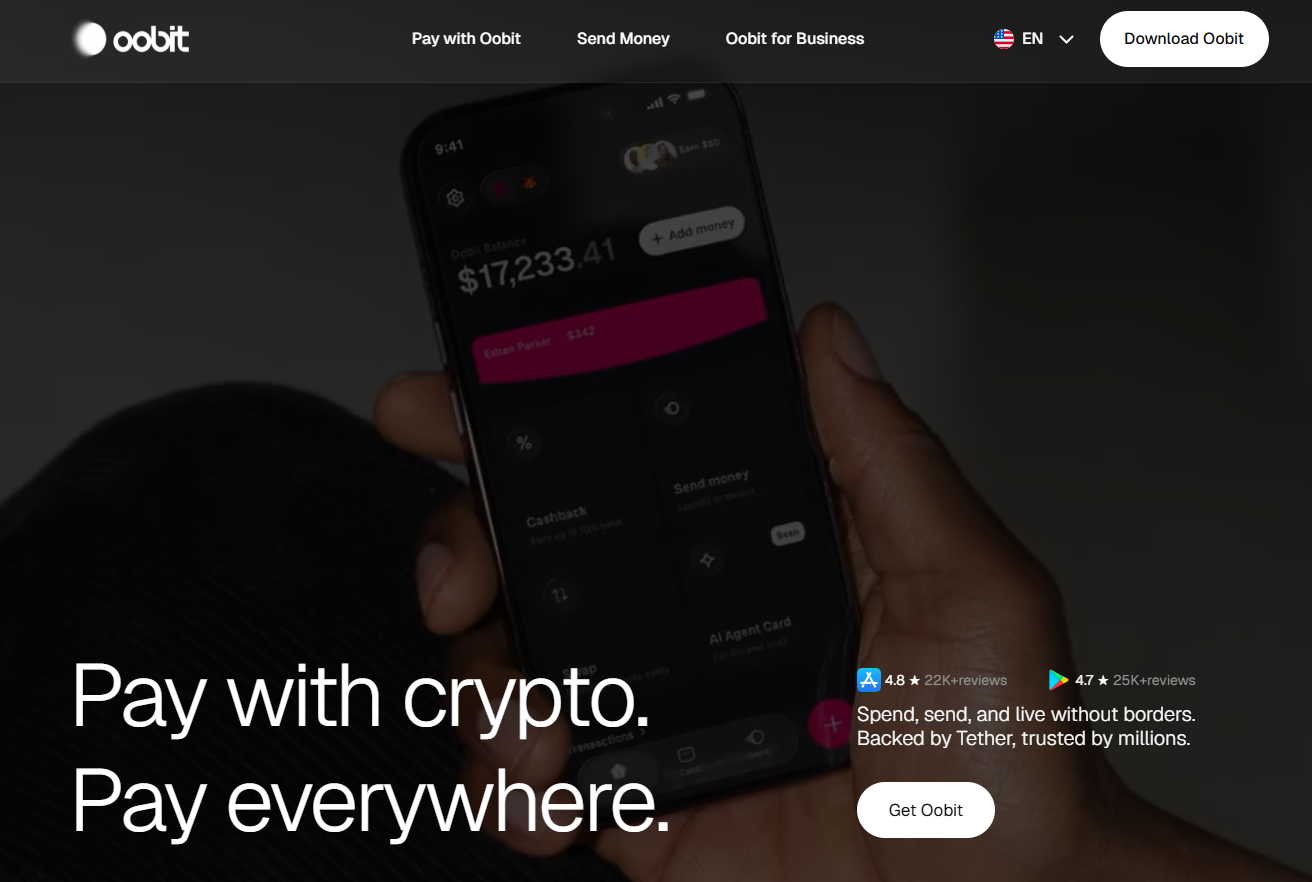
Oobit is a crypto payments app built around tap-to-pay, offering consistent cashback from everyday crypto payments rather than a staking scheme.
How Oobit Works
You download the app, fund with Bitcoin, other crypto or stablecoins, and pay in real life by tapping your phone at contactless terminals, with rewards in USDT. You can send funds to and from a wallet, and referral code bonuses stack on early spend.
Oobit Costs & Fees
No annual fee on the base product. Cashback reaches 5% in USDT, or up to 10% on purchases funded with OOB tokens, capped at $10,000 of OOB-funded spend and requiring Level 2 status.
Oobit Spending Limits and Funding
Funded from your crypto balance, with tiers unlocked by cumulative qualifying spend.
Oobit Key Advantages
-
Among the highest no-stake cashback rates available
-
Stablecoin-denominated rewards
-
A strong sign-up bonus structure
Oobit Specific Drawbacks
-
The headline 10% requires holding and spending OOB tokens
-
A thinner virtual card feature set than a dedicated provider
Who Oobit Is Best For
Everyday spenders who want real cashback without locking up a platform token.
Why Choose Oobit Over RedotPay
Materially better rewards with fewer staking strings, though it does not solve the custody question.
5. Solid Card
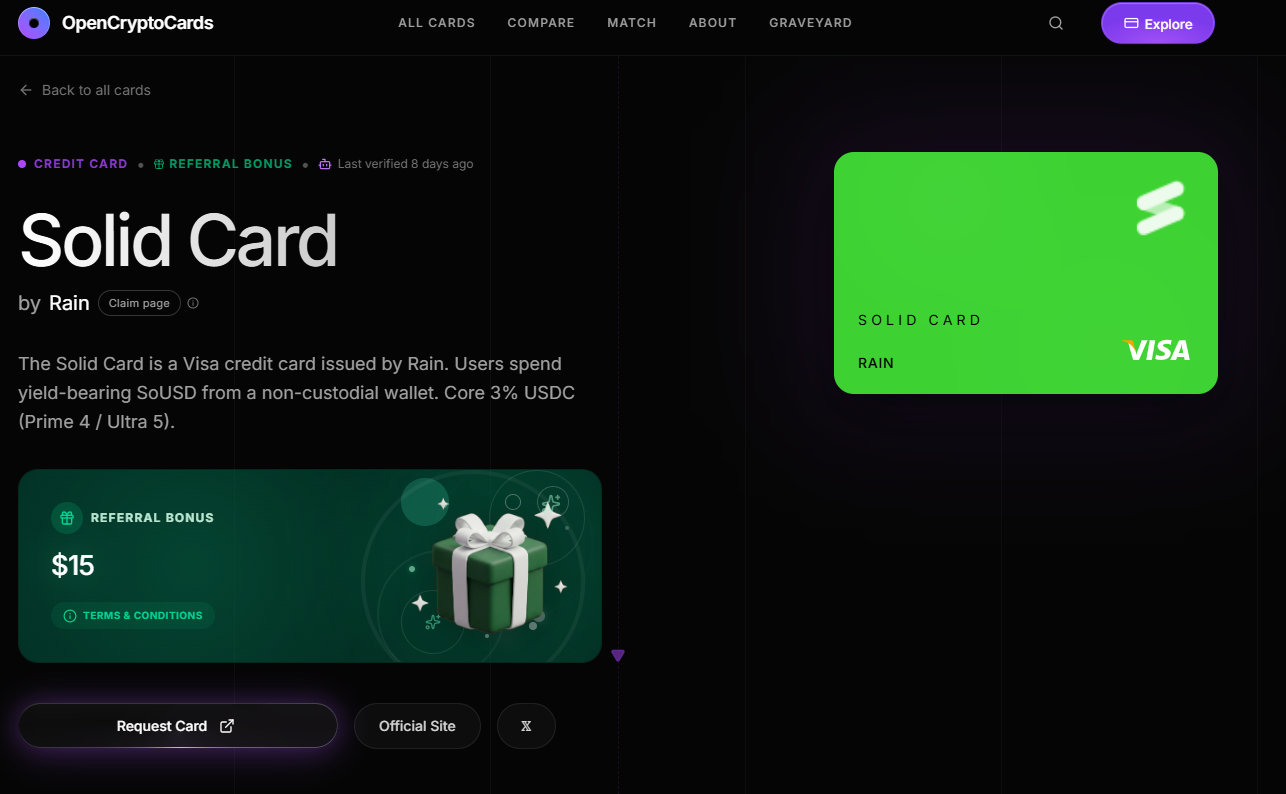
Solid Card is a straightforward crypto rewards card offering a flat 3% back with no annual fee, which puts it near the top of the no-stake rewards table.
How Solid Card Works
You fund from a crypto balance and spend at Visa or Mastercard merchants, earning rewards in crypto on qualifying purchases.
Solid Card Costs & Fees
No annual fee, 3% crypto rewards, and a foreign transaction fee around 1%.
Solid Card Spending Limits and Funding
Set by your loaded balance and verification tier.
Solid Card Key Advantages
- A 3% rate with no annual fee and no staking requirement
Solid Card Specific Drawbacks
-
Availability varies by region and is narrower than RedotPay's
-
Rewards paid in crypto carry price risk
Who Solid Card Is Best For
Users who want the highest flat rewards rate without a token lock-up.
Why Choose Solid Card Over RedotPay
Better rewards with simpler conditions, though check availability in your country before committing funds.
6. Rizon Card
Rizon Card sits just below Solid on rewards, offering 2.5% in crypto with no annual fee, and is frequently listed as the closest alternative to KAST.
How Rizon Works
A crypto rewards card funded from your balance, spending at standard card-network merchants.
Rizon Costs & Fees
No annual fee, 2.5% crypto rewards, and a foreign transaction fee around 1.02%.
Rizon Spending Limits and Funding
Determined by your funded balance and account tier.
Rizon Key Advantages
-
Solid flat rewards with no staking
-
No annual fee
Rizon Specific Drawbacks
- Lower rewards than Solid at a similar cost
Who Rizon Is Best For
Users wanting predictable crypto rewards without complexity.
Why Choose Rizon Over RedotPay
Higher effective rewards and no annual fee, though it lacks RedotPay's scale and transaction limits.
7. Wirex
Wirex is one of the longest-running crypto cards, spending across multiple digital assets with tiered rewards by stake.
How Wirex Works
You hold crypto and fiat in the app and spend from either, with in-network currency conversion and a card usable in real life at Mastercard merchants.
Wirex Costs & Fees
A free base tier paying 0.5%, rising to as much as 8% on higher tiers that require staking WXT. Wirex offers 0% FX in-network.
Wirex Spending Limits and Funding
Funded from crypto or fiat balances, with limits by verification tier.
Wirex Key Advantages
-
A long operating history
-
0% in-network FX, useful for travel
Wirex Specific Drawbacks
-
The 8% headline needs a substantial token stake
-
Custodial
Who Wirex Is Best For
Travellers who want low FX and are willing to stake for rewards.
Why Choose Wirex Over RedotPay
A longer track record and better FX treatment, though the reward maths only works if you stake.
8. Crypto.com Card
The Crypto.com Card is the most widely available programme in the category, a prepaid Visa with the deepest regional coverage.
How Crypto.com Works
You top up from your Crypto.com balance, converting crypto to local currency for spending, and use the card wherever Visa is accepted.
Crypto.com Costs & Fees
No monthly fee on lower tiers, with cashback of roughly 1% to 5% depending on how much CRO you stake. Higher tiers add lounge access and subscription rebates.
Crypto.com Spending Limits and Funding
Funded from your exchange balance, with mid-market FX on most tiers.
Crypto.com Key Advantages
- The broadest regional coverage
Crypto.com Specific Drawbacks
-
Real cashback requires locking significant CRO, which is volatile
-
Custodial
Who Crypto.com Is Best For
Existing Crypto.com users who already hold CRO.
Why Choose Crypto.com Over RedotPay
Greater scale, longer history and wider coverage, though the rewards structure ties you to one token.
9. Privacy.com
Privacy.com is not a crypto card, and that is why it belongs here: if what you wanted from RedotPay was payment privacy rather than crypto spending, this is the US benchmark.
How Privacy.com Works
US residents 18 and over link a US checking account, then create virtual cards that lock to a single merchant, close after one use, or carry custom spending limits, with a browser extension filling details at checkout.
Privacy.com Costs & Fees
A free Personal tier with 12 new cards monthly, then $5, $10 and $25 plans. A 3% foreign transaction fee applies on lower tiers, waived on Pro and Premium, which also pay 1% back.
Privacy.com Spending Limits and Funding
Cards draw from your linked account, with per-card caps rather than one shared limit.
Privacy.com Key Advantages
-
Merchant locking, the strongest anti-fraud control here
-
A genuinely free tier
-
A 4.5/5 Trustpilot rating from 3,358 reviews, far above RedotPay's
Privacy.com Specific Drawbacks
-
US residents with a US bank only
-
No crypto funding whatsoever
Who Privacy.com Is Best For
US users who want card privacy and have no need to spend digital assets.
Why Choose Privacy.com Over RedotPay
A far stronger reliability record and real merchant locking, at the cost of any crypto functionality. See our best Privacy.com alternatives roundup.
10. Revolut
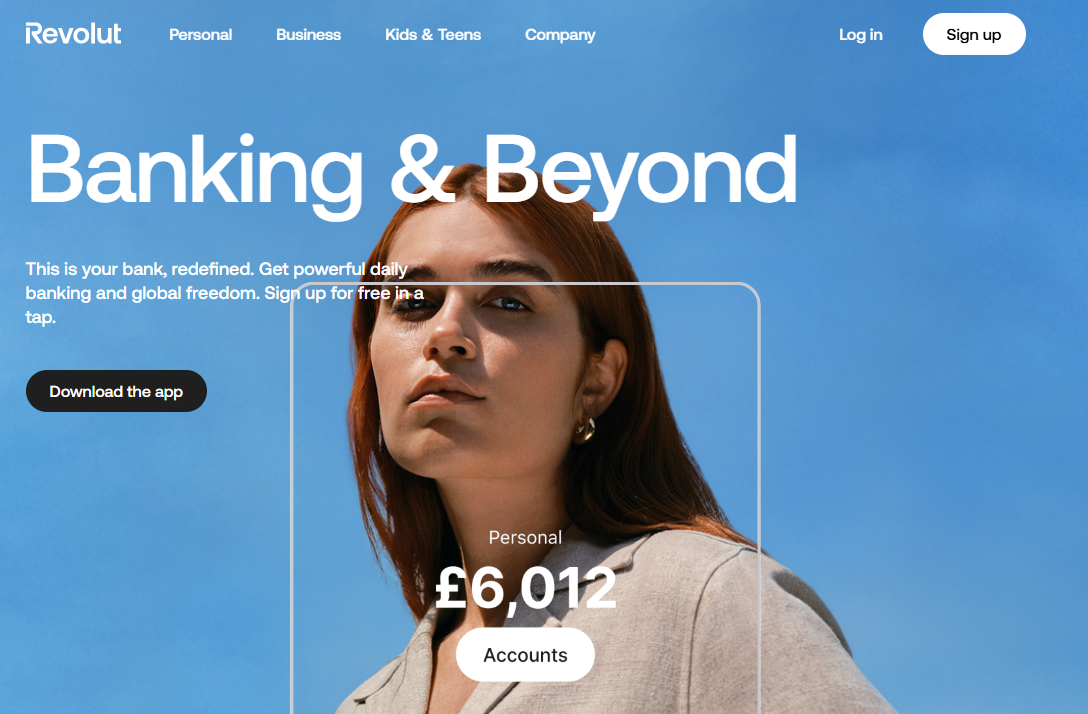
Revolut is the fiat-first option, worth a look if RedotPay's crypto exposure is what you want to reduce.
How Revolut Works
You open a multi-currency account, hold and exchange 30+ currencies at interbank rates, and create up to 20 virtual cards plus a single-use disposable card.
Revolut Costs & Fees
Standard is free; Premium $9.99 and Metal $16.99 monthly. Currency exchange is free to a monthly allowance, then a small percentage.
Revolut Spending Limits and Funding
Funded from bank transfer, card or balance, with limited in-app crypto features in supported regions.
Revolut Key Advantages
- 20 virtual cards on a free plan
Revolut Specific Drawbacks
-
Crypto functionality is limited compared with a dedicated crypto card
-
No stablecoin funding of the card
Who Revolut Is Best For
Users who want mainstream banking features and virtual cards rather than crypto spending.
Why Choose Revolut Over RedotPay
Far more virtual cards and a regulated fiat platform, though it will not turn your digital assets into spending the way a crypto card does.
What Users Think About These RedotPay Alternatives
Scores move constantly, so weigh volume and recency. Links go to the sources so you can read them.
RedotPay holds roughly 3.3/5 on Trustpilot from around 1,013 reviews, alongside a stronger App Store rating from 2,600-plus ratings. The card works well day to day; complaints concentrate on getting money out. Several reviewers describe $0.50 declined-transaction fees charged after freezing a card, and one reported a balance driven negative by a fraudster's repeated attempts.
In fairness, RedotPay has raised close to $200 million from investors including Lightspeed and Circle Ventures and uses institutional custody with segregated wallets and insurance, which is stronger than many rivals. The reasonable read is to size your balance to the trust you have in any custodian.
Halocard carries a small but positive Trustpilot presence, roughly 4.2/5 (11 reviews), too thin to weigh heavily. Reviewers cite a clean setup on GrapheneOS, responsive support and reliable approvals, with subscription cost the standing criticism.
KAST reports over 1 million users and strong volume growth, with reviewers praising near-instant Solana funding. The friction is the reworking of KastPoints from a promised token allocation into an equity-linked instrument, which frustrated some early users.
Gnosis Pay earns respect in the DeFi community for self-custody and its 0% fee stack, though the June security incident and the GNO holding requirement draw criticism.
Oobit, Solid and Rizon are newer and thinner on independent reviews. Oobit draws attention for high no-stake cashback; Solid and Rizon appear mostly in aggregator comparisons rather than large review samples, so test with small amounts.
Wirex and Crypto.com have long histories and correspondingly mixed records, with staking requirements and support responsiveness the repeated themes.
Privacy.com holds 4.5/5 from 3,358 reviews, and Revolut sits at 4.7/5 across 470,000+ reviews, app-wide, with account restrictions the common complaint.
How to Switch From RedotPay to Halocard Without Stranding Funds
This is the part most comparison articles skip. Moving between a custodial crypto card and a virtual card platform is where people actually lose money, usually by leaving a balance behind or by cancelling cards their subscriptions still depend on. Here is the sequence that avoids both.
1. Stop topping up before you stop spending. The single most common mistake is opening a new account and abandoning the old balance. Freeze new deposits to RedotPay first, then run the existing balance down through normal spending. Do not attempt a large withdrawal while the account is active and unproblematic, since withdrawals are the exact process reviewers report friction with.
2. Inventory your recurring charges before you cancel anything. List every subscription, ad account and SaaS tool billed to the old card. Anything on annual billing needs the new card in place before the renewal date, not after. Our guide to managing SaaS subscriptions with virtual cards covers a workable inventory method.
3. Match the funding route to the amount. Halocard accepts debit/credit card, Apple Pay, Google Pay, bank transfer, stablecoins, or crypto, and the routes suit different amounts:
| Funding route | Best used for |
|---|---|
| Stablecoins (USDC, USDT) | Anything, especially larger loads |
| Other crypto (BTC, ETH, SOL) | When you hold no stablecoins |
| Debit or credit card | Small, urgent top-ups only |
| Bank transfer (SEPA, UK Faster Payments) | Regular funding from fiat |
If you are coming from RedotPay you almost certainly hold stablecoins already, which is the simplest route.
4. Issue cards by purpose, not all at once. Create one card per recurring merchant rather than a single card for everything, since a per-merchant card is what limits the blast radius when a retailer is breached. Set the monthly limit slightly above the subscription price so an unexpected price rise fails loudly rather than passing silently.
5. Set the billing address before the first charge. This is the step people miss. If you are paying a US platform that previously declined your RedotPay card, the custom billing address is what makes the difference at address verification, not the card number itself. Our explainer on virtual cards with a US billing address sets out why.
6. Keep the old card alive for a month. Do not close the RedotPay account the day you switch. Refunds from merchants route back to the card that made the purchase, and a refund to a closed card can fail outright or take weeks to trace. Give any recent purchases a full refund window before shutting anything down.
Where Halocard Fits, and Where It Does Not
Being direct about this saves you time. Halocard makes sense if you want US-format cards that clear US checkout checks, a separate card per merchant, spending limits you control, and funding that does not require a bank relationship. It works well for media buying, AI and cloud platform billing, shopping and subscriptions, and private purchases, and teams can run it through Halocard for business.
It is the wrong tool if crypto cashback is your main goal or if you want self-custody. Halocard pays no rewards, and like RedotPay it holds your funded balance rather than leaving keys with you. If those are dealbreakers, Oobit or Solid Card serve the first, and Gnosis Pay serves the third.
If RedotPay's frozen balances rather than its features brought you here, Halocard addresses that directly: fund what you plan to spend, set limits per card, and freeze any card without a stored balance sitting in dispute.
Halocard issues virtual cards under the Visa network through its financial partners, each with 3D Secure by Visa, per-card limits, instant freeze, and a custom billing address that clears US checkout checks. You can fund it with debit/credit card, Apple Pay, Google Pay, bank transfer, stablecoins, or crypto, and USD purchases carry no fee. It is not a rewards product and offers no self-custody, so if crypto cashback is your priority, a card above fits better. If privacy, control and dependable acceptance matter more, this is the switch.
Further reading: the ultimate guide to virtual cards, whether virtual credit cards are safe, and masked card services.
Step-by-Step
-
Sign up in your browser.
-
Verify with a passport or national ID; non-US residents need no SSN.
-
Fund with debit/credit card, Apple Pay, Google Pay, bank transfer, stablecoins, or crypto.
-
Create a card, set its limits and billing address, then add it to Apple Pay or Google Pay.
-
Spend online or in store, and freeze or replace any card instantly.
Frequently Asked Questions
What Are the Best RedotPay Alternatives for Everyday Purchases in Real Life?
For everyday spending, KAST offers the widest coverage at 170-plus countries, Oobit and Solid Card pay the best no-stake cashback, and Crypto.com has the deepest regional footprint. If you would rather not hold a large balance on a custodial platform, Halocard lets you fund only what you plan to spend, and Gnosis Pay removes the custodian entirely.
Which Alternatives Offer Both a Virtual and Physical Card?
KAST, Wirex, Crypto.com and Gnosis Pay all issue a physical card alongside virtual options, and Halocard now offers one too. Privacy.com is virtual-only; Revolut provides both. If you need to tap in a shop rather than only pay online, check the physical card fee, since several charge separately.
How Do I Load Funds Onto a Crypto Card?
Most platforms let you load funds via cryptocurrency straight from a wallet or exchange, with stablecoins the simplest route since there is no price movement between deposit and spend. Crypto cards allow instant funding from digital wallets, and across the wider market more than 200 payment methods now support crypto loading. The platform converts crypto to local currency at the point of sale, so the merchant receives fiat settlement.
Are Virtual Cards Safer Than a Single Crypto Card?
For online spending, yes. Virtual credit cards enhance online payment security by giving each merchant a substitute number, providing transaction anonymity from the merchant's side, and letting you set spending limits per card. A single crypto card exposes one number everywhere you shop; a virtual card can be created instantly and closed after use, and with card-not-present fraud driving most global card losses that separation matters.
Which RedotPay Card Alternative Is Best for Self-Custody?
Gnosis Pay, clearly. It links a Visa card to a Safe smart account so you keep the keys and authorisations settle onchain, removing the counterparty behind most frozen-balance disputes. The trade-offs are no US availability, a tie to one chain, and rewards that depend on holding GNO. Every other card here, RedotPay and Halocard included, is custodial in some form.
Do Any Alternatives Offer Virtual Account Details as Well as Cards?
Yes. VaultLeap provides virtual USD, EUR and MXN account details alongside cards, which suits freelancers and clients settling in multiple currencies, and Revolut and Wise offer multi-currency accounts with local details for managing multiple currencies in one place. Halocard also includes a US bank account with its own account and routing numbers, so you can receive and send funds as well as spend. Comparing reward mechanics can feel like a game of fine print, so check the caps first.
Is RedotPay Available in the United States?
No. The United States sits on RedotPay's unsupported-countries and regions list, which covers roughly 42 markets in total, so US residents cannot complete KYC or open an account. This is the single most common reason American searchers land on an alternatives page. If you are in the US, Privacy.com is the strongest free option, and Halocard issues US-format virtual cards for customers in the US and 120+ countries, with no SSN required for non-US applicants.
What Does RedotPay Actually Cost?
There is no monthly or annual fee, which is genuinely competitive. The costs sit elsewhere: a one-time $10 virtual card issuance fee and $100 for the physical card, both non-refundable, roughly 1.2% FX on foreign-currency transactions, around 1% on local-currency purchases, and ATM withdrawals at 2%, or 3% above $10,000 a month in ATM withdrawals on the USD card. Card-based top-ups carry around 3%. Rewards are effectively zero on the standard account, and the optional RedotPay Pro plan ($12.90 a month or $129 a year) pays 3% cashback on Apple Pay and Google Pay purchases, up to $18 a month, so unlike most cards here you pay the fees without earning much back.
Does RedotPay Offer Cashback or Rewards?
Practically none on the standard account, and this is its clearest weakness against the field. RedotPay competes on reach and high limits rather than rewards, offering little beyond a small welcome bonus and referral credits. Its optional Pro plan ($12.90 a month or $129 a year) pays 3% cashback on Apple Pay and Google Pay purchases, up to $18 a month. If rewards are your priority, Oobit pays up to 5% in USDT without staking, Solid Card offers a flat 3% with no annual fee, and KAST runs 1.5% to 3% by tier. Just check the caps and conditions, since headline rates rarely survive the fine print.
Can I Withdraw Money From RedotPay?
Yes, through ATM withdrawals on the physical card and through the platform's own withdrawal process, but this is where reviewer friction concentrates. ATM fees run 2%, or 3% above $10,000 a month on the USD card, on top of any operator charge, and the virtual card does not support ATM access at all. Because withdrawals happen on the company's timeline rather than yours, the practical advice from the user community is to keep only a working balance on the platform.
Does RedotPay Work With Apple Pay and Google Pay?
Generally yes, with one wrinkle worth knowing. Cards issued after 22 August 2025 could not link to Apple Pay directly, and RedotPay began rolling out a free card upgrade in January 2026 to restore compatibility. If your card falls in that window and has not been upgraded, request it through in-app support. Halocard, KAST, Wirex and Crypto.com all support both wallets without that caveat.
Are Crypto Cards Safe, and How Do I Reduce the Risk?
Crypto cards are safe in the sense that the card networks work as designed; the risk is concentrated in the platform holding your funds and in the wider fraud environment. The FBI recorded more than $11.3 billion in cryptocurrency-related losses in 2025, and independent trackers put total on-chain scam receipts even higher. Three habits reduce your exposure sharply: keep only a working balance on any custodial platform, use a separate card per merchant so one breach cannot cascade, and set spending limits low enough that an unauthorised charge fails. Our guide to whether virtual credit cards are safe goes further, and recovering from a hacked card covers what to do if it happens.
Is There a Crypto Card With No Monthly Fee?
Several. RedotPay itself charges no recurring fee after issuance, and Solid Card, Rizon Card and Oobit all operate without an annual fee. KAST has a free Standard tier, and Gnosis Pay charges only a one-time card fee of around €30. Halocard is the exception here, running on a monthly subscription from $12, which buys per-card controls and a custom billing address rather than rewards. Which model is cheaper depends entirely on volume, so run your real monthly spend through each fee schedule before deciding.
Which Crypto Card Works Best for Online Subscriptions?
Reloadable cards with reliable recurring billing, which rules out single-use products. RedotPay's virtual card generally handles subscription billing more smoothly than its physical card, and adding it as a new payment method rather than editing an existing one avoids most declines. For US-billed subscriptions, see our walkthroughs on paying for ChatGPT Plus and paying for Claude with a virtual card.
RedotPay holds a Hong Kong money lender licence and has more than 9 million users, and for most people the card works as advertised. The documented concerns are about fund access rather than the card: fees charged after freezing, and balances held during disputes. The community consensus is sensible, keep only working balances on the platform rather than treating it as storage.
Sources
-
Trustpilot. Halocard Reviews
-
Nilson Report. Global Card Fraud Losses at $33 Billion
-
FICO. Card-Not-Present Fraud Remains a Leading Concern
-
FBI Internet Crime Complaint Center. 2025 Internet Crime Report
-
The Record (Recorded Future News). FBI: Cyber Fraud Surges to $17.6 Billion in Losses
-
Security.org. 2026 Credit Card Fraud Report
-
CoinLaw. Cryptocurrency Security and Fraud Statistics 2026
-
RedotPay. Homepage
-
Trustpilot. RedotPay Reviews
-
CryptoSlate. RedotPay Crypto Card Review 2026
-
Bleap. RedotPay Review 2026: Fees, Features, Pros & Alternatives
-
KK Investing. RedotPay Supported Countries and Merchant Tests
-
Ranked+. RedotPay Card Review
-
Coin Bureau. RedotPay Review 2026
-
KAST. Homepage
-
KK Investing. Kast Card Review 2026
-
Gnosis Pay. Homepage
-
Eco. Best Stablecoin Debit Cards 2026 Compared
-
Eco. Best Crypto Debit Cards in 2026, Ranked by Fees and Rewards
-
Oobit. Homepage
-
Paymentscan. Best Crypto Cards 2026 Comparison
-
Coin Interest Rate. KAST Card Alternatives
-
Card Pilled. Crypto Card Aggregator
-
Spendnode. Best Crypto Cards in 2026
-
The Block. Best Debit Cards With Crypto Rewards in 2026
-
VaultLeap. Best Crypto Debit Cards in 2026 Compared
-
Wirex. Homepage
-
Crypto.com. Visa Card
-
Privacy.com. Virtual Cards
-
Trustpilot. Privacy.com Reviews
-
Revolut. Plans and Virtual Cards
-
Trustpilot. Revolut Reviews
Sourced on September 10,2026
*Please see Halocard's Terms of Service or Pricing for the most up to date pricing and fee information. This publication is provided for general information purposes and does not constitute legal, tax or other professional advice from Halocard LLC or its subsidiaries and its affiliates, and it is not intended as a substitute for obtaining advice from a financial advisor or any other professional. We make no representations, warranties or guarantees, whether expressed or implied, that the content in the publication is accurate, complete or up to date.
Halocard Virtual Cards


Instant approval
Create your first card in under 5 minutes.

Private purchases
Purchases never appear on your bank account.

Powered by Visa
Accepted at 175M+ merchants globally.
3 steps to create your virtual credit card

1. Sign up
Create your account from a web browser. No need to download an app.

2. Verify
Verify you're a real person in 3 minutes, from the US or any of 120+ countries.

3. Fund
Add funds by debit/credit card, Apple Pay, Google Pay, bank transfer, stablecoins, or crypto.

Pay with Halocard
Pay online and in-person wherever Visa is accepted. You can also order a physical Halocard if you prefer.