

Quick Answer: Halocard is the best Crypto.com Card alternative for private online spending, with a virtual card instantly, crypto funding and per card limits in 120+ countries. MetaMask Card and Gnosis Pay suit self-custodial users, Bybit and Nexo lead in Europe on rewards and credit mode, and Gemini or the Coinbase One Card fit US users who want crypto rewards on a credit card.
The Crypto.com Card comes in two forms in the US: a prepaid Visa card issued by Community Federal Savings Bank and a newer Visa Signature credit card issued by Comenity Capital Bank. Both tie rewards to Crypto.com's Level Up program, which means a monthly subscription or a 12-month CRO stake for anything beyond the entry tier. On the prepaid card, the free Midnight Blue tier now earns 0%, free ATM withdrawals start at $200 a month, and crypto has to be converted to fiat currency before it can be loaded onto the card.
That structure pushes people to compare. Some want crypto rewards without paying for a tier, some want a self custodial card that spends from their own wallet, and some simply want a virtual card for online purchases that keeps their real details private. Crypto.com is a large, regulated platform with SOC 2 and PCI DSS certifications, so this is about fit rather than safety. This guide compares 15 alternatives, and every one of them issues a virtual card you can use online or add to a phone wallet before any plastic arrives.
Key Takeaways
-
Halocard is the best Crypto.com Card alternative for privacy and control. A US issued Visa with a billing address you choose, limits on every card, and funding by stablecoins.
-
Crypto.com's rewards depend on your tier. The prepaid card pays 0% on the free tier and 1.5% on Ruby Steel for $4.99 a month, capped at $750 of monthly spending.
-
Self-custodial cards change the risk model. MetaMask Card, Gnosis Pay and Bleap let you spend from your own wallet, so no exchange holds your balance between purchases.
-
Custodial platforms remain the main target. Chainalysis counted over $3.4 billion stolen in 2025, with a single exchange hack accounting for about 44% of the total.
-
Headline cashback rarely matches real returns. Once subscriptions, spending caps and conversion fees are counted, a 2% card with no fee can beat a 2.5% card that costs $29.99 a month.
Quick Comparison Table
| Provider | Card Type | Virtual Card | Custody | Availability | Rewards | Key Fees |
|---|---|---|---|---|---|---|
| Halocard | US-issued Visa credit card | Yes, instant, multiple cards | Funded balance | 120+ countries | None | From $12/month |
| MetaMask Card | Mastercard debit | Yes, free | Self-custodial | Supported regions incl. US and EU | 1% virtual, 3% Metal | Metal $199/year |
| Bybit Card | Mastercard debit | Yes, instant | Custodial | EEA and selected markets, not US | 2% to 10% by tier | No issuance or annual fee |
| Nexo Card | Mastercard, credit mode and debit mode | Yes, in seconds | Custodial | EEA and UK | Up to 2% | No annual fee |
| KAST Card | Stablecoin Visa | Yes, within minutes | Custodial | 170+ countries | 1% to 6% in KastPoints | Free to $10,000/year |
| Bleap | Mastercard debit | Yes, free | Self-custodial | EEA, expanding to Latin America | Up to 20% in select categories | No subscription |
| Gnosis Pay | Visa debit on a Safe account | Yes, free, up to 5 cards | Self-custodial | EEA, UK | Tied to GNO holdings | One-time card fee |
| Coinbase Card | Visa debit | Yes, at signup | Custodial | US and much of the EEA | Up to 4%, rotating | 2.49% FX; $2.50 ATM |
| Coinbase One Card | Amex credit | Yes, on approval | Custodial rewards | US | 2% to 4% in BTC | Coinbase One membership |
| Gemini Credit Card | Mastercard World Elite credit | Yes, digital card on approval | Custodial rewards | US | 1% to 4% in crypto | No annual or FX fee |
| Uphold Debit Card | Visa debit (US) | Yes | Custodial | US and UK | 2% to 3% in XRP | Elite: no ATM or FX fees |
| Wirex | Visa or Mastercard debit | Yes | Custodial | EEA, UK, APAC, LatAm | Up to 8% in WXT | Plan based |
| Bitpanda Card | Visa debit | Yes, up to 3 cards | Custodial | EEA | Up to 2% | Free ATM to €50/month |
| Plutus Card | Visa debit | Yes, free | Custodial fiat layer | EEA and UK | 3% in PLU, capped | £6.99 to £19.99/month |
| RedotPay | Visa, virtual and physical | Yes, $10 | Custodial | 100+ countries, not US | None meaningful | $10 virtual card fee |
What the Crypto.com Card Offers Today
Before weighing alternatives, it helps to see exactly what you would give up. Figures below come from Crypto.com's US card pages in September 2026.
Crypto.com Prepaid Visa Card Tiers
| Tier | Cost | CRO rewards on everyday spending | Free ATM withdrawals |
|---|---|---|---|
| Midnight Blue | Free | 0% | $200/month |
| Ruby Steel | $4.99/month, $49.90/year or $500 CRO stake | 1.5% on up to $750/month | $400/month |
| Jade Green, Royal Indigo | $29.99/month, $299.90/year or $5,000 CRO stake | 2.5% on up to $1,500/month | $800/month |
| Icy White, Rose Gold | $50,000 CRO stake | 3.5% on up to $3,000/month, then 0.5% | $1,000/month |
| Obsidian | $500,000 CRO stake | 4.5% on up to $5,000/month, then 1% | $1,000/month |
According to Crypto.com's US prepaid card page, ATM withdrawal limits run from $5,000 to $10,000 a month, ATM withdrawal fees apply once you pass the free allowance, top ups are limited to $25,000 a month, and higher tiers add Spotify and Netflix rebates and airport lounge access. The card is a prepaid card rather than a normal debit card: you top it up from your crypto wallet, cash account or another card, and cryptocurrency is converted before it can be loaded.
Crypto.com Visa Signature Credit Card
The newer Visa Signature credit card, sometimes still called the Crypto.com Visa card, has no annual fee, a soft credit check for prequalification, and rewards in BTC or CRO. Basic earns 1.5%, capped at $250 of monthly spending in BTC before dropping to 1%, while Plus earns 3.5% for the same Level Up fee as Ruby Steel. Pro and Private tiers raise the BTC cap and include Priority Pass lounge access. It is a US product, and rewards remain tied to your Level Up subscription or stake.
How Crypto Debit Cards Work at Checkout
Most crypto cards follow the same pattern, which is why the leading crypto cards feel alike at the till. When you tap or enter your card details, the provider converts digital assets to fiat at the point of sale, and the merchant receives a normal Visa or Mastercard payment in its local currency. That is why crypto cards work at millions of merchants worldwide and can withdraw cash at ATMs.
The difference is where your money sits beforehand. A custodial crypto card, like Crypto.com's, holds your balance on the platform. A self custodial card lets you spend crypto directly from your own wallet and keep control of your private keys, with conversion still happening at checkout. Crypto credit cards such as Gemini's skip the conversion entirely: you spend dollars on a credit line and receive crypto rewards afterward.
Who Holds Your Digital Assets
This is the question that separates the cards more than any rewards rate. With a custodial crypto card, your coins sit with the card provider, which enables users to top up and spend from the same app they trade in, but also means the platform's security and solvency become your risk.
With a self custodial card, the card provider never holds your coins; it only receives permission to convert the amount of each purchase. With a card like Halocard, you convert crypto into a US dollar balance first and then spend dollars, so the card never touches your wallet at all. Each model suits a different person: the first favors convenience, the second favors control, and the third favors privacy online.
Best Crypto.com Card Alternatives for Virtual Cards and Crypto Spending
The 15 options below are grouped loosely: privacy and control first, then self-custodial cards, European exchange cards, US credit cards, and finally platforms with narrower appeal.
1. Halocard
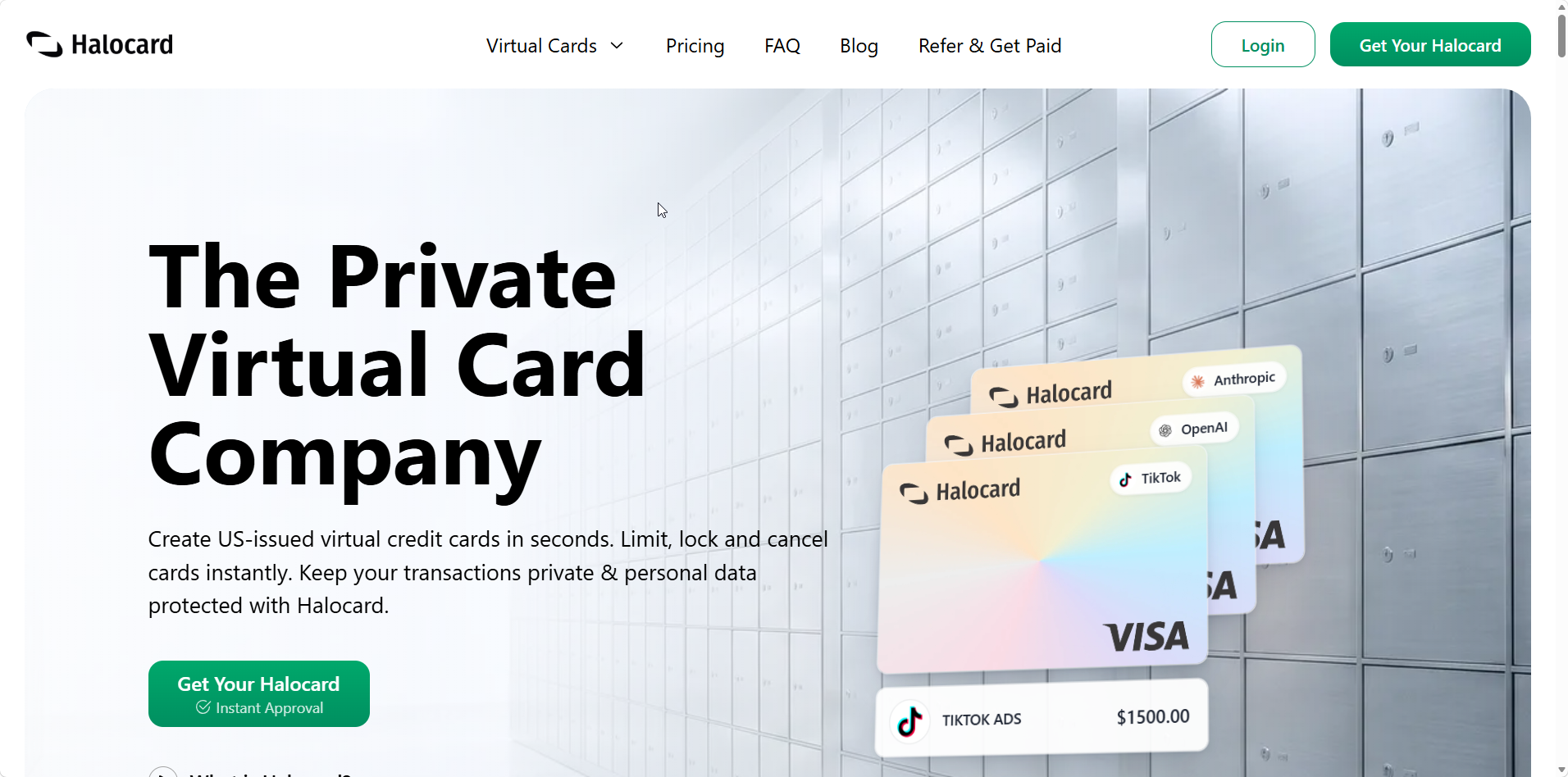
Halocard is a US based fintech platform offering virtual and physical Visa cards, built around transaction anonymity and control rather than rewards. It accepts crypto as funding, so it works for people who hold digital assets and want to spend them privately online. See Halocard vs the Crypto.com Card side by side.
How Halocard Works
Sign up in a browser and you can create a virtual card instantly after a short ID check, with no app to install, no credit check, and no SSN for anyone outside the US. Every card is a US-issued Visa credit card, with issuance handled by Third National as a Visa principal member, and supports 3D Secure, Apple Pay and Google Pay. Halocard prioritizes transaction anonymity and control: each payment card can carry its own billing address, disposable cards close after a single use, and high-risk merchant categories are blocked. Support runs by chat, email and phone on every plan.
Halocard Costs & Fees
Essential costs $12 a month and includes 3 cards, Pro is $15 with 12, and Elite is $75 with 60. Paying yearly costs $144, $180 and $900 and unlocks a physical card plus a monthly allowance of disposable cards that depends on the tier. There is no issuance fee per card, and referrals can cover the monthly fees entirely. Purchases in US dollars carry no fee, and other currencies cost 1.5% + $0.30.
Halocard Spending Limits and Funding
Halocard offers loading funds via multiple methods, including cryptocurrency: debit/credit card, Apple Pay, Google Pay, bank transfer, stablecoins, or crypto. Everything sits in one USD balance with capacity up to $1 million a day. You can cap each card per purchase, per day and per month, give it its own billing address, and lock or cancel it in one tap.
Separate cards per merchant are the practical response to where theft now happens. The FBI's Internet Crime Complaint Center tied more than $11.3 billion in losses to cryptocurrency in 2025, and the FTC reported that investment scams alone took $7.9 billion from Americans last year. A virtual card that only works at one merchant, and never exposes your exchange login, keeps a leak contained.
Halocard Key Advantages
-
Stablecoin funding and no staking or subscription tiers for rewards, because there are none
-
Unlimited card level control: limits, billing address and auto-cancel after one use
-
US issued Visa that clears US platforms, available in 120+ countries
-
No credit check and no SSN for non-US users
Halocard Specific Drawbacks
-
No cashback rewards or crypto rewards at all
-
A monthly or annual fee, unlike free tiers elsewhere
-
Balances are held in USD, not in crypto, so there is no self custody
-
Trustpilot shows 4.2/5 (11 reviews), too few reviews to rely on
Who Halocard Is Best For
Crypto holders who want to spend privately online, pay US services such as Claude, or separate subscriptions by card. Our virtual card guide explains the model.
Why Someone Would Choose Halocard Over the Crypto.com Card
Control instead of rewards: as many isolated cards as your plan allows, a chosen billing address per card, and no need to hold a platform token to unlock features. Read how Halocard handles privacy for more.
2. MetaMask Card
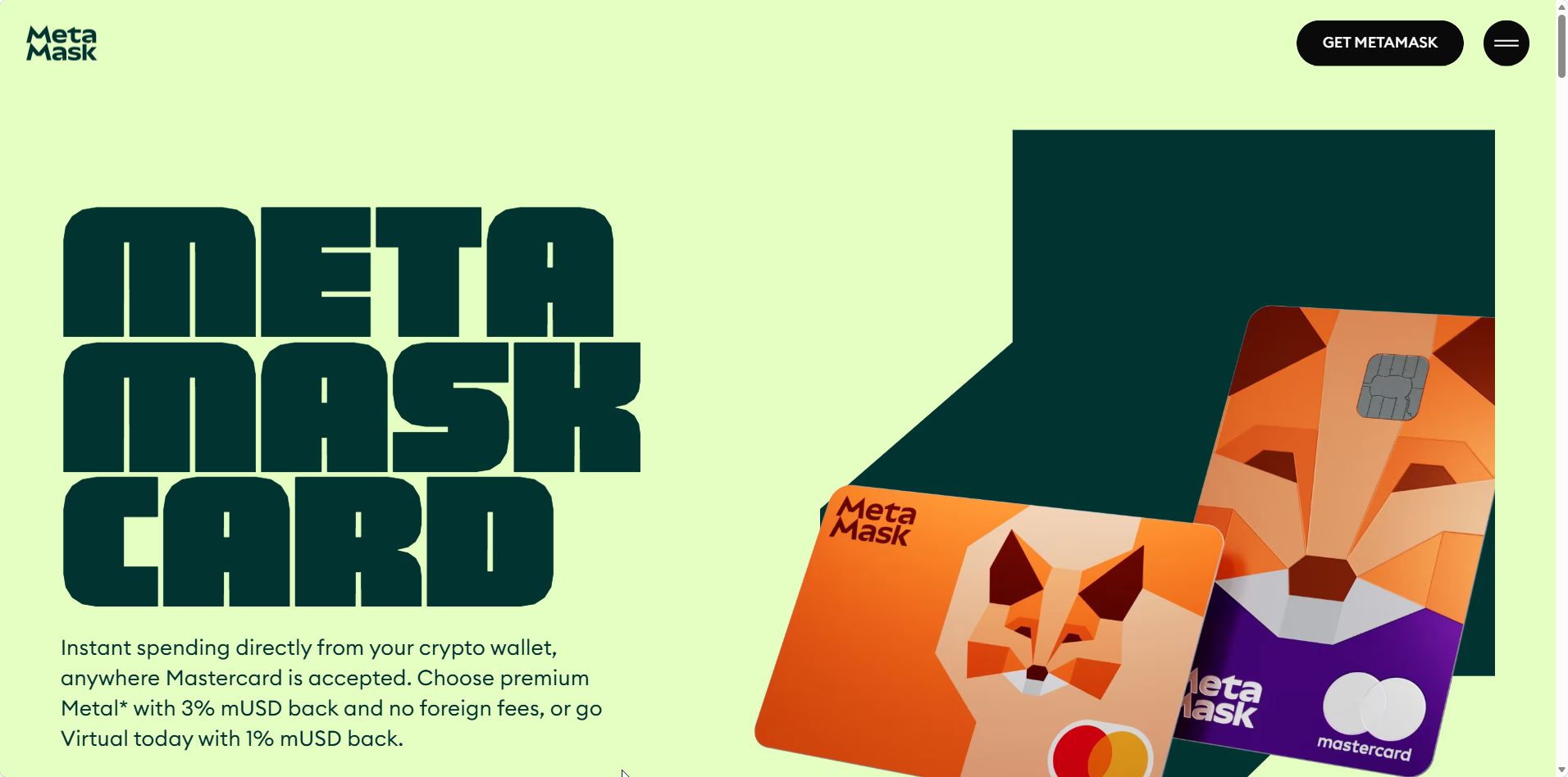
The MetaMask Card is the most widely known self-custodial option, letting you spend directly from the MetaMask wallet you already use.
How MetaMask Card Works
New users receive a free virtual card, which is currently the only card being issued. You delegate a spending allowance from your wallet to it, and tokens stay on-chain until the moment you pay, when they convert to fiat. Supported tokens include mUSD, USDC, USDT and wETH across networks such as Linea, Base and Solana, which enables users to spend digital assets without a separate exchange account. MetaMask says it does not keep or report card data to governments itself; its regulated partners handle that compliance. Baanx provides the card, Monovate issues it and Mastercard runs the network, according to MetaMask's card FAQ.
MetaMask Card Costs & Fees
The virtual card is free with no annual fee. The Metal card costs $199 a year, adds no foreign transaction fees, and pays 3% back on the first $10,000 each year, but new Metal orders are currently paused. Stablecoin spending on Linea costs only a gas fee of roughly $0.02; other tokens carry a small percentage fee, widely reported at 0.875%.
MetaMask Card Spending Limits and Funding
Your wallet balance and the allowance you approve set the ceiling, so there is no separate card account to top up.
MetaMask Card Key Advantages
-
Genuine self custody, which reduces exposure to centralized risks
-
1% back in mUSD on the free virtual card, with extra cashback paid on hotel bookings through MetaMask Card Travel (5% total on the virtual card)
-
Runs on the Mastercard network, with Apple Pay and Google Pay support
MetaMask Card Specific Drawbacks
-
Metal card orders paused, limiting the higher rewards rate
-
Non-stablecoin spending adds a conversion fee
-
Wallet management is on you, including seed phrase security
Who MetaMask Card Is Best For
People who already hold stablecoins in MetaMask and want to spend without moving funds to an exchange.
Why Someone Would Choose MetaMask Over the Crypto.com Card
No staking, no subscription for the base rate, and no exchange holding your money between purchases.
3. Bybit Card
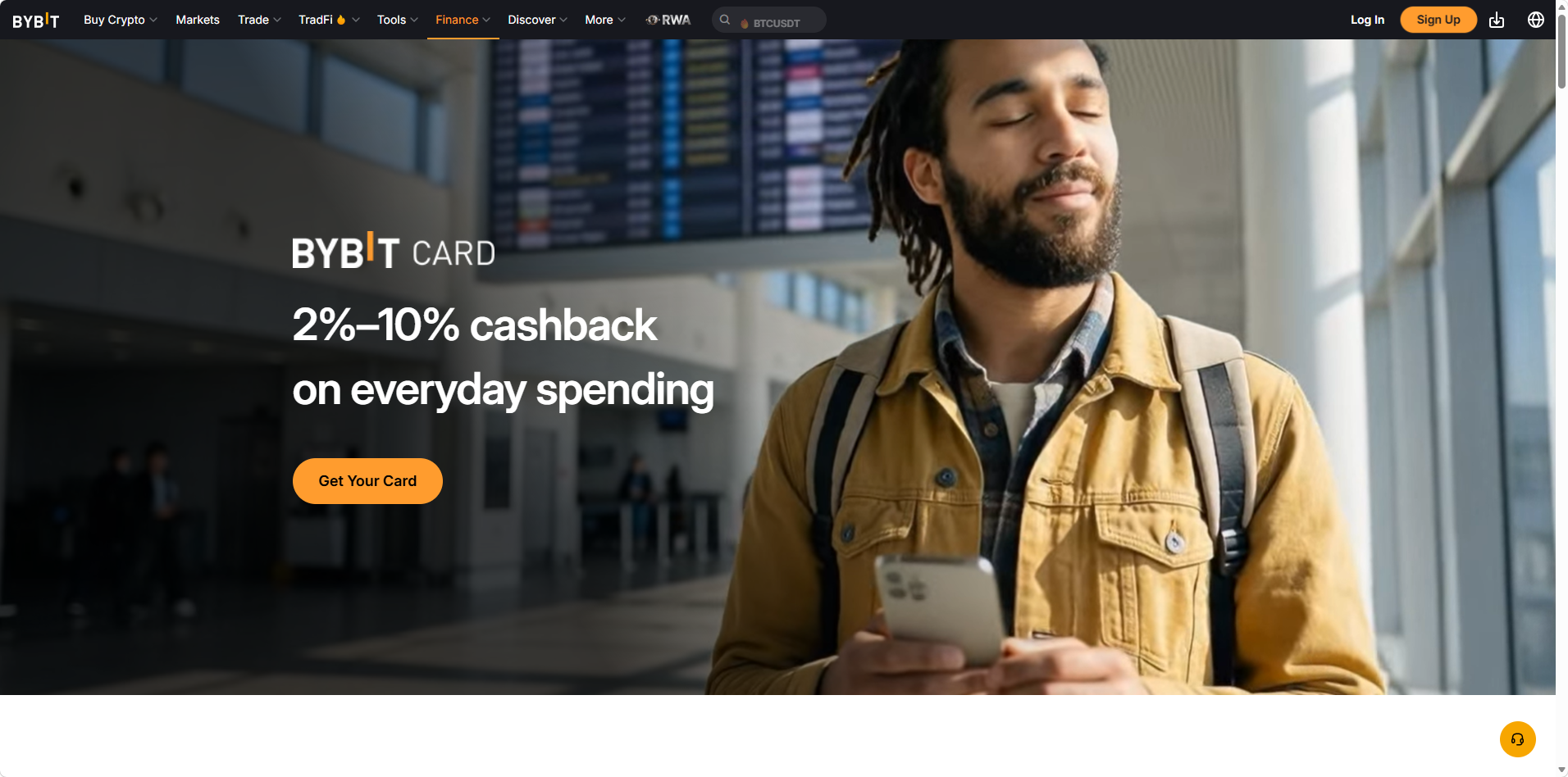
The Bybit Card is a Mastercard debit card linked to your Bybit funding account, with one of the higher reward ceilings among exchange cards.
How Bybit Card Works
Crypto converts to fiat in real time at checkout, and a virtual card is available immediately after approval. Supported assets include BTC, ETH, XRP, TON, USDT, USDC, MNT and BNB, and you can choose to pay from a crypto or fiat balance. In Europe, the card is issued through Bybit EU, which launched it across the European Economic Area in September 2025 as a licensed crypto asset service provider.
Bybit Card Costs & Fees
Bybit's card page lists free issuance and no annual fees. Cashback runs 2% to 10% depending on VIP tier, and since January 2026 Bybit EU users can take rewards in Bitcoin, according to its press release.
Bybit Card Spending Limits and Funding
Limits follow your verification and VIP level. Bybit previously charged a 0.5% FX fee on some European currencies and waived it for seven of them, including the Polish zloty and Swedish krona, in 2024, so check the current foreign exchange terms for your currency. Selected users get 100% rebates on Netflix, Spotify, Prime, ChatGPT and TradingView, and idle balances can earn up to 8% APR through Auto-Savings.
Bybit Card Key Advantages
-
Bybit Card provides up to 10% cashback with no staking requirement
-
Instant virtual card with Apple Pay, Google Pay and Samsung Pay
-
Subscription rebates on popular services
Bybit Card Specific Drawbacks
-
Not available in the US
-
Top reward tiers depend on trading volume or VIP status
-
Custodial, and Bybit suffered the largest crypto hack on record in February 2025
Who Bybit Card Is Best For
European users who trade on Bybit and want high base rewards, plus rebates on the streaming and AI subscriptions they already pay for.
Why Someone Would Choose Bybit Over the Crypto.com Card
A 2% base rate with no subscription fee beats Crypto.com's free tier outright.
4. Nexo Card
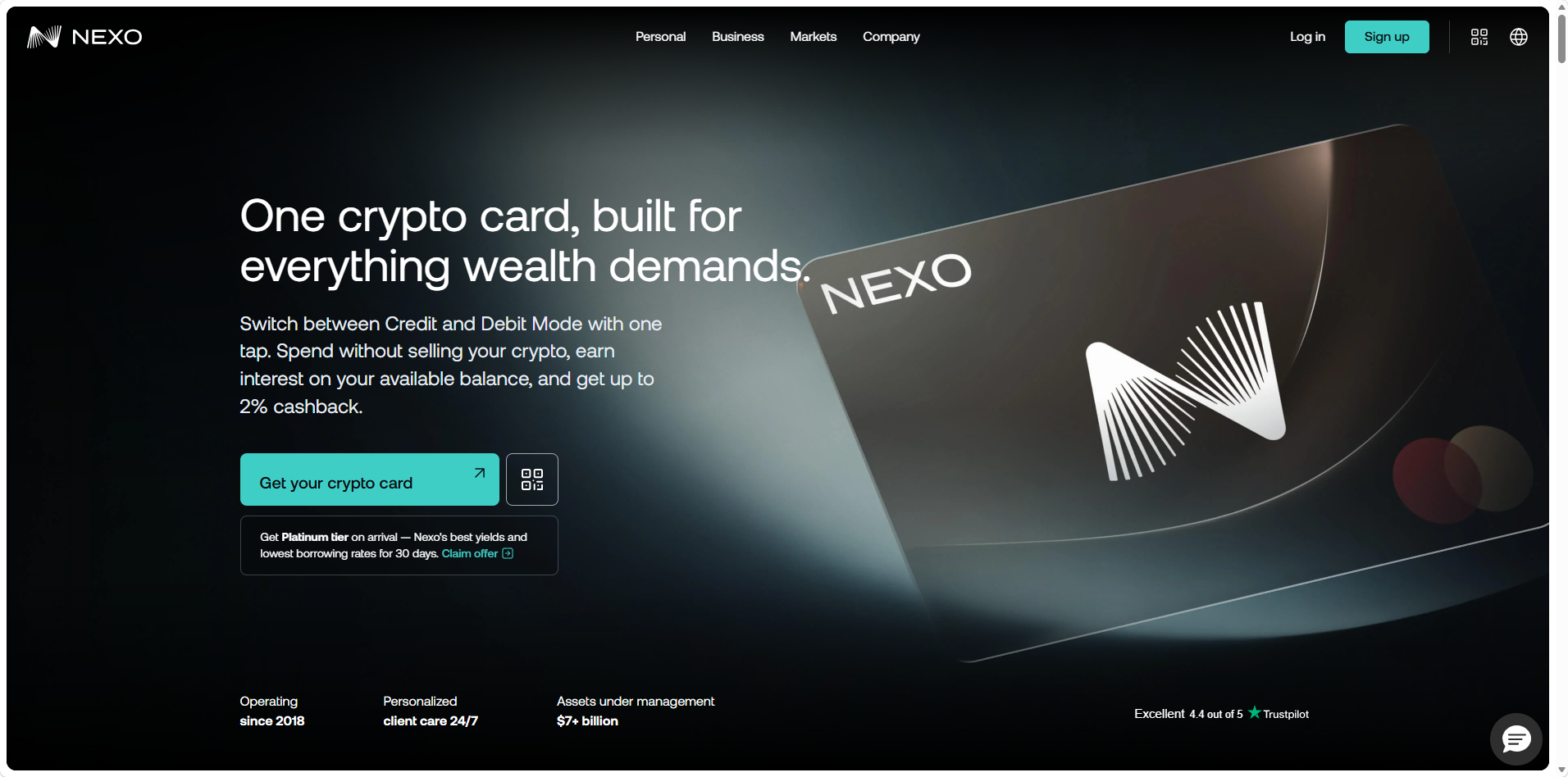
The Nexo Card is built around a choice between two ways of paying: credit mode and debit mode.
How Nexo Card Works
The card launched in April 2022 through a partnership with Mastercard and DiPocket. In credit mode, you spend against a credit line secured by crypto collateral, so you do not have to sell your assets, and nearly any asset Nexo supports can serve as collateral. In debit mode, you spend your EUR, USD or GBP stablecoin balance while it earns interest. Nexo says the virtual card can be issued in seconds and added to Apple Pay or Google Pay.
Nexo Card Costs & Fees
No monthly, annual or inactivity fees, and no FX fees on up to €20,000 a month, according to Nexo's launch post. Cashback reaches up to 2% in NEXO or Bitcoin in credit mode, depending on your loyalty tier.
Nexo Card Spending Limits and Funding
Credit mode depends on collateral value, and free withdrawals at ATMs follow a tier-based monthly allowance. Independent reviews have reported portfolio minimums of around $50 for a virtual card and higher balances plus a Gold or Platinum loyalty tier for a physical card.
Nexo Card Key Advantages
-
Spend without selling crypto
-
No FX fee within the monthly allowance
-
Virtual and physical cards
Nexo Card Specific Drawbacks
-
EEA and UK only
-
Borrowing against volatile collateral carries liquidation risk
-
Best rewards require holding NEXO for a higher loyalty tier
Who Nexo Card Is Best For
Long-term holders in Europe who want liquidity without triggering a sale, and who keep their loan-to-value ratio well below liquidation levels.
Why Someone Would Choose Nexo Over the Crypto.com Card
A credit line secured by crypto, which Crypto.com's prepaid card does not offer.
5. KAST Card
The KAST Card is a stablecoin Visa built for global reach, with coverage in more than 170 countries.
How KAST Card Works
You deposit USDC, USDT or SOL and receive a virtual card within minutes, with physical cards on higher tiers. Settlement runs on Solana, so funding is fast and cheap.
KAST Card Costs & Fees
The Standard tier is free, Premium costs around $1,000 a year, and Luxe $10,000 a year, according to KAST's site, with a one-time Limited Edition tier in between. Crypto cashback is paid in KastPoints: recent seasons paid 1% on Standard, 4% on Premium and 6% on Luxe. KAST reports more than 1 million users and around $5 billion in annualized volume.
KAST Card Spending Limits and Funding
Limits follow your tier, and some tiers offer yield on idle balances.
KAST Card Key Advantages
-
The widest country coverage among crypto cards
-
Near-instant stablecoin funding
-
A free entry tier
KAST Card Specific Drawbacks
-
Early users were promised a token allocation for KastPoints, which KAST later converted into an equity-linked instrument
-
High annual fees on the best reward tiers
-
Custodial
Who KAST Card Is Best For
Stablecoin holders who travel or live outside the main card markets and want a virtual card instantly without a bank account.
Why Someone Would Choose KAST Over the Crypto.com Card
Availability in supported regions where Crypto.com's card is not offered.
6. Bleap
Bleap is a self-custodial Mastercard from two former Revolut employees, who raised $2.3 million to build it, according to The Block.
How Bleap Works
Bleap issues free virtual cards, according to ITC.ua's coverage of its launch. You spend stablecoins held in your own wallet across several chains, including Solana and Arbitrum, and the card converts at checkout. The co-founders previously led card and product teams at Revolut, and the funding round valued the company at $10 million. There is no minimum balance to open an account.
Bleap Costs & Fees
Bleap advertises 0% FX fees, no monthly subscription and no staking requirement on its own blog. Cashback reaches up to 20% in USDC, but only in select categories such as gaming and streaming.
Bleap Spending Limits and Funding
Spending comes from your wallet balance, with KYC required.
Bleap Key Advantages
-
Bleap offers up to 20% cashback with self-custody in eligible categories
-
No subscription or staking
-
Zero FX fees
Bleap Specific Drawbacks
-
The 20% figure applies only to specific categories, not everyday spending
-
EEA focused, with Latin America still expanding
-
A young company with a short track record
Who Bleap Is Best For
European stablecoin users who spend heavily on gaming and streaming.
Why Someone Would Choose Bleap Over the Crypto.com Card
Self custody and category rewards without a tier fee.
7. Gnosis Pay
Gnosis Pay attaches a Visa debit card to a Safe smart account on Gnosis Chain, the purest self-custody model here.
How Gnosis Pay Works
Virtual cards are free and activated the moment you order them, with up to five active cards at once, according to Gnosis Pay's documentation. You fund your Safe with EURe, GBPe or bridged USDC, and payments settle onchain through regulated e-money rails. Your keys stay with you, though card transactions from a Safe are visible on Gnosis Chain.
Gnosis Pay Costs & Fees
A one-time issuance fee of around €30 applies. Gnosis Pay has promoted zero FX and conversion fees, but recent comparisons list small FX and ATM charges, so confirm the current schedule on Gnosis Pay's site. Rewards depend on holding GNO.
Gnosis Pay Spending Limits and Funding
Spending is limited to what sits in your Safe.
Gnosis Pay Key Advantages
-
Self-custodial cards like this let users retain control of their private keys
-
Low fees on the base product
-
No exchange account needed
Gnosis Pay Specific Drawbacks
-
Not available in the US
-
Rewards require holding GNO, a volatile token
-
The company disclosed a June security incident, saying affected balances were restored
Who Gnosis Pay Is Best For
DeFi users in Europe who refuse custodial platforms.
Why Someone Would Choose Gnosis Pay Over the Crypto.com Card
No platform ever holds your funds.
8. Coinbase Card
The Coinbase Card is a Visa debit card that spends directly from your Coinbase balance.
How Coinbase Card Works
Sometimes called the Coinbase debit card, it lets you choose an asset as your spending source, and Coinbase sells it at checkout. US users receive a virtual card number at signup, before the physical card arrives. Spending USDC avoids the liquidation fee, which makes a stablecoin balance the cheapest way to use it, and a replacement card costs $4.99.
Coinbase Card Costs & Fees
Issuance and monthly use are free. Coinbase has charged a 2.49% crypto liquidation fee on spending assets other than USDC, and a 2026 review by Eco lists a 2.49% foreign transaction fee and $2.50 per ATM withdrawal on top of the operator's charge.
Coinbase Card Spending Limits and Funding
Eco lists daily limits of $2,500 in spending and $1,000 at ATMs, with $25,000 a month overall.
Coinbase Card Key Advantages
-
Coinbase Card provides up to 4% cashback, with rolling rewards that vary by asset and can be boosted for Coinbase One subscribers
-
Spend any Coinbase-listed asset
-
No monthly fee
Coinbase Card Specific Drawbacks
-
The 4% rate applies only to whichever asset Coinbase is promoting
-
Liquidation, FX and ATM fees add up quickly
-
Custodial
Who Coinbase Card Is Best For
US users who already keep a balance on Coinbase.
Why Someone Would Choose Coinbase Over the Crypto.com Card
Rewards with no staking or tier fee, from a publicly listed US company.
9. Coinbase One Card
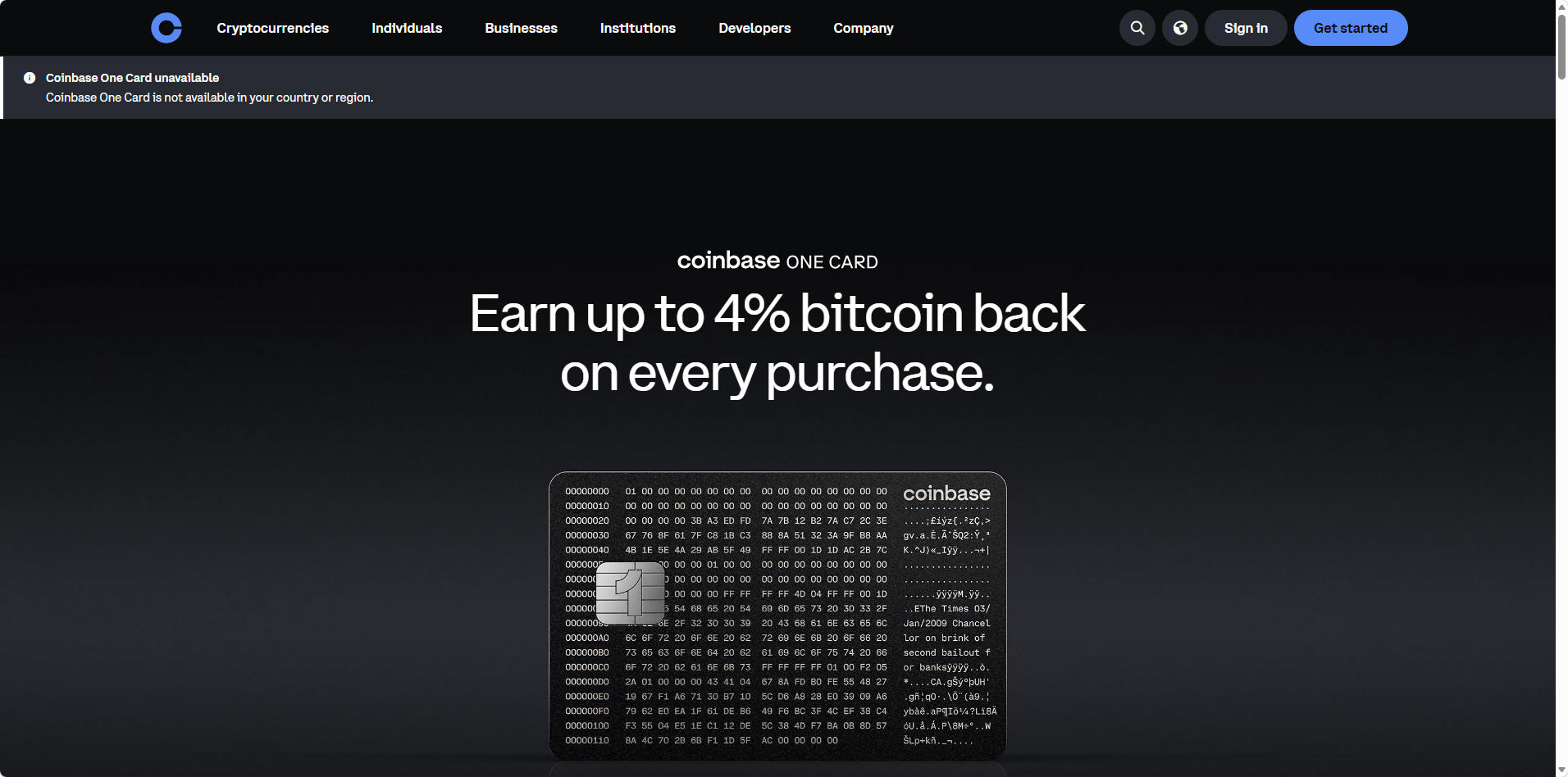
The Coinbase One Card is Coinbase's credit card, running on the American Express network.
How Coinbase One Card Works
You spend dollars on credit and earn Bitcoin rewards, with the card issued by First Electronic Bank and powered by Cardless. Cardless says every card it runs comes with a virtual card number you can use as soon as you are approved.
Coinbase One Card Costs & Fees
Rewards start at 2% back in BTC and rise through 2.5% and 3% to 4% based on the assets you hold on Coinbase, with rewards paid in Bitcoin. The card requires a Coinbase One membership, which starts at $4.99 a month, according to The Block's launch coverage.
Coinbase One Card Spending Limits and Funding
A credit line set at approval, subject to a credit check.
Coinbase One Card Key Advantages
-
Coinbase One Card offers up to 4% cashback for US users
-
Credit card protections plus American Express benefits
-
No crypto sale at checkout
Coinbase One Card Specific Drawbacks
-
A paid membership is required
-
The top rate depends on holding significant assets on Coinbase
-
Amex acceptance is narrower than Visa or Mastercard abroad
Who Coinbase One Card Is Best For
Coinbase One subscribers who want Bitcoin rewards on credit.
Why Someone Would Choose Coinbase One Over the Crypto.com Card
A 2% base rate in BTC with credit card protections.
10. Gemini Credit Card
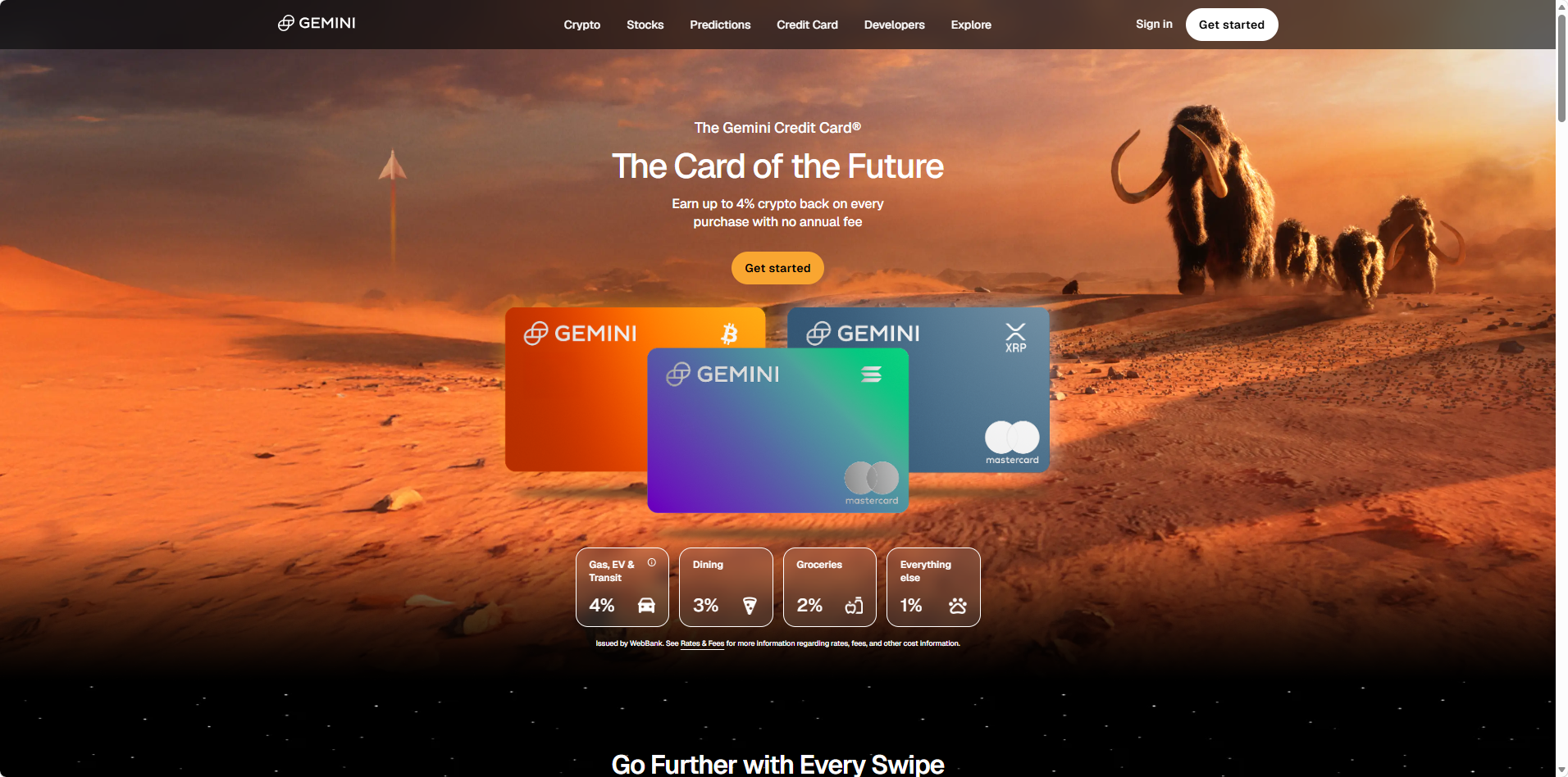
The Gemini Credit Card is a Mastercard World Elite card issued by WebBank that pays crypto rewards instantly.
How Gemini Credit Card Works
Once you are approved and verified, Gemini issues a virtual card, a digital version of the credit card that works online and in Apple Pay, Google Pay and Samsung Pay, according to Gemini's help center. You spend dollars and receive rewards in your choice of 50+ cryptocurrencies, including BTC, SOL and XRP. The card number is not printed on the metal card and is only shown in the Gemini app, which requires two factor authentication.
Gemini Credit Card Costs & Fees
No annual fee, no foreign transaction fees and no fee to receive rewards, according to Gemini. Rewards are 4% on gas, EV charging, transit and rideshare on up to $300 a month, 3% on dining, 2% on groceries and 1% on everything else.
Gemini Credit Card Spending Limits and Funding
A credit line set at approval, with a credit check. New cardholders can earn a $200 welcome bonus after spending $3,000 in the first 90 days, and the XRP Edition has offered 10% back at select merchants on up to $250 of monthly spending. The Gemini Credit Card offers category-based rewards of 3% back on dining, one of the strongest dining rates on any crypto card.
Gemini Credit Card Key Advantages
-
Category rewards that beat most flat crypto cards on everyday spending
-
No FX or annual fees
-
Card details hidden behind app authentication
Gemini Credit Card Specific Drawbacks
-
US only, and reward availability varies by state
-
Requires good credit
-
Rewards count as a purchase of volatile assets
Who Gemini Credit Card Is Best For
US users with good credit who spend on gas, dining and groceries and would rather build a crypto position gradually than buy it outright.
Why Someone Would Choose Gemini Over the Crypto.com Card
Up to 4% without any subscription, stake or tier.
11. Uphold Debit Card
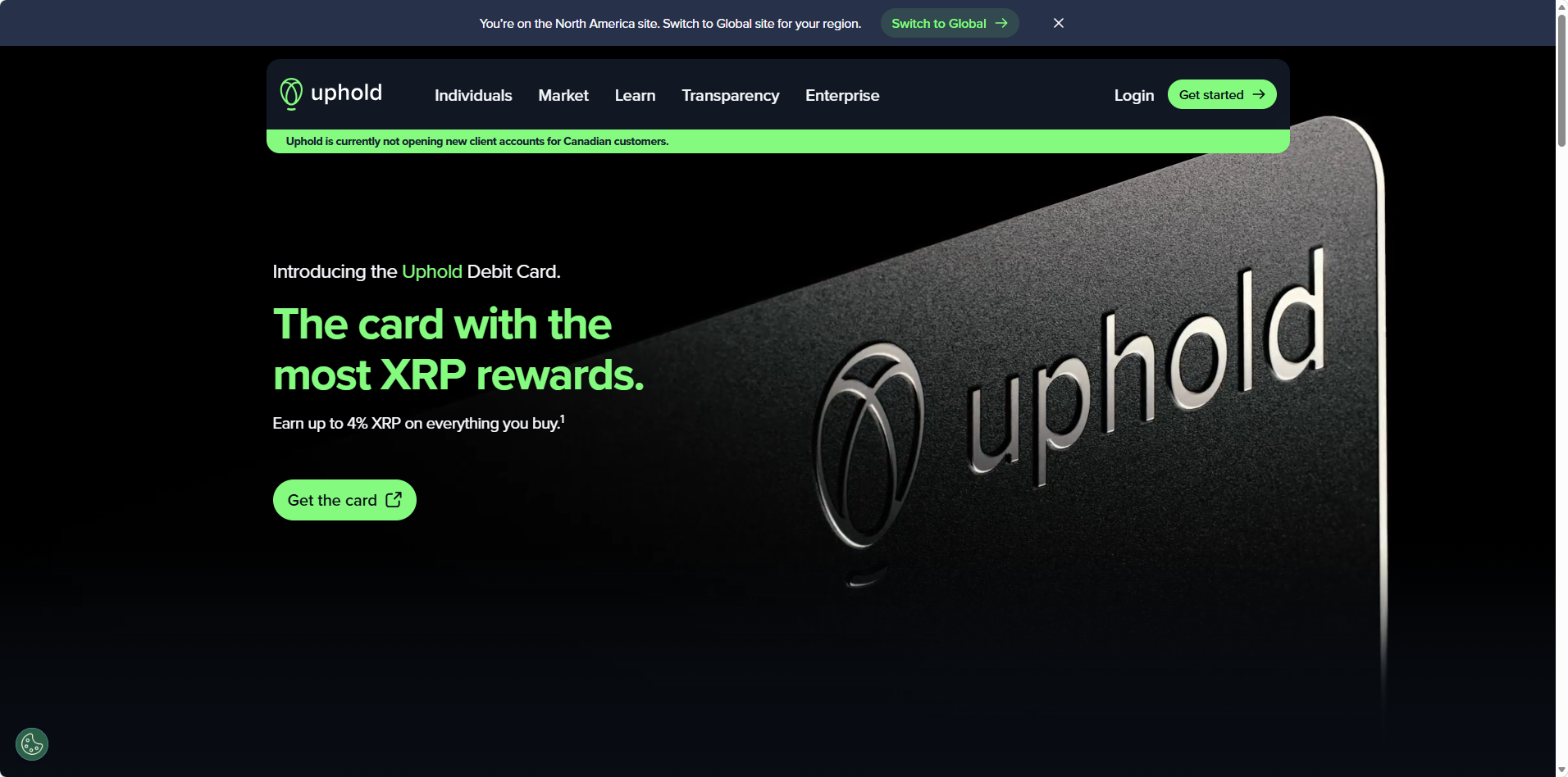
Uphold relaunched its US debit card in October 2025 after discontinuing an earlier version in March 2023, according to The Block. The new card is a Visa debit issued by Cross River Bank.
How Uphold Debit Card Works
You spend dollars, stablecoins or crypto held at Uphold, with instant conversion to fiat currency at checkout. Uphold issues a virtual card as well as a physical one: Finder's 2026 review of the UK card notes you can pay with the virtual card, including through Apple Pay or Google Pay, before the plastic arrives.
Uphold Debit Card Costs & Fees
The launch rates of up to 6% in XRP on the Elite metal card and 4% on the Essential card applied only to people who signed up before January 1, 2026, and only for 90 days. After that, Uphold's own terms limit XRP rewards to 3% on Elite and 2% on Essential. Elite also removes ATM and foreign transaction fees. The widely quoted Uphold Card figure of 4% cashback in XRP comes from the Essential launch rate and from Uphold's earlier UK card.
Uphold Debit Card Spending Limits and Funding
Promotional rewards were capped at $5,000 of monthly spending on Elite and $3,000 on Essential. Direct deposit of part of your pay adds a separate XRP reward, and Elite carries higher spending limits than Essential.
Uphold Debit Card Key Advantages
-
Rewards on all everyday purchases rather than selected categories
-
Elite charges no ATM fees or FX fees
-
Spend dollars, stablecoins or crypto from one account
Uphold Debit Card Specific Drawbacks
-
The headline 6% and 4% rates were time-limited; ongoing rates are 3% and 2%
-
Rewards paid only in XRP, so their value moves with one asset
-
Custodial, with a short record since the 2025 relaunch
Who Uphold Debit Card Is Best For
US XRP holders who want a flat rewards rate on everyday spending.
Why Someone Would Choose Uphold Over the Crypto.com Card
A 2% to 3% rate on all spending without staking CRO or paying a monthly fee.
12. Wirex
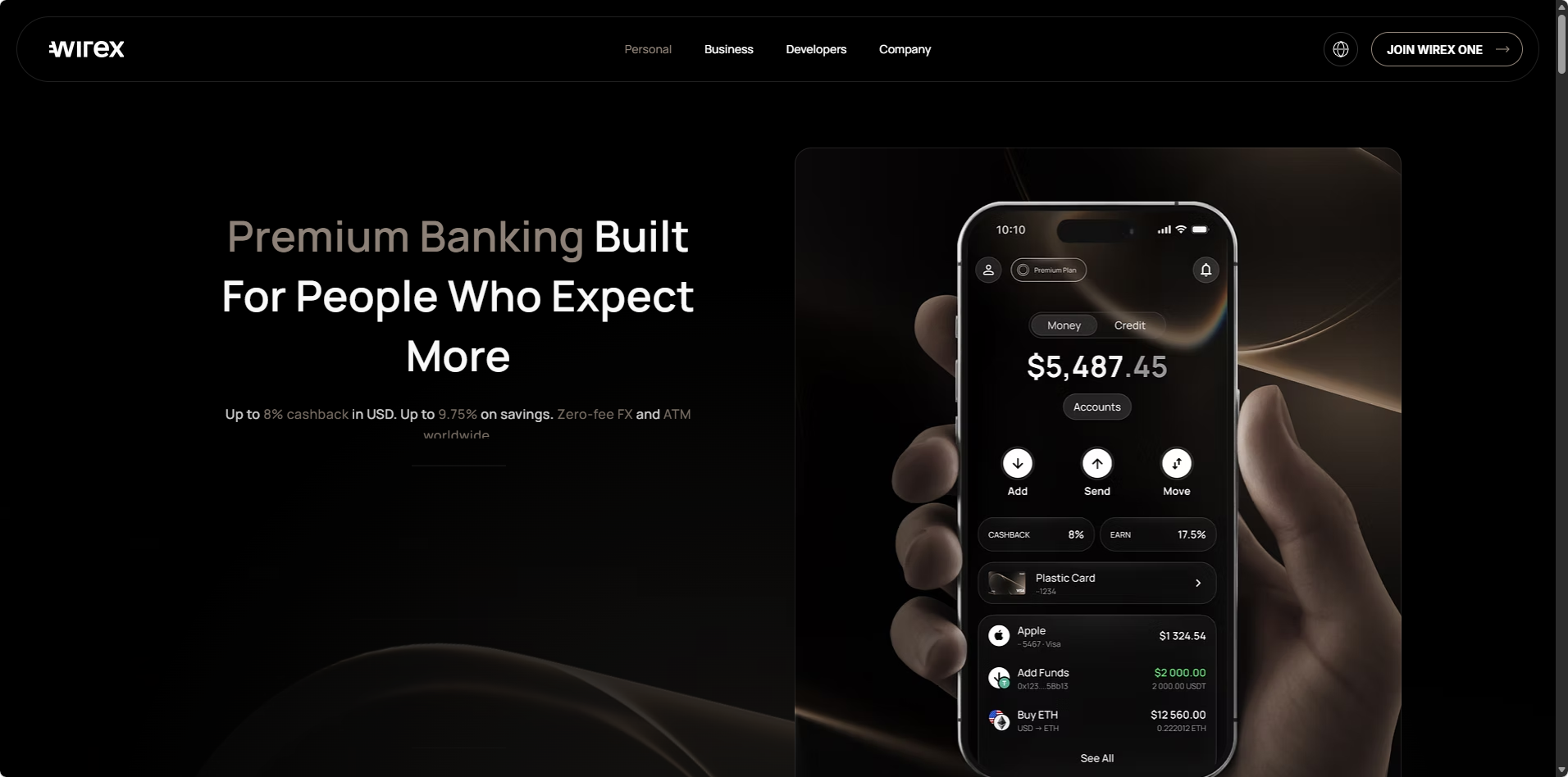
Wirex is one of the oldest crypto card providers, operating since 2014.
How Wirex Works
You hold fiat and crypto in multi-currency accounts and spend through Visa or Mastercard, with virtual and physical cards across 35+ European countries plus APAC and Latin America. Wirex launched in the US in 2022.
Wirex Costs & Fees
Cryptoback rewards reach up to 8% in WXT on Premium and Elite plans with WXT staking, and Wirex advertises no monthly maintenance fee on its base plan and free ATM withdrawals within limits.
Wirex Spending Limits and Funding
Limits reach €30,000 per transaction on higher tiers. Wirex also offers X-Accounts savings and Wirex Credit, which lends stablecoins against BTC or ETH collateral, and it runs its own Wirex Pay Chain for non-custodial card spending.
Wirex Key Advantages
-
Long operating history
-
Multi-currency accounts alongside crypto
-
A non-custodial wallet option
Wirex Specific Drawbacks
-
Wirex Card offers up to 8% cashback but requires WXT lockup
-
Top tiers carry fees
-
Rewards paid in its own token
Who Wirex Is Best For
Travelers who want multi-currency accounts and crypto together.
Why Someone Would Choose Wirex Over the Crypto.com Card
A comparable model with multi-currency features and a longer track record.
13. Bitpanda Card
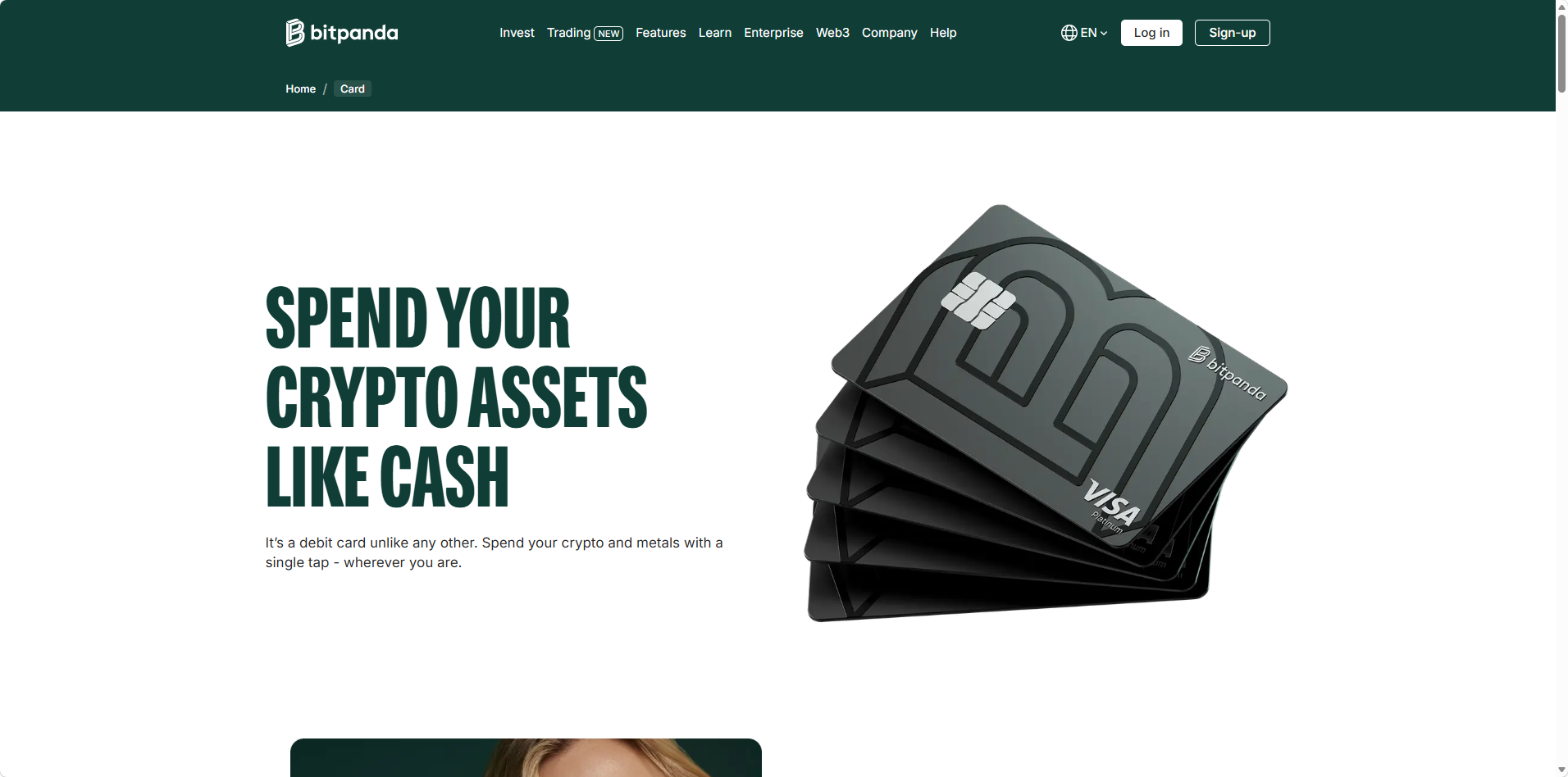
The Bitpanda Card is a Visa debit card from the Vienna exchange, aimed at European users.
How Bitpanda Card Works
You can order a virtual-only card and hold up to three active cards at once, according to Bitpanda support. You choose which asset to spend from, and Bitpanda converts at checkout. Bitpanda supports thousands of digital assets, including crypto, precious metals and stocks, and the card draws on whichever one you select in the same app.
Bitpanda Card Costs & Fees
Eco's 2026 comparison lists up to 2% back in your chosen asset, no card fee, Visa's exchange rate, and free ATM withdrawals up to €50 a month, then 2.5%.
Bitpanda Card Spending Limits and Funding
Limits follow verification level.
Bitpanda Card Key Advantages
-
Spend from a very wide asset list
-
Favorable conversion with no FX markup
-
Beneficial for European users avoiding hidden fees
Bitpanda Card Specific Drawbacks
-
EEA only
-
A small free ATM allowance
-
Custodial
Who Bitpanda Card Is Best For
European investors who already hold a varied portfolio on Bitpanda and want a card that spends any of it without a subscription or a platform token.
Why Someone Would Choose Bitpanda Over the Crypto.com Card
No tier fees and a broader choice of spending assets.
14. Plutus Card
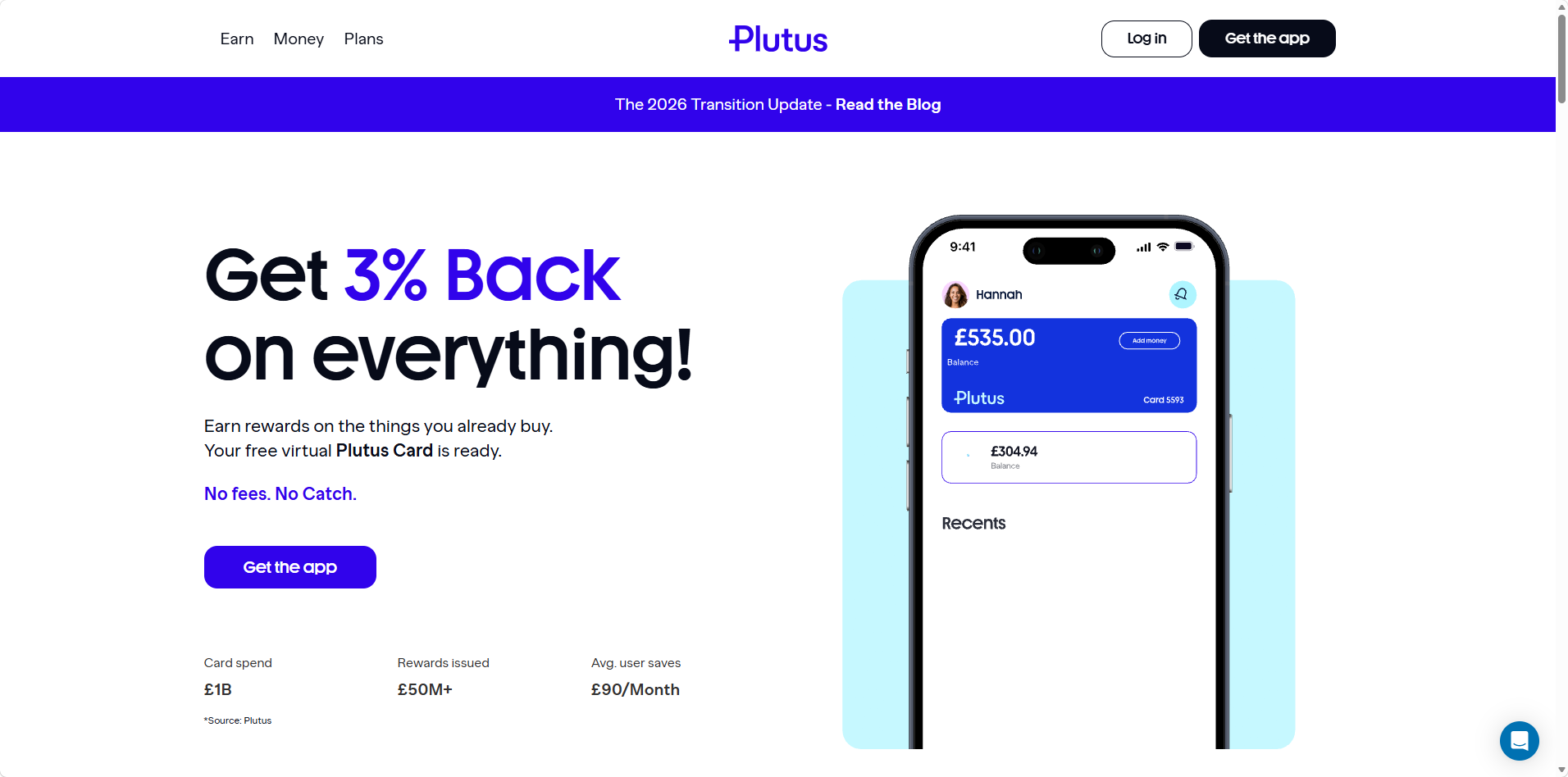
Plutus is a London fintech whose Visa debit card pays rewards in its own PLU token. It operates in the UK and the European Economic Area.
How Plutus Card Works
Plutus converts crypto into a pound or euro balance that you spend through the card, with PLU rewards added afterward. A virtual card is free on every plan, and a physical card costs £9.99 or €9.99 to order, according to FitGap's listing of Plutus's published plans.
Plutus Card Costs & Fees
Plutus discontinued its free Standard plan on February 13, 2025. Plans now run £6.99 or €6.99 a month for Starter, £9.99 for Everyday and £19.99 for Premium, each paying 3% back in PLU on up to £250, £500 or £1,000 of monthly spending. Card payments abroad and ATM withdrawals each cost 2.5%.
Plutus Card Spending Limits and Funding
The reward cap rises with your plan, and Starter adds a 1% trading fee that the higher plans remove.
Plutus Card Key Advantages
-
Free virtual card on every plan
-
A 3% rate on everyday purchases, higher than most exchange cards
-
Monthly Perks that rebate chosen subscriptions or merchants
Plutus Card Specific Drawbacks
-
No free plan since February 2025
-
2.5% on foreign card payments and ATM withdrawals
-
Rewards paid in a single, volatile token
Who Plutus Card Is Best For
UK and EEA users who spend close to their plan's reward cap each month and are comfortable with a token-based rewards program.
Why Someone Would Choose Plutus Over the Crypto.com Card
A 3% rate for £6.99 a month, against 1.5% for Crypto.com's $4.99 Ruby Steel tier.
15. RedotPay

RedotPay is a Hong Kong platform serving roughly 8 million users across more than 100 countries, but not the US.
How RedotPay Works
You fund a custodial balance with crypto and spend through a Visa card, with high single transaction limits. RedotPay holds a money service operator license in Hong Kong and has raised close to $200 million. Cards issued after August 22, 2025 could not be added to Apple Pay until a free upgrade began in January 2026.
RedotPay Costs & Fees
A $10 virtual card and a $100 physical card, both non-refundable, about 1.2% on foreign currency and roughly 1% on local purchases. ATM withdrawals cost about 2% to 4.2%.
RedotPay Spending Limits and Funding
Up to $100,000 per transaction.
RedotPay Key Advantages
-
Wide availability outside the US
-
High transaction limits
RedotPay Specific Drawbacks
-
US residents cannot sign up
-
Rewards are effectively zero
-
Reviews describe balances held during disputes
Who RedotPay Is Best For
Users outside the US who need a crypto card where others are unavailable. Our RedotPay vs Halocard comparison goes further.
Why Someone Would Choose RedotPay Over the Crypto.com Card
Coverage in regions Crypto.com does not serve.
Crypto Rewards and Cashback Rewards Compared
Finding a substitute for a crypto card often depends on user preferences for rewards, and the alternatives offer varied rewards structures: flat rates, category rates, tiered subscriptions and token stakes. Here is what several cards actually return on $1,000 of monthly spending, before any token price movement:
| Card | Monthly fee | Rewards on $1,000 | Net per month |
|---|---|---|---|
| Crypto.com prepaid, Midnight Blue | $0 | $0 | $0 |
| Crypto.com prepaid, Ruby Steel | $4.99 | $15 at 1.5% | $10.01 |
| Crypto.com prepaid, Jade Green | $29.99 | $25 at 2.5% | minus $4.99 |
| Crypto.com Visa Signature, Basic (BTC) | $0 | $11.25 ($250 at 1.5%, then 1%) | $11.25 |
| MetaMask virtual card | $0 | $10 at 1% | $10, less conversion fees on volatile tokens |
| Bybit Card, base tier | $0 | $20 at 2% | $20 |
| Coinbase One Card, base rate | $4.99 | $20 at 2% | $15.01 |
| Gemini Credit Card, sample mix | $0 | $25 on $300 gas, $200 dining, $200 groceries, $300 other | $25 |
| Halocard Essential | $12 | $0 | minus $12 |
Two patterns stand out. Paid tiers with monthly fees rarely pay for themselves unless you spend near the monthly spend limits, and several alternatives with no fee earn more than Crypto.com's entry tiers. Halocard loses on this table by design, because it charges for control and privacy rather than paying rewards. Community members discuss the pros and cons of shifting from debit to credit rewards often; a credit card that combines traditional protections with crypto capabilities, like Gemini's, avoids selling crypto at checkout but needs a credit check and on-time repayment.
Spending Limits, ATM Caps and Withdrawal Fees
| Card | Free ATM allowance | After the allowance | Notable spending limits |
|---|---|---|---|
| Crypto.com prepaid | $200 to $1,000/month by tier | Fees apply | ATM cap $5,000 to $10,000/month |
| Coinbase Card | No free withdrawals | $2.50 plus operator fee | $2,500 daily spending |
| Nexo Card | Tier based | Fees apply | FX free to €20,000/month |
| Bitpanda Card | €50/month | 2.5% | By verification level |
| Plutus Card | None | 2.5% | Rewards capped at £250 to £1,000/month |
| Uphold Elite | No ATM fees | None | Higher than Essential |
| RedotPay | None | About 2% to 4.2% | Up to $100,000 per transaction |
Cards That Have Disappeared or Changed
Several cards still appear in comparison lists with outdated figures. The Binance Card was withdrawn from Latin America and the Middle East in 2023, so claims such as up to 8% back with 600 BNB held or a 0.9% transaction fee no longer describe a card most people can get. Older lists also cite a $2.50 US ATM fee on the BitPay Card, so confirm that card is still issued in your region before relying on it. SoFi has allowed its 2% cash back credit card rewards to be redeemed into crypto, but check current availability of its crypto features. MetaMask's Metal card is paused for new orders, and Uphold's current US card is a 2025 relaunch whose 6% launch rate has ended.
Spending Crypto Safely: Security Features and Fraud Data
Crypto theft concentrates on platforms that hold other people's money, including exchanges and other financial institutions that custody coins. Chainalysis counted over $3.41 billion stolen in 2025, with the $1.5 billion Bybit exchange hack making up about 44% of the total and private key breaches at centralized services accounting for 88% of stolen value in the first quarter. North Korea-linked hackers alone took a record $2.02 billion. Individuals are targeted too: personal wallet compromises reached 158,000 cases involving at least 80,000 victims.
Self-custodial cards reduce exposure to centralized risks because no exchange holds your balance, but they move the security burden onto you. Custodial cards spread risk differently: the platform protects the keys, and you rely on its security. Either way, card fraud is its own problem, with worldwide losses of $33.41 billion in 2024, and virtual credit cards can provide enhanced privacy in online transactions by keeping one number per merchant.
Card Features Worth Comparing
Crypto cards typically include two factor authentication for security, and the standard security features include a PIN and EMV chip on physical cards. Most crypto cards allow users to freeze their cards instantly, and providers monitor transactions for suspicious activity continuously. Beyond those basics, compare:
-
Custody. Who holds your digital assets between purchases.
-
Virtual card access. Whether you get a virtual card instantly or wait for plastic.
-
Per card controls. Transaction anonymity and spending limits are key features for users prioritizing privacy.
-
Conversion and FX fees. The real cost of spending crypto or paying in a foreign exchange currency, including transaction fees on each purchase.
-
Crypto cashback terms. When cashback is paid, in which token, and whether it arrives instantly or monthly.
-
Reward terms. Caps, staking requirements and which token pays out.
-
Supported regions. Many cards exclude the US or cover only the European Economic Area.
User experiences also highlight the importance of a frictionless onboarding process, since several cards require full KYC, a waitlist or a credit check before you can spend.
What Users Think About These Crypto.com Card Alternatives
Independent review coverage is thin for most crypto cards, so the notes below focus on documented themes rather than star ratings.
Crypto.com Card
The most common complaint is repeated changes to rewards, most recently leaving the free prepaid tier at 0%.
Halocard
Halocard's Trustpilot page shows 4.2/5 (11 reviews), a small sample, so treat it as an early signal. Reviewers praise cards working on US AI and app store subscriptions and fast support.
MetaMask Card
Users value spending from their own wallet; the paused Metal card is the recurring frustration.
Bybit Card
Praised for rewards and rebates, though the 2025 hack remains a concern for custodial balances.
Nexo Card
Valued for credit mode; borrowing against volatile assets is the main risk users raise.
KAST Card
Users praise fast Solana funding; the KastPoints rework drew criticism.
Bleap
Too new for a meaningful review base.
Gnosis Pay
Respected in DeFi circles for true self custody; the June security incident drew concern.
Coinbase Card
Reviewers criticize liquidation, FX and ATM fees more than the card itself.
Coinbase One Card
Early users note the membership fee needed to access it.
Gemini Credit Card
Well regarded for instant crypto rewards and no FX fees.
Uphold Debit Card
Early feedback focuses on XRP rewards after the relaunch.
Wirex
Long history, with mixed feedback on support and staking requirements.
Bitpanda Card
Liked by European investors for asset choice.
Plutus Card
Feedback centers on changes to PLU rewards over time.
RedotPay
RedotPay holds about 3.3/5 on Trustpilot from roughly 1,013 reviews, with complaints focused on held balances.
How to Leave the Crypto.com Card Without Losing Money
Switching cards is simple; unwinding a Level Up tier is not. These steps, taken in order, avoid the usual losses.
1. Check your CRO lockup date first. Ruby Steel and above can be unlocked with a 12-month CRO stake or lockup. Crypto.com notes that staking and unstaking involve activation and unbonding periods, so plan around the unlock date rather than cancelling mid-term and waiting on locked funds.
2. Cancel the Level Up subscription separately. Subscriptions renew automatically until you cancel under Manage Subscription in the app. Closing or ignoring the card does not stop the monthly or annual charge.
3. Move rebated subscriptions before the rebate ends. If Netflix or Spotify are billed to the card for rebates, add a new card to those accounts first. A per-service virtual card, such as a Halocard with a limit just above the subscription price, keeps each one separate.
4. Spend down the prepaid balance. The prepaid card holds fiat, not crypto. Use the remaining balance on planned purchases, or move it back to your cash account in the app, before closing the card.
5. Keep records of your CRO rewards. Rewards arrive as tokens at the market rate when you spend. Selling or converting them later can create a gain or loss, so export your transaction history before closing anything.
6. Match the new card to how you fund. If you hold stablecoins, a self-custodial card or Halocard's stablecoin funding avoids conversion costs. If you hold BTC or ETH, compare each card's conversion fee on volatile assets, since that is where the everyday spending cost hides.
How to Get Halocard
Halocard suits crypto holders who want privacy and control rather than rewards. Fund with stablecoins, create a card per merchant, and set a billing address and limits on each one. Common uses are private purchases, AI and cloud tools, ad accounts and recurring subscriptions, with business plans for teams.
Halocard pays no crypto rewards, holds your balance in USD rather than crypto, and charges a subscription unless you earn it back through referrals.
More reading: masked card services, virtual card safety, how virtual cards work and US billing address cards.
Step-by-Step
-
Sign up at halocard.co in a web browser.
-
Pass a quick ID check with a passport or national ID.
-
Fund with USDC or USDT for free, or use other crypto, a bank transfer or a card.
-
Create a virtual card and choose its spending caps and billing address.
-
Load it into your phone's wallet if you want contactless payments, and lock it from the dashboard at any time.
Frequently Asked Questions
These are the questions people ask most when comparing crypto cards.
Are Crypto Debit Cards Safe?
The cards themselves run on Visa and Mastercard with standard protections such as PINs, EMV chips and freezing. The larger risk is the platform holding your funds, which is why many users keep only a working balance on custodial cards or choose a self-custodial card.
Do Crypto Cards Work With Apple Pay and Google Pay?
Most do. Halocard, MetaMask Card, Bybit, Nexo and Crypto.com all support mobile wallets, which also make contactless payments possible with a virtual card. Wallets are now the dominant online checkout method, making up 53% of global ecommerce spend according to FICO's payments research, so wallet support is worth confirming before you pick a card.
Which Crypto Card Has No Annual Fees?
MetaMask's virtual card, Bybit, Nexo, Gemini and Coinbase Card charge no annual fees. Crypto.com's prepaid card is free on Midnight Blue but pays no rewards there.
Can I Use a Crypto Card as My Main Payment Method?
You can, but most people keep one for crypto spending alongside a normal debit card or credit card. Crypto cards that sell assets at checkout can create taxable events in some countries, and custodial balances carry platform risk, so a mix of cards is common.
Can I Get a Crypto Card Without a Credit Check?
Yes. Debit and prepaid crypto cards, including Crypto.com's prepaid card, Bybit and MetaMask Card, do not check credit. Credit cards from Gemini, Coinbase One and Crypto.com's Visa Signature do. Halocard runs no credit check either.
What Is the Difference Between Credit Mode and Debit Mode?
On the Nexo Card, credit mode spends against a credit line secured by your crypto, while debit mode spends your stablecoin or fiat balance directly.
Which Crypto Cards Are Self-Custodial?
MetaMask Card, Gnosis Pay and Bleap let you spend from your own wallet. Most others, including Crypto.com, are custodial.
What Is the Best Crypto Card for US Residents?
For rewards on credit, Gemini pays up to 4% with no annual fee, and the Coinbase One Card pays 2% to 4% in Bitcoin for members. For debit, the MetaMask Card offers self custody and the Coinbase Card spends straight from an exchange balance. Bybit, Nexo, Bitpanda and RedotPay are not available to US residents.
What Is the Best Crypto Card in Europe?
Bybit and Bleap lead on rewards without staking, Nexo stands out for credit mode, Gnosis Pay for self custody, and Bitpanda for choice of assets. All operate across much of the European Economic Area, with UK coverage varying by card.
Can a Virtual Card Be Traced?
A virtual card hides your real number and details from merchants, but it is not anonymous to the issuer. The company behind the card verifies your identity, keeps a record of payments and must respond to lawful requests.
Does Halocard Require an SSN?
Only US residents are asked for an SSN. Everyone else signs up with a passport or national ID, and Halocard runs no credit check.
Is Halocard Available in My Country?
Halocard covers 120+ countries, excluding a small list that includes China, India, Russia, Turkey and Iran. Check halocard.co for the latest list.
Sources
-
Trustpilot. Halocard Reviews
-
Crypto.com. Visa Signature Credit Card and Prepaid Visa Card pages, US site
-
MetaMask. Card FAQ
-
Bybit. Bybit Card
-
PR Newswire. Bybit EU Bitcoin Cashback
-
Nexo. The Nexo Card
-
KAST. Homepage
-
The Block. Bleap Raises $2.3 Million
-
Gnosis Pay. Homepage
-
Eco. Coinbase Card Review 2026
-
Eco. Best Crypto Debit Cards 2026
-
The Block. Coinbase One Card
-
Gemini. Gemini Credit Card Rewards
-
The Block. Uphold Relaunches Debit Card
-
ITC.ua. Bleap Launch Coverage
-
Gnosis Pay. Create a Virtual Card
-
Cardless. Virtual Card Numbers
-
Gemini. Digital and Physical Cards
-
Finder. Uphold Debit Card Review
-
Bitpanda. Bitpanda Card Support
-
Trustpilot. RedotPay Reviews
-
The Block. Chainalysis 2025 Crypto Hacks
-
The Record. FBI Cyber Fraud Report
-
Federal Trade Commission. 2025 Fraud Testimony
-
FICO. Card Not Present Fraud
-
Nilson Report. Global Card Fraud Losses
All sources checked and current as of September 2026.
*Please see Halocard's Terms of Service or Pricing for the most up to date pricing and fee information. This publication is provided for general information purposes and does not constitute legal, tax or other professional advice from Halocard LLC or its subsidiaries and its affiliates, and it is not intended as a substitute for obtaining advice from a financial advisor or any other professional. We make no representations, warranties or guarantees, whether expressed or implied, that the content in the publication is accurate, complete or up to date.
Halocard Virtual Cards


Instant approval
Create your first card in under 5 minutes.

Private purchases
Purchases never appear on your bank account.

Powered by Visa
Accepted at 175M+ merchants globally.
3 steps to create your virtual credit card

1. Sign up
Create your account from a web browser. No need to download an app.

2. Verify
Verify you're a real person in 3 minutes, from the US or any of 120+ countries.

3. Fund
Add funds by debit/credit card, Apple Pay, Google Pay, bank transfer, stablecoins, or crypto.

Pay with Halocard
Pay online and in-person wherever Visa is accepted. You can also order a physical Halocard if you prefer.