

Halocard is the best Ramp alternative for foreign-owned US entities, startups and distributed teams that cannot show a qualifying cash balance: it's a US-issued Visa credit card for customers in the US and 120+ countries, funded by debit/credit card, Apple Pay, Google Pay, bank transfer, stablecoins, or crypto. There is no minimum cash balance and no revenue requirement, business plans run from $29 to $299 a month, and the first card typically arrives within 24 to 48 hours of business verification. Brex is the stronger pick for funded companies with global operations and heavy travel spend. BILL Spend & Expense suits US businesses that want free expense software with a credit line, and Tipalti is the deepest option for global accounts payable.
-
This is a guide comparing the best Ramp alternatives for finance teams that need different eligibility requirements, deeper accounts payable automation, multi entity support, global operations coverage, or a pricing model that does not scale per head.
-
Compared to Ramp, there are better options for accounts payable, invoice processing, international payments, travel management, or simply getting approved at all, depending on your company's size, structure, and where it operates.
If you're looking for the best Ramp alternatives, this guide is for you. Ramp is one of the strongest spend management platforms available, pairing a Visa corporate card with genuinely capable expense management tools, bill pay, and accounting automation on a free plan, now used by more than 70,000 businesses powering over $100 billion in annual purchases. But it also has real limits.
Ramp requires at least $25,000 in cash in a US business bank account, most of your operations and business spending in the US, and a physical US address that isn't a PO box or virtual office. It accepts corporations, LLCs, limited partnerships, and nonprofits, but sole proprietors and unregistered businesses do not qualify at all. Ramp has begun expanding internationally, though its underwriting model has not changed with it.
Beyond eligibility, three things push existing customers to look elsewhere. Ramp's free plan has limited features compared with some competitors, and advanced controls require upgrading to Plus at $15/user/month plus a platform fee that reported figures put in the $5,000 to $10,000 annual range for mid-sized deployments. Ramp lists chat, email and phone support on every plan, but reviewers describe slow responses, and users on the free tier may wait hours or days for them.
And for companies with complex multi entity capabilities or heavy cross-border AP needs, Ramp's spend management workflows may require extra configuration to scale. Ramp's Trustpilot score is 2.3/5 from about 214 reviews, against 4.8 on G2 from more than 2,000 largely vendor-solicited reviews.
The best Ramp alternative depends on what you actually need, with globally distributed and foreign-owned businesses often benefiting most from options such as Halocard, Airwallex, or Payhawk.
Quick Comparison Table
| Provider | Card Type | Platform Type | Availability | Eligibility / Minimums | Pricing / Fees | Best For |
|---|---|---|---|---|---|---|
| Halocard | US virtual Visa credit | Virtual card platform | Cardholders in 120+ countries | US entity, KYB; no cash minimum | $12–$75/mo personal, $29–$299/mo business, 1.5% + $0.30 | Foreign-owned US entities, contractors abroad, fast issuance |
| Brex | Mastercard corporate charge | Spend management + banking | Cards accepted in 210+ countries | US EIN; $50k cash or $500k+ revenue | Essentials $0, Premium $12/user/month, Enterprise custom | Funded startups, global travel, high credit limits |
| BILL Spend & Expense | Visa/Mastercard charge | Spend management + AP | US businesses | Business financials; credit lines $1k–$5M | Software free; BILL AP/AR $49–$89/user/mo | Free software with a credit line attached |
| Rho | Corporate charge | Banking + cards + AP | US businesses | US entity; no minimums | $0 platform, per-seat or per-card fees; 1% FX | Startups wanting banking and AP at zero platform cost |
| Airbase by Paylocity | Corporate cards | Spend management + procurement | US and Canada focus | Mid-market, 100–5,000 employees | No public pricing; quoted via Paylocity | Mid-market teams consolidating payroll and spend |
| Spendesk | Virtual + physical cards | Procure-to-pay | Europe primarily | Up to 1,000 employees | Quote-based; reported average ~$7,600/yr | European procurement plus spend management |
| Payhawk | Visa corporate cards | Spend management + AP | Europe, UK, US | Mid-market to enterprise | Quote-based across 5 plans | Multi-entity European finance teams |
| Tipalti | Tipalti Card + payment rails | AP automation + mass payments | Payees in 200+ countries | Transaction-volume based | Select plan from $99/mo, unlimited users | Global supplier payments and tax compliance |
| Navan | Corporate cards | Travel + expense | Global travel inventory | Free up to ~200 employees | Business free; expense $15/user after first 5 | Travel-heavy teams needing T&E in one place |
| Expensify | Expensify Card or BYOC | Expense management | Global | Any size, single user up | Collect ~$5/user/mo, Control ~$9–$18/user/mo | Small teams keeping their existing corporate cards |
| SAP Concur | BYOC + virtual cards | Enterprise T&E | Global enterprise | Enterprise procurement | Custom quote, typically ~$8–$25/user/mo | Large enterprises with SAP or Oracle ERP |
| Airwallex | Visa corporate cards | Multi-currency accounts + cards | 20+ currencies; businesses in 69 countries | Business account application | US Explore free; card user fees on higher tiers | Cross-border businesses needing FX and cards |
| Mercury | Debit + IO charge card | Business banking + cards | US businesses, some global founders | US entity; ~$25k for IO card | Free $0/mo, Plus $35/mo, Pro $350/mo | Startups and ecommerce wanting modern banking |
| Volopay | Corporate cards | Spend management + AP | APAC focus, Singapore HQ | Quote-based onboarding | No published pricing | APAC teams wanting cards and AP together |
| Center | Center Card (Mastercard) | Real-time expense + travel | US focus | Mid-market | No published pricing | Real-time expense capture with ERP sync |
| Revolut Business | Virtual + physical debit | Multi-currency business account | UK, EEA, US only | Incorporated in supported region | Basic $0, Grow $30/mo, Scale $119/mo, Enterprise custom | Multi-currency spend with team card controls |
| Wise Business | Virtual + physical debit | Multi-currency account | Broad international | Business verification | No monthly fee; one-time opening fee (€50 EEA) | Low-cost international transfers and card spend |
Best Ramp Alternatives for Expense Management and Corporate Cards
Here are the top Ramp competitors for finance teams that need different eligibility, deeper automation, or broader global reach.
1. Halocard
Halocard is a virtual card platform built around US-issued virtual Visa credit cards, instant card issuance, and access for businesses and individuals that spend management platforms routinely reject. Unlike most Ramp alternatives, which underwrite against a qualifying cash balance in a US business bank account, Halocard verifies your entity and identity and then issues cards, which makes it the practical option for foreign-owned US entities, bootstrapped startups, and teams paying contractors abroad. See Halocard vs Ramp side by side.
How Halocard Works
Businesses sign up with a company email, submit an EIN, incorporation documents, and UBO paperwork, and are typically verified within 24 to 48 hours. Individuals verify with a passport or national ID in under three minutes with no US residency required.
You then fund the account and generate virtual cards from the dashboard, assigning each one a name, a spending limit, and a custom billing address. Cards work for recurring billing, online purchases, and in-person payments through Apple Pay and Google Pay at more than 175 million merchants. A team dashboard shows every card, transaction, and team member in one view, filterable by person, merchant, date, or category.
Halocard Costs & Fees
-
Personal: Essential $12/month (3 cards), Pro $15/month (12 cards), Elite $75/month (60 cards)
-
Business: Core $29/month (30 cards, 3 users), Growth $99/month (100 cards, 10 users), Scale $199/month (300 cards, 30 users), Enterprise $299/month (500 cards, 50 users)
- Essential is free with 3 referrals
-
USD purchases: 0% fee
-
Non-USD purchases: 1.5% + $0.30 foreign transaction fees
-
Funding methods: debit/credit card, Apple Pay, Google Pay, bank transfer, stablecoins, or crypto
Halocard Spending Limits and Funding
Halocard uses a load-and-spend model rather than a credit line, so there is no preset cap beyond your available balance and no repayment cycle to manage. Accounts fund with debit/credit card, Apple Pay, Google Pay, bank transfer, stablecoins, or crypto, with bank transfers in USD, CAD, EUR or GBP, with no minimum balance and no cash reserve requirement. Fund with as little as $100 and start issuing cards immediately. Per-card controls cover per-transaction, daily, weekly, and monthly limits, plus instant freeze, cancel, and real-time transaction alerts.
Halocard Key Advantages
-
No minimum cash balance, no revenue requirement, and no personal credit checks
-
Supports foreign-owned US entities where most competitors are limited
-
Cards issued to team members across 120+ countries
-
Custom billing address on every card, in the US or anywhere in the world
-
Stablecoin and multi-currency fiat funding
-
Instant card issuance, with the first card typically within 24 to 48 hours
-
Pricing scales by card count rather than per user
Halocard Specific Drawbacks
-
No cash back rewards or points programme
-
No native accounting integrations, bill pay, or receipt matching
-
FX charges apply outside USD
Who Halocard Is Best For
Halocard is best for foreign-owned US entities, distributed teams issuing cards to contractors overseas, agencies and media buyers running advertising and AI tooling spend, and any business that cannot clear a $25,000 or $50,000 cash threshold. It also suits individuals who need a reliable US-issued card for SaaS and subscriptions, covered further in this guide to virtual cards with a US billing address.
Why Someone Would Choose Halocard Over Ramp
Ramp requires $25,000 in a US business bank account, US-centric operations, and a verifiable US physical address, and it does not serve sole proprietors. Halocard requires none of that. It also offers two things Ramp does not have at any tier: custom billing addresses per card, and stablecoin funding. For a company whose money is not already sitting in a US bank, or whose team is spread across a dozen countries, Halocard is the more realistic Ramp alternative.
2. Brex
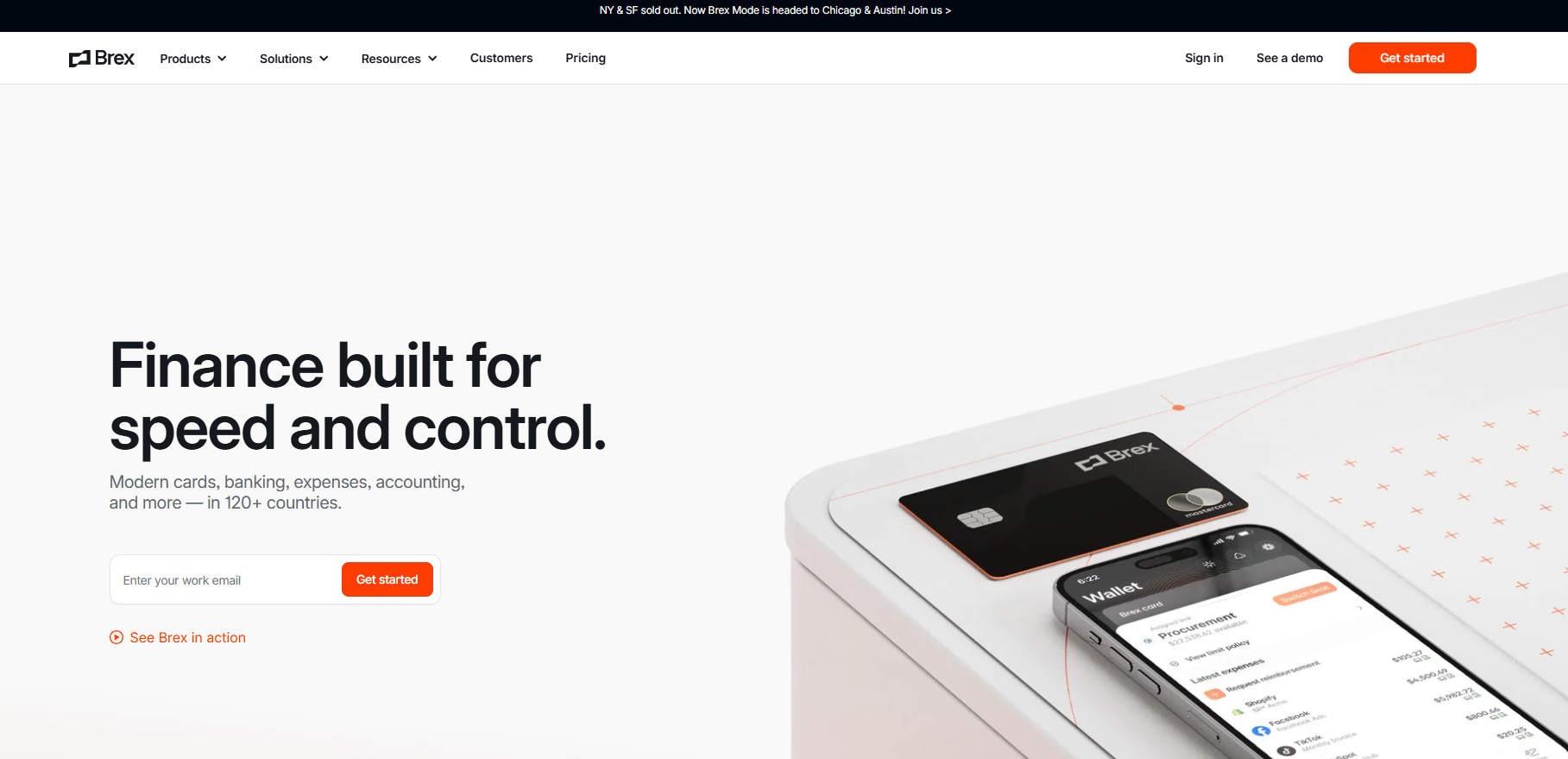
Brex is a hybrid financial platform combining a Mastercard corporate charge card with expense management, business banking, travel, and bill pay. It is the most direct Ramp competitor and one of the best Ramp alternatives for funded companies with global operations, having been acquired by Capital One for $5.15 billion in a deal completed on 7 April 2026.
How Brex Works
Companies apply with a US EIN and connect their bank accounts, and Brex sets a credit limit from cash balance, revenue, and funding history rather than credit history. Finance teams then issue employee cards and virtual purchasing cards instantly, with no cap on how many virtual cards each user can hold. Administrators apply merchant locks, category rules, and approval chains, and Brex offers auto-enforced spend controls that block out of policy spend before the transaction occurs rather than flagging it afterward.
Brex Costs & Fees
-
Essentials: $0/user/month
-
Premium: $12/user/month
-
Enterprise: custom pricing
-
Smart Card: custom pricing
-
No annual card fees and no foreign transaction fees, though an FX rate markup of up to 3% may apply
-
Rewards up to 7x on rideshare, 4x on Brex Travel, 3x on restaurants, 2x on recurring software
Brex Spending Limits and Funding
Brex markets credit limits 10 to 20 times higher than traditional corporate cards, with daily or monthly repayment terms. Eligibility thresholds are published: funded startups need a $50,000 minimum cash balance, commercial businesses more than $500,000 in annual revenue, and mid-market companies more than $400,000 per month. Brex offers customizable spend limits designed for effectively infinite use cases, with multiple spend limits assignable to a single card rather than a new card number per limit.
Brex Key Advantages
-
Brex offers a free plan with no annual fees for users
-
Cards accepted in 210+ countries and territories, with local currency cards in 50+ countries
-
Tiered points reaching 7x, plus airline miles transfer partners
-
Brex provides 24/7 live support for travel-related inquiries
-
Business banking, treasury, and bill pay in one platform
-
Brex supports businesses through every stage of growth, from seed to enterprise
-
May report payment history to credit reporting agencies
Brex Specific Drawbacks
-
Higher eligibility bar than Ramp, and sole proprietors do not qualify
-
Requires a verifiable US physical address, which has excluded some international customers
-
Reviewers report account closures when revenue falls below thresholds
-
Mobile wallet support covers the Mastercard product but not the Visa Commercial Card
-
Trustpilot score of 1.8/5 across around 576 reviews
Who Brex Is Best For
Brex is best for Series B and later companies with global operations, significant travel spend, and the revenue to clear its thresholds. It is generally not a fit for small businesses with limited cash flow.
Why Someone Would Choose Brex Over Ramp
Someone might choose Brex over Ramp for stronger global operations, local currency cards in 50+ countries, and tiered rewards that beat flat cash back on travel-heavy spend. The trade-off is a materially higher bar to get approved.
3. BILL Spend & Expense
BILL Spend & Expense, formerly Divvy, pairs free expense management software with the BILL Divvy corporate charge card and an attached credit line. It is one of the strongest Ramp alternatives for businesses that want a genuinely free spend management platform with access to credit rather than a balance-based card.
How BILL Spend & Expense Works
Businesses apply for a credit line, then admins set proactive budgets by department or project and issue cards against them. When an employee spends, funds deduct instantly from that specific budget and the transaction data flows to accounting in real time. The system automatically declines charges that exceed a cardholder's budget or violate spending rules, so overspending is blocked rather than reported.
BILL Spend & Expense Costs & Fees
-
BILL Spend & Expense software: free
-
BILL Divvy Corporate Card: no annual fee
-
Unlimited virtual cards at no extra cost
-
No foreign transaction fees
-
BILL Accounts Payable & Receivable: $49–$89/user/month separately
-
Rewards up to 7x restaurants, 5x hotels, 2x recurring software on the first $5,000 monthly
BILL Spend & Expense Spending Limits and Funding
Credit lines range from $1,000 to $5 million, set from business revenue, cash flow, and bank balances, with variable, fixed, and secured options. It is a charge card with no revolving APR, and businesses choose weekly, semi-monthly, or monthly billing cycles. Rewards multipliers scale with payment frequency, and roughly 30% of the credit line must run through the card monthly to unlock rewards at all.
BILL Spend & Expense Key Advantages
-
Expense management software is completely free
-
Credit line from $1,000 to $5 million with no personal guarantee
-
Instant card issuance and unlimited free virtual cards
-
Enforceable budgets that decline out of policy spend automatically
-
Direct QuickBooks integration and broad accounting software support
-
Reports activity to the Small Business Financial Exchange
BILL Spend & Expense Specific Drawbacks
-
Rewards rules are complex, with a 30% monthly utilisation requirement and a 12-month points holding period
-
AP automation is a separate paid product rather than included
-
US-focused, with limited value for internationally distributed teams
-
Rewards multipliers capped at the first $5,000 of monthly category spend
Who BILL Spend & Expense Is Best For
BILL Spend & Expense is best for established US businesses with consistent spending and cash flow that want free expense management plus a real credit line, particularly those already using BILL for accounts payable.
Why Someone Would Choose BILL Spend & Expense Over Ramp
Someone might choose BILL over Ramp for access to a credit line of up to $5 million rather than a limit pegged to a bank balance, and for a fully free software tier without an upgrade path gating core controls. Both are US-centric, so this is a like-for-like swap rather than a fix for eligibility problems.
4. Rho
Rho is an integrated financial operations platform combining business checking, corporate cards, expense management, AP automation, and treasury, all at zero platform cost. Among Ramp alternatives it is the closest thing to Ramp's value proposition with banking built in and no per-seat pricing at any scale.
How Rho Works
Companies open a Rho account, and deposits sit with Webster Bank, N.A. and a network of 400+ FDIC-insured banks, which is how Rho offers up to $75 million in FDIC coverage per entity rather than the standard $250,000. Teams then issue physical, virtual, vendor-locked, or single-use cards, set policy rules, and run bill pay with OCR invoice capture, approval routing, and instant vendor payment. Everything syncs to the accounting system.
Rho Costs & Fees
-
Platform: $0
-
Per-user fees: none
-
Per-card fees: none
-
ACH, wire, and check payments: $0
-
Foreign currency transfers: 1%
-
Corporate card cashback: reported between 1.25% and 2% depending on source, so worth confirming your rate directly
Rho Spending Limits and Funding
Rho has no minimum balance and no monthly minimums, with unlimited users. Card limits derive from account funds and underwriting, with real-time spend controls, policy enforcement, and automated receipt capture. Treasury tools put idle cash to work while keeping funds accessible.
Rho Key Advantages
-
No platform, per-seat, or per-card fees at any company size
-
Cashback that can exceed Ramp's reported variable 0 to 1.5% range
-
Up to $75 million in FDIC coverage per entity
-
Integrated banking and treasury that Ramp does not natively provide
-
Free AP automation with zero transaction fees on ACH, wire, and check
-
Accounting integrations across QuickBooks Online, NetSuite, Xero, Sage Intacct, and Microsoft Dynamics 365
-
24/7 customer support and a G2 rating of 4.8
Rho Specific Drawbacks
-
US entities only, with no support for foreign-owned structures
-
1% FX fee makes it less economical for heavy international payment volume
-
Published cashback figures vary between sources
-
Smaller review base than Ramp or Brex
-
Not built for consumer or individual use
Who Rho Is Best For
Rho is best for venture-backed and growth-stage US startups that want banking, cards, and accounts payable in one place without paying per-seat SaaS fees as headcount grows.
Why Someone Would Choose Rho Over Ramp
Someone might choose Rho over Ramp to avoid Ramp's $15/user/month Plus tier and platform fee entirely, and to get integrated business banking and treasury that Ramp does not offer natively.
5. Airbase by Paylocity
Airbase is a spend management platform combining bill pay and accounts payable automation, expense management, corporate cards, and procurement. Paylocity acquired it for $325 million in October 2024, and it is now sold as part of the Paylocity suite rather than as a fully independent product.
How Airbase by Paylocity Works
Airbase runs a guided procure-to-pay workflow: purchase requests route through approval chains, POs are matched against invoices, and automated invoice processing extracts line items and codes them before payment. Corporate cards and employee reimbursements sit in the same approval framework, and everything syncs to the ERP system. Post-acquisition, the pitch is unified visibility across payroll and non-payroll spend on one platform.
Airbase by Paylocity Costs & Fees
-
No public pricing; quoted through Paylocity
-
Previously structured as Standard, Premium, and Enterprise tiers priced by company size and module selection
-
Reported annual contracts historically ranged from roughly $42,000 to $230,000+
-
Paylocity per-employee-per-month rates are reported between $15.81 and $50 depending on modules and negotiation
Airbase by Paylocity Spending Limits and Funding
Card limits and approval thresholds are configured per policy, with pre-approval enforced before spend occurs rather than reviewed afterward. Multi-entity structures are supported, with ERP sync to systems including NetSuite.
Airbase by Paylocity Key Advantages
-
Airbase positions its accounts payable automation as more capable than Ramp's, with three-way PO matching and deeper procurement workflows
-
Airbase offers a direct email for customer support inquiries rather than portal-only ticketing
-
Genuine multi entity support with consolidated reporting
-
Unified payroll and non-payroll spend visibility through Paylocity
-
Built for the 100 to 5,000 employee mid-market segment
Airbase by Paylocity Specific Drawbacks
-
No published pricing, and evaluation requires a sales conversation
-
Now a component of a larger HCM suite rather than a standalone product
-
Reported implementation timelines of five to six months for mid-market deployments
-
Heavy for smaller teams
-
Cashback rates are undisclosed, making direct cost comparison difficult
Who Airbase by Paylocity Is Best For
Airbase is best for mid-market finance teams that want expense, AP, cards, and procurement consolidated in one suite, especially companies already running Paylocity payroll.
Why Someone Would Choose Airbase Over Ramp
Someone might choose Airbase over Ramp for stronger procurement and three-way PO matching, real multi entity capabilities, and the ability to see payroll and spend in a single system. The trade-offs are opaque pricing and a much longer implementation.
6. Spendesk
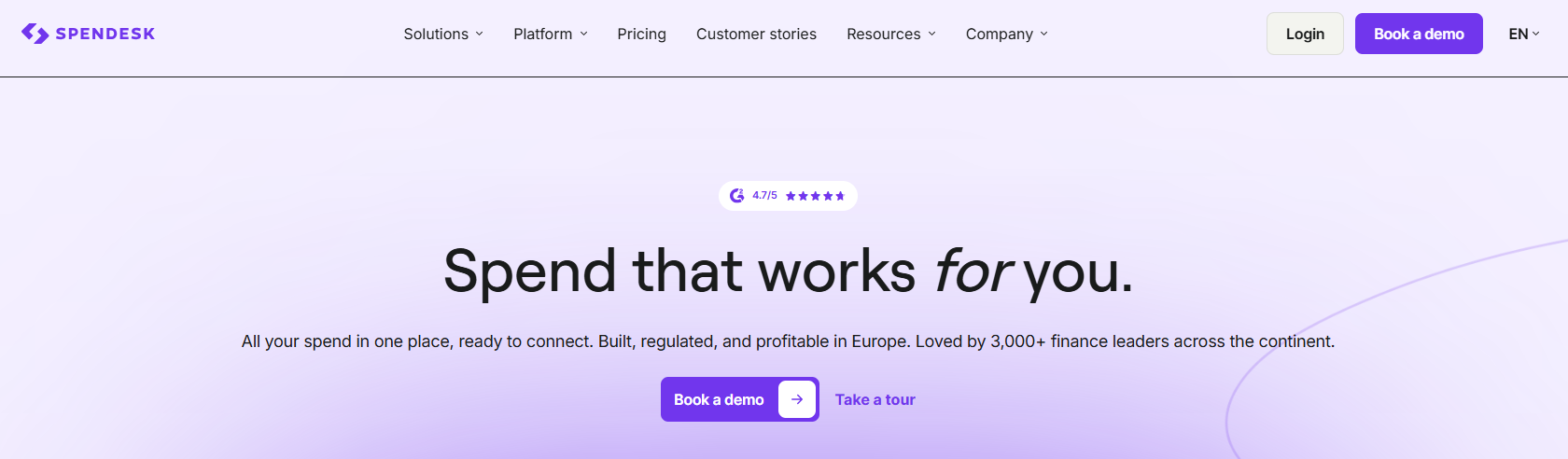
Spendesk is a European procure-to-pay platform combining procurement, corporate cards, accounts payable, and expense management. Spendesk processes over €20 billion annually for 200,000+ business users, and it was the first European platform to fully integrate procurement and spend management.
How Spendesk Works
Employees raise purchase requests that route through approval workflows before any money moves. Approved spend happens on virtual or physical Spendesk cards, and AI handles receipt validation, invoice processing, and spend allocation. Supplier management tracks contracts and renewals, and everything exports to accounting platforms including Xero, Sage, Datev, Cegid, and NetSuite.
Spendesk Costs & Fees
-
Quote-based; no per-user prices published
-
Reported average annual contract around $7,600, with deals up to roughly $24,000
-
Starter tier limits users to 7, with 1 approver
-
Starter tier caps at 100 transactions per month
-
Higher tiers unlock full procurement and multi-entity features
Spendesk Spending Limits and Funding
Budgets and approval thresholds are set per team and per policy, with virtual cards issued against approved requests. Spending controls are pre-approval rather than retrospective, and the platform is designed for businesses up to 1,000 employees.
Spendesk Key Advantages
-
Best-in-class procurement plus spend management integration for European mid-market
-
Comprehensive supplier management with contract renewal tracking
-
Strong invoice processing with AI receipt validation
-
Consistently positive customer support reviews
-
Apple Pay and Google Pay support
-
Spendesk states customers reduce costs by around 5% annually
Spendesk Specific Drawbacks
-
Pricing is quote-based with no transparency until you speak to sales
-
Hard cap of 100 transactions per month on Starter is unusual and forces early upgrades
-
Reach outside Europe is thin
-
Some users report imperfect invoice recognition and manual edits for partial reimbursements
-
Not suitable for sole entrepreneurs
Who Spendesk Is Best For
Spendesk is best for European companies between roughly 30 and 1,000 employees that need procurement and spend control in one system rather than cards with reporting bolted on.
Why Someone Would Choose Spendesk Over Ramp
Someone might choose Spendesk over Ramp because Ramp requires US-centric operations and a US bank balance, while Spendesk is built for European entities from the ground up, with procurement depth Ramp's intake module does not match.
7. Payhawk
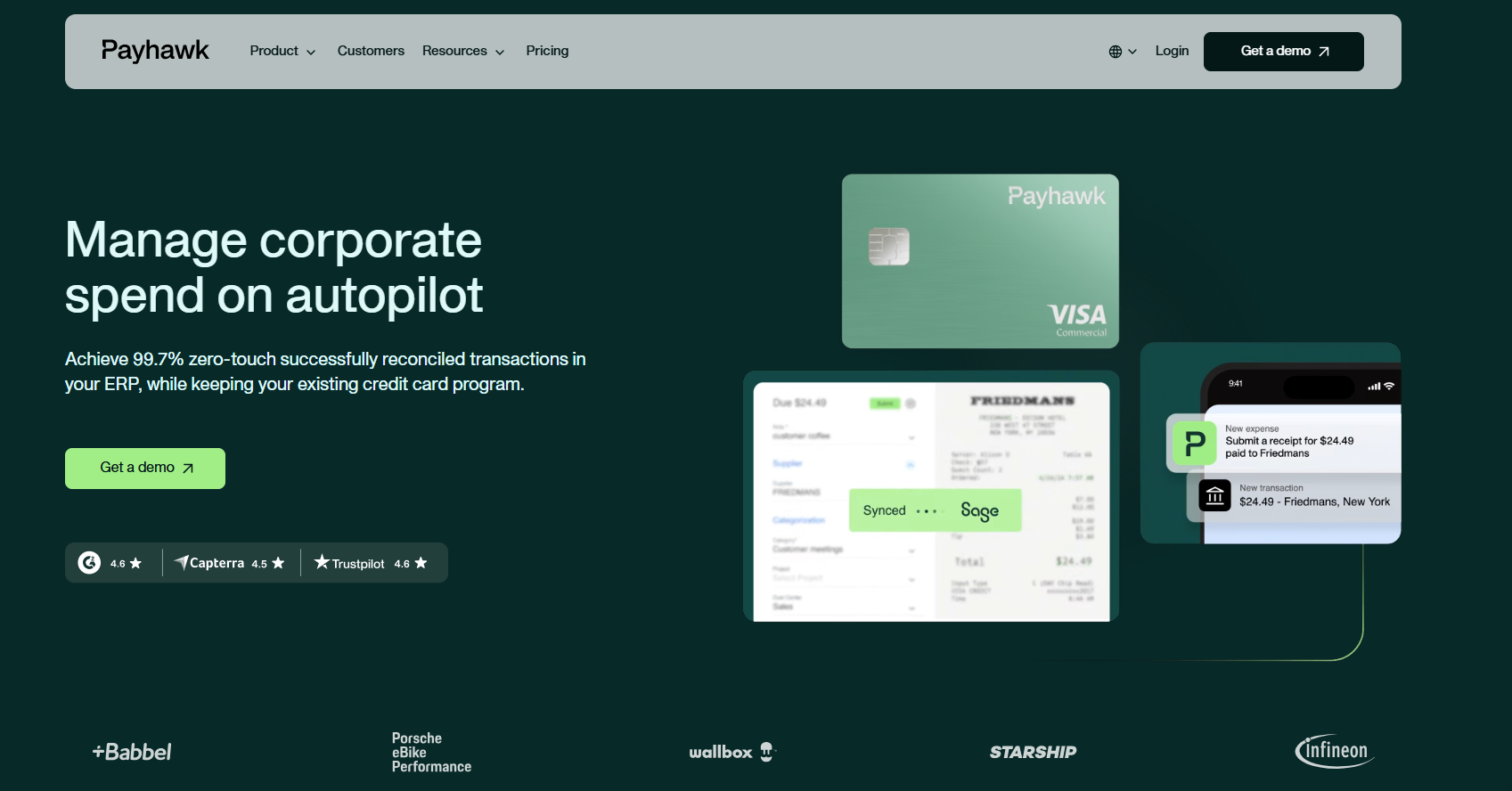
Payhawk is a B2B spend management platform headquartered in London that combines corporate cards, expense management, invoice automation, and accounts payable workflows in one system. It serves mid-market to enterprise companies across Europe and beyond, and it is one of the better Ramp alternatives for multi-entity European finance teams.
How Payhawk Works
Payhawk issues Visa corporate cards against company funds, with policy rules and approval workflows applied per entity. Invoice automation extracts and codes invoices, and expense capture runs through the mobile app with OCR. The platform's positioning centres on reconciliation: Payhawk states it reconciles 99.7% of expenses with zero manual effort, and markets what it calls lightning-fast, multilingual customer support, a claim supported by a G2 quality-of-support score of 9.2 across more than 600 responses. Payhawk has also added AI agents, including one that retrieves missing receipts directly from supplier portals.
Payhawk Costs & Fees
-
Quote-based across five plans; entry pricing is "contact us"
-
Separate Travel module
-
No published per-user rates
-
Card and FX fees vary by region and plan
Payhawk Spending Limits and Funding
Card limits are set per employee, per team, and per entity, funded from company balances with customizable spend limits and approval workflows. Multi-entity support is a core strength, with consolidated reporting across subsidiaries and local entities.
Payhawk Key Advantages
-
Strong multi entity capabilities for companies operating several legal entities
-
Reported reconciliation rate of 99.7% with minimal manual data entry
-
G2 score of 4.6 from more than 850 reviews, with a support score of 9.2
-
Centralizes cards, invoices, and payments in one place
-
Automation and tracking features consistently praised by reviewers
-
Built for European and UK entities that Ramp does not serve well
Payhawk Specific Drawbacks
-
No published pricing at all
-
Card currency coverage is narrower than Airwallex or Brex, reported at around six currencies
-
No integrated travel booking on the core product
-
Credit limits and banking features are more limited compared with US-based competitors
-
At least one reviewer reports a mid-contract price increase of 22%
Who Payhawk Is Best For
Payhawk is best for European and UK mid-market companies running multiple entities that need cards, invoice automation, and accounts payable in a single platform with responsive multilingual support.
Why Someone Would Choose Payhawk Over Ramp
Someone might choose Payhawk over Ramp for genuine multi-entity architecture, European entity support, and human multilingual support rather than the slow responses Ramp reviewers report.
8. Tipalti
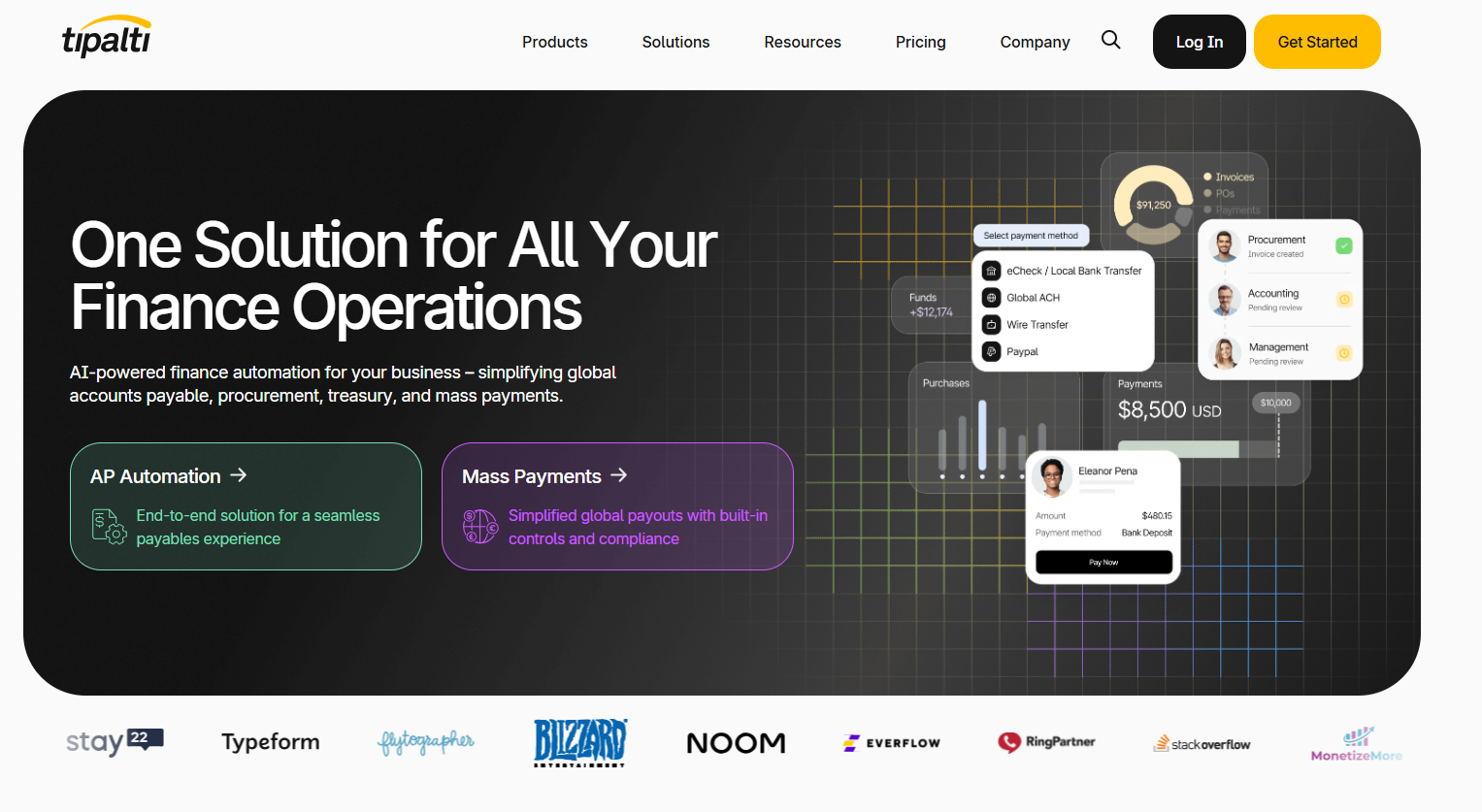
Tipalti is a global accounts payable automation and mass payments platform. Tipalti automates AP processes for businesses in 200+ countries and offers multi-entity support, covering the full cycle from supplier onboarding and tax form collection through invoice processing, payment, and reconciliation - along with virtual cards for corporate use.
How Tipalti Works
Suppliers self-onboard through a branded portal, submitting W-9 or W-8 tax details and choosing their preferred payment method and currency. TIN validation and compliance screening run in the background, cutting manual work at year-end when 1099 and 1042-S filings are due. Invoice processing uses AI to extract line items, suggest coding, and route documents through two-way and three-way PO matching before approval and payment.
Tipalti Costs & Fees
-
Select plan: core AP automation from $99/month with unlimited users
-
No per-user or per-approver fees; pricing is based on transaction volume and enabled features
-
Higher tiers adding global payments, W-8 handling, and multi-entity support are quoted by sales
-
Reported Advanced platform fees of $299 to $599/month for multi-entity organisations
-
Transaction fees apply on top, with reported figures around $0.40 per domestic ACH and $26 per international SWIFT wire
-
No free trial
Tipalti Spending Limits and Funding
Tipalti is an AP platform rather than a card-first product, so limits are approval thresholds and payment controls rather than card spend caps. Payments run via ACH, wire, check, local bank transfer, virtual card, PayPal, and the Tipalti Card, reaching 200+ countries in more than 120 currencies.
Tipalti Key Advantages
-
Deepest accounts payable automation of any option on this list
-
Genuine multi entity support with consolidated global AP
-
Supplier tax compliance including W-8, W-9, 1099, and 1042-S, on a KPMG-approved tax engine
-
VAT auto-coding, self-billing, and two- and three-way PO matching
-
No per-user fees, so approvers cost nothing to add
-
Integrations with QuickBooks, Oracle NetSuite, Sage Intacct, and Microsoft Dynamics
Tipalti Specific Drawbacks
-
Not a corporate card platform; expense management is thin by comparison
-
Total cost of ownership is driven by transaction and FX fees rather than the subscription
-
Reviewers report configuration difficulty matching specific workflow needs
-
Enterprise deployments can exceed $100,000 annually
-
No free tier or trial
Who Tipalti Is Best For
Tipalti is best for companies with complex global supply chains, decentralised multi-entity structures, or high-volume creator and supplier payouts across borders.
Why Someone Would Choose Tipalti Over Ramp
Someone might choose Tipalti over Ramp because Ramp's bill pay is a module inside a card platform, while Tipalti is purpose-built AP automation with supplier tax compliance and payment rails into 200+ countries that Ramp does not attempt to match.
9. Navan
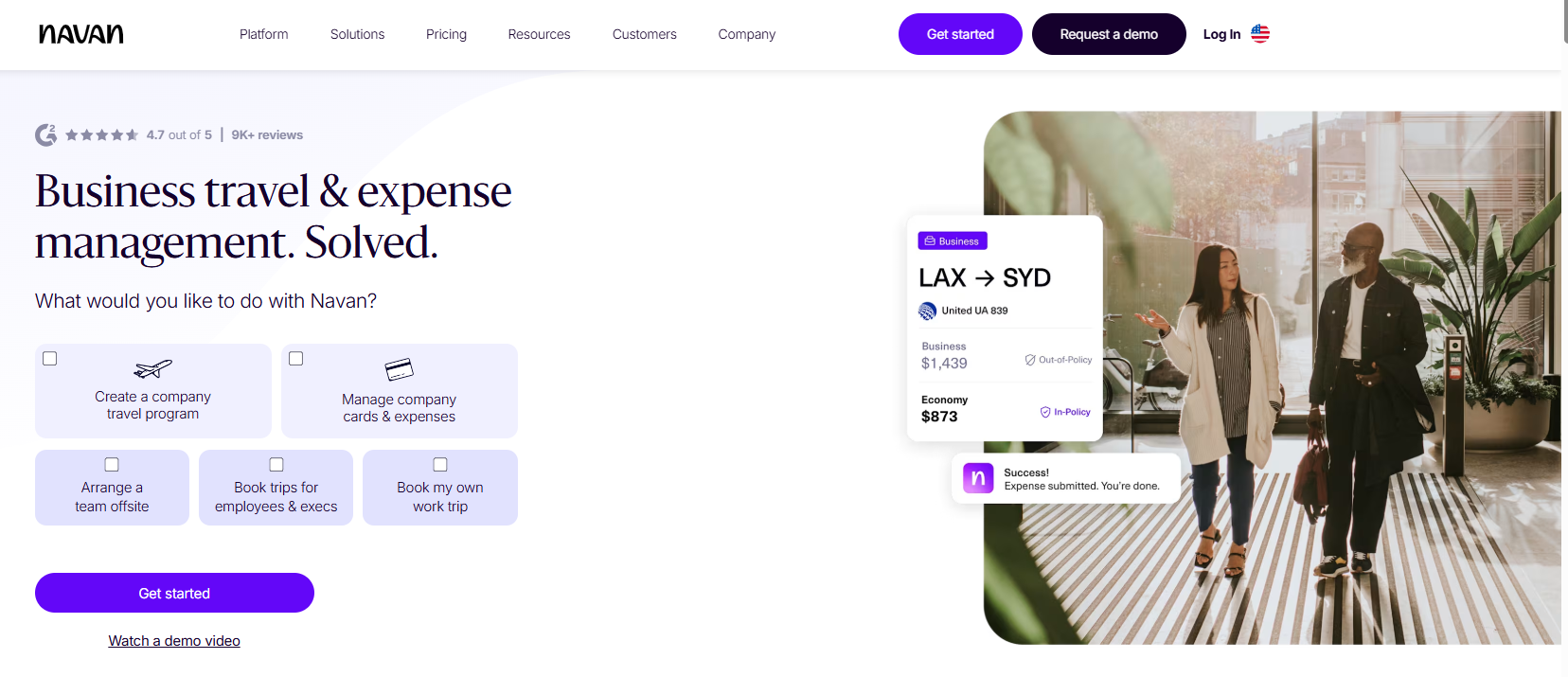
Navan, formerly TripActions, combines corporate travel booking with expense management and corporate cards. It is one of the most cost-effective Ramp alternatives for travel-heavy companies because travel booking is free and funded by supplier commissions.
How Navan Works
Employees book flights, hotels, trains, and rental cars inside Navan against policy rules set by finance, and out of policy bookings route for approval automatically. Card transactions and receipts flow into the expense module, and the platform reconciles travel spend against budgets in real time. Duty-of-care integrations cover traveller safety.
Navan Costs & Fees
-
Navan Business: free for companies up to around 200 employees
-
Travel booking: free, with Navan earning supplier commissions
-
Expense management: free for the first 5 users, then $15/user/month
-
Navan Enterprise: custom pricing
-
Reported median contract around $15,000/year; enterprise deployments around 500 users reported at $85,000 to $105,000 annually
-
Add-ons such as International Air and Rail and Passport and Visa management priced as flat-fee modules
Navan Spending Limits and Funding
Spend controls run through travel policy configuration and card limits, with unlimited policy and approval workflows even on the free tier. Department budgets track live so overspending surfaces before month-end.
Navan Key Advantages
-
Genuinely free travel booking with global inventory and exclusive rates
-
Free tier covers small and mid-sized companies entirely
-
24/7 human support for travellers, admins, and finance teams
-
Reported 75% average reduction in expense reporting time
-
G2 rating of 4.5 to 4.7 across a base of more than 10,000 companies
-
ERP integrations across NetSuite, Xero, Sage Intacct, and QuickBooks
Navan Specific Drawbacks
-
The $15/user expense fee only makes sense if you use the travel side
-
Reviewers report unresponsive support, platform bugs, and a difficult cancellation process
-
Pricing sometimes higher than booking direct once taxes are included
-
Some API features require special enablement, with undisclosed access fees
-
Weaker as a pure expense platform than Ramp, Brex, or Rho
Who Navan Is Best For
Navan is best for mid-market companies with significant travel volume that want travel, expense, and cards in one platform rather than stitching a travel tool onto a spend platform.
Why Someone Would Choose Navan Over Ramp
Someone might choose Navan over Ramp for integrated travel booking, which Ramp offers but not as its centre of gravity, and for a free tier that covers travel management outright. For teams needing expense management without travel, Ramp and Rho are cheaper.
10. Expensify
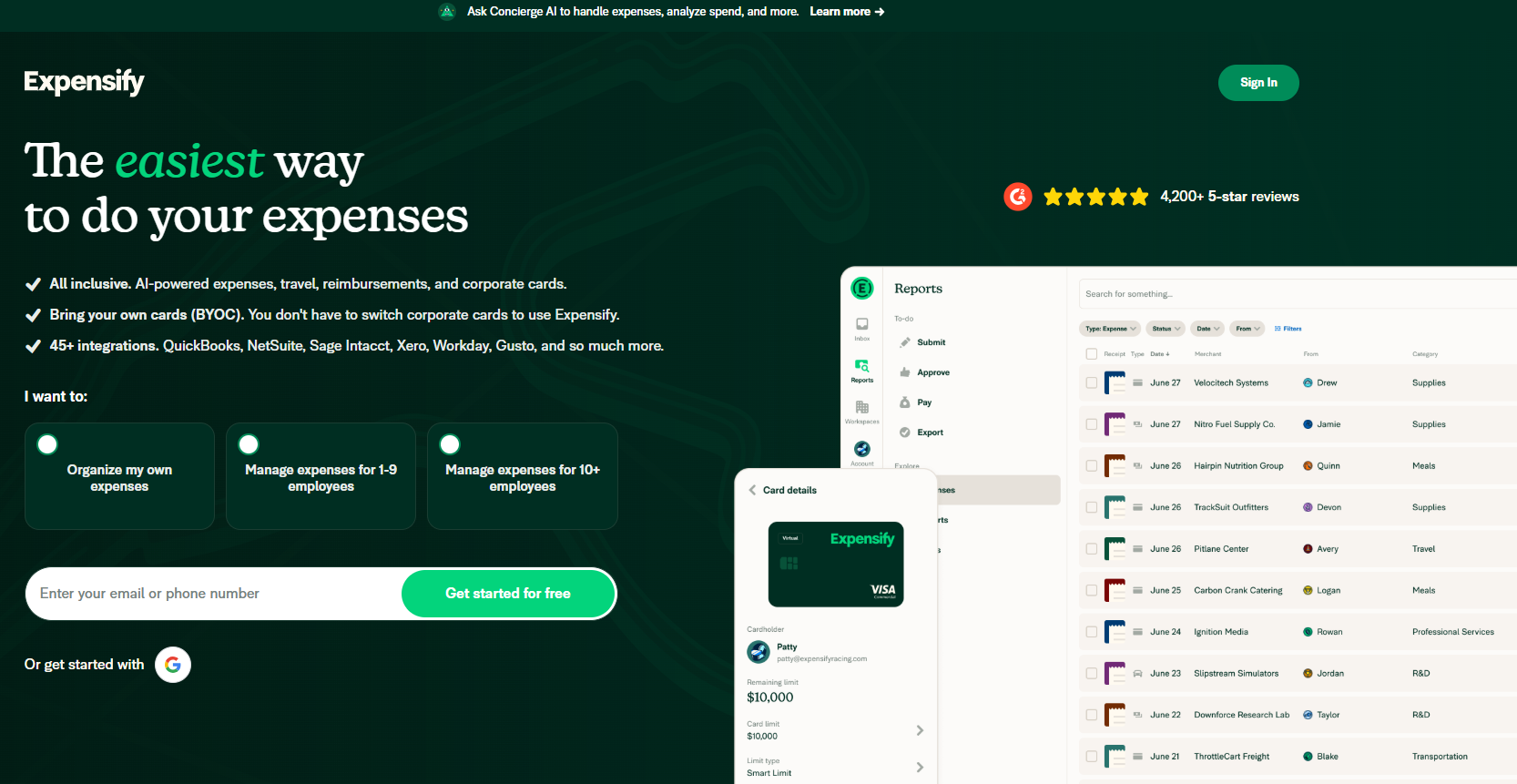
Expensify is an expense management platform with SmartScan OCR receipt capture, a direct reimbursement engine, and the option to keep your existing corporate cards. It is one of the few Ramp alternatives that scales down to a single user and publishes its pricing openly.
How Expensify Works
Users photograph receipts and SmartScan reads the data and builds the expense claim automatically. Expensify's BYOC feature connects the corporate cards you already use, so you keep your existing rewards while still getting automatic transaction coding, receipt matching, and reconciliation. Approvals route by policy, and reimbursements pay out directly by ACH.
Expensify Costs & Fees
-
Collect: from around $5 per member per month on the annual plan
-
Control: from around $9 per member per month, requiring a 12-month commitment plus routing at least 50% of US card spend through the Expensify Card
-
Keep your existing cards and Control roughly doubles to about $18 per active user
-
Free tier available for basic use
-
Enterprise deployments of 250 to 2,500 users reported at $30,000 to $200,000 annually
Expensify Spending Limits and Funding
The Expensify Card carries spend limits and controls, but many customers use Expensify purely as a software layer over existing corporate cards, in which case limits stay with the original issuer. Policy rules enforce category and amount thresholds at submission rather than at the point of sale.
Expensify Key Advantages
-
Published, transparent list pricing, which is unusual in this category
-
Scales from a single user upward, unlike most competitors
-
BYOC lets you keep existing corporate cards and rewards
-
Self-serve setup in 15 to 30 minutes with no sales call
-
QuickBooks, Xero, and NetSuite integrations plus a direct reimbursement engine
-
Global availability without US-entity requirements
Expensify Specific Drawbacks
-
The $9 Control rate is conditional on card spend routing, and doubles without it
-
Per-active-user pricing gets expensive at scale, and inactive users still cost money on Collect
-
Thinner AP automation and procurement than Airbase, Tipalti, or Spendesk
-
Enforcement is reactive at submission rather than blocking spend at point of sale
-
Reviewers report chat-only support bots struggling with accounting sync bugs
Who Expensify Is Best For
Expensify is best for small to mid-market teams that want expense management without changing their existing corporate cards, and for companies too small to interest enterprise vendors.
Why Someone Would Choose Expensify Over Ramp
Someone might choose Expensify over Ramp because it works with the cards you already have, publishes its pricing, has no cash balance requirement, and serves companies of any size, including the sole proprietors Ramp excludes entirely.
11. SAP Concur
SAP Concur is the enterprise incumbent in travel and expense, with deep ERP integration and a global compliance footprint. Among Ramp alternatives it is the option chosen for scale and audit rigour rather than speed or price.
How SAP Concur Works
Concur ingests card feeds, receipts, and travel bookings, applies policy rules by role, geography, and cost centre, and routes expense reports through configurable approval workflows. Virtual cards can be issued through partners including American Express. AI audits transactions at scale, and reporting is built for controllers who need a defensible audit trail across dozens of entities and currencies.
SAP Concur Costs & Fees
-
Custom quote only
-
Reported typical range of roughly $8 to $25 per user per month
-
G2 lists an average price of around $9 per expense report
-
Transaction fees apply on top in many contracts
-
Implementation and professional services priced separately
-
Multi-year terms produce meaningful discounting
SAP Concur Spending Limits and Funding
Concur is a software layer rather than a card issuer, so limits sit with whichever corporate card programme feeds it. Policy enforcement happens at expense submission and approval rather than at the point of sale.
SAP Concur Key Advantages
-
Deepest ERP integration of any option here, particularly with SAP and Oracle
-
Global tax compliance and multi-currency support at enterprise scale
-
Mature multi entity capabilities and audit trail
-
Extensive professional services and implementation support
-
Handles complex approval workflows other platforms cannot model
-
G2 rating of 4.0 from 6,940 reviews, the largest sample on this list
SAP Concur Specific Drawbacks
-
Reviewers consistently describe it as complex and slow
-
No published pricing and no free tier
-
Controls are retrospective rather than blocking out of policy spend before it happens
-
Poor fit for non finance users without training
-
Long implementation cycles, and reviewers report the interface changing little over years
Who SAP Concur Is Best For
SAP Concur is best for large enterprises with SAP or Oracle ERP systems, thousands of employees, and compliance requirements that outweigh user experience concerns.
Why Someone Would Choose SAP Concur Over Ramp
Someone might choose Concur over Ramp for enterprise-grade ERP integration, global tax compliance, and multi-entity depth at a scale where Ramp's spend management workflows may require extra configuration to keep up.
12. Airwallex
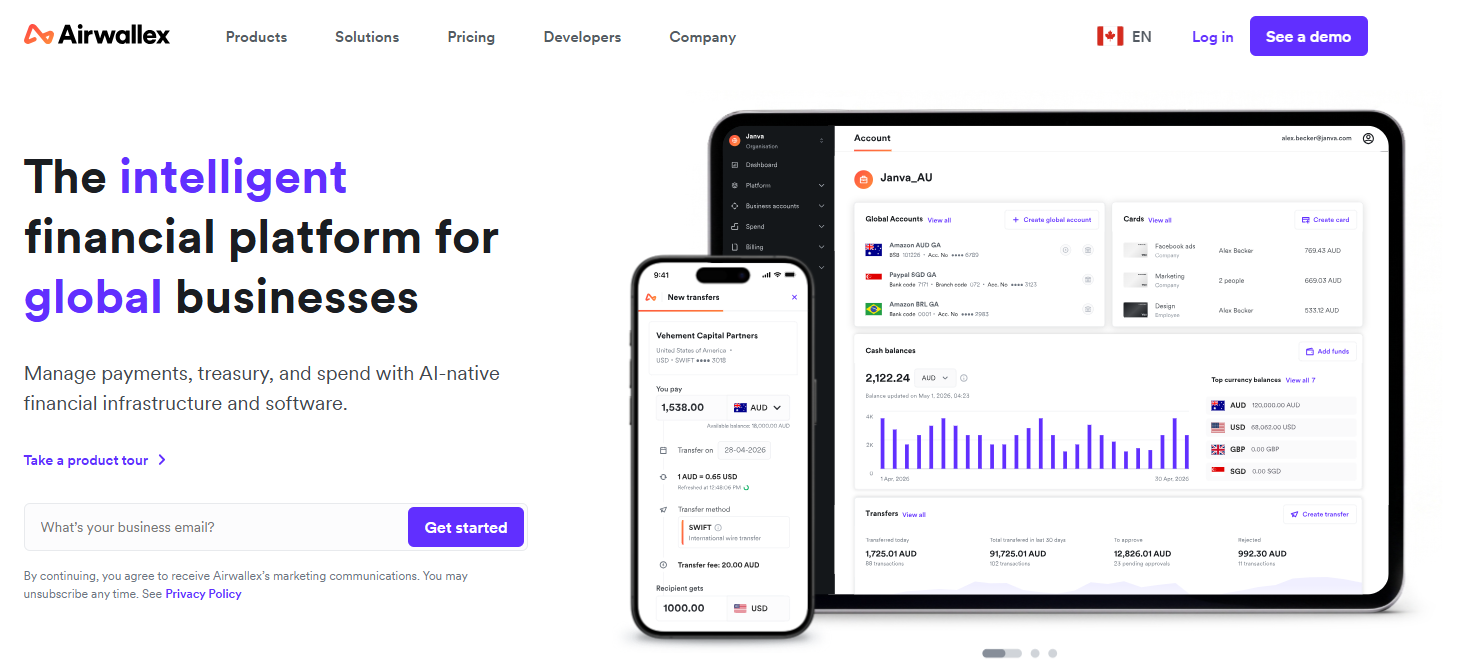
Airwallex is a global financial platform offering multi-currency business accounts, low-markup FX, corporate cards, expense management, and payment acceptance from one dashboard. Founded in Melbourne in 2015 and now headquartered in Singapore, it serves more than 100,000 businesses and is among the strongest Ramp alternatives for cross-border operations.
How Airwallex Works
Businesses open Global Accounts with local bank details in 20+ currencies, then issue virtual or physical Visa corporate cards to teams and departments. Cards can be linked to specific currency wallets to avoid unnecessary FX conversion, and settle from the matching balance where available. Spend limits and approval workflows apply per card, and bill pay handles international supplier payments.
Airwallex Costs & Fees
-
Explore: free in the US unconditionally; UK, EU, and Australian Explore plans require minimum monthly deposits or balances
-
Explore includes 10 free cards, then around £5 per additional card user per month
-
Grow and Accelerate: 5 free spend users, then around £12 per additional spend user per month
-
FX markup: 0.5% on major currencies, 1.0% on others
-
No international transaction fees on cards
-
Free local transfers to 120+ countries
Airwallex Spending Limits and Funding
Card limits are configured per card and per wallet, funded from multi-currency account balances rather than a credit line. Unlimited virtual and physical cards are available subject to plan, with instant issuance, freeze and cancel, and Apple Pay and Google Pay support.
Airwallex Key Advantages
-
FX markup of 0.5% versus 1.5% to 4% at traditional banks
-
Multi-currency accounts in 20+ currencies with local bank details
-
Genuinely global, without the US-entity requirement Ramp imposes
-
Corporate cards, expense management, and payment acceptance in one platform
-
Yield on idle balances in some regions
-
Free local transfers across 120+ countries
Airwallex Specific Drawbacks
-
Free Explore access outside the US is conditional on deposit or balance thresholds
-
SWIFT fees apply on non-local transfers
-
Named account managers are officially reserved for the highest tier
-
Reviewers report account terminations with balances held for extended periods
-
Not an accounting platform, and pairs with rather than replaces your accounting system
Who Airwallex Is Best For
Airwallex is best for businesses that move money across borders regularly and need multi-currency accounts, low FX, and corporate cards in one place, including companies with no US entity at all.
Why Someone Would Choose Airwallex Over Ramp
Someone might choose Airwallex over Ramp because Ramp requires most operations and spending in the US, while Airwallex is built for cross-border businesses. The FX economics alone justify the switch for companies converting meaningful volume.
13. Mercury

Mercury is a business banking platform popular with startups and ecommerce operators, combining business accounts, debit and IO charge cards, bill pay, and treasury tools. It is one of the more practical Ramp alternatives for founders who want banking and cards from the same provider.
How Mercury Works
Businesses open a Mercury account, typically with an application of around ten minutes, then create physical or virtual cards from the dashboard, nicknaming cards per vendor and assigning team permissions. The Mercury IO Corporate Card is available to account holders with roughly $25,000 in cash and pays 1.5% cash back. Bill pay, wire transfers, and automation tools run alongside, with QuickBooks, Xero, Stripe, and PayPal integrations.
Mercury Costs & Fees
-
Mercury: $0/month core tier
-
Mercury Plus: $35/month, or $29.90/month billed annually
-
Mercury Pro: $350/month, or $299/month billed annually
-
Debit and IO credit cards, receipt policies, reminders, and user permissions are free
-
Expense reimbursement beyond 5 active users: $5 per active user per month
-
Non-USD wires: 1% FX; non-USD card purchases: up to 3% international transaction fees
-
Mercury Treasury requires balances over $250,000
Mercury Spending Limits and Funding
Debit card spending draws on account balances, while the IO charge card is underwritten separately against cash held. Per-card limits, vendor assignment, and team permissions are configurable, and treasury tools put idle balances to work. There is no minimum account balance and no overdraft fees.
Mercury Key Advantages
-
Genuinely free core banking, with cards and permissions included at no cost
-
Easy creation of multiple virtual cards with good permission controls
-
1.5% cash back on the IO card at a $25,000 threshold
-
Free domestic wires, ACH, and checks
-
Fast onboarding compared with legacy banks
-
Trustpilot score of 3.9 from around 3,000 reviews, the strongest of the US banking options here
Mercury Specific Drawbacks
-
Non-USD card purchases carry up to 3%, materially worse than Brex or Ramp
-
Primarily for businesses, not individual users
-
Eligibility varies by company type and geography, and international founders report friction
-
Reviewers report rejections without explanation and occasional sudden closures
-
Expense management is lighter than Ramp, Brex, or Airbase
Who Mercury Is Best For
Mercury is best for ecommerce operators, agencies, and US-linked startups that want modern business banking with virtual cards attached rather than a dedicated spend management platform.
Why Someone Would Choose Mercury Over Ramp
Someone might choose Mercury over Ramp to get a real business bank account and cards from one provider, and because the IO card's $25,000 threshold buys 1.5% cash back without needing to hold that balance at a separate institution purely to qualify.
14. Volopay
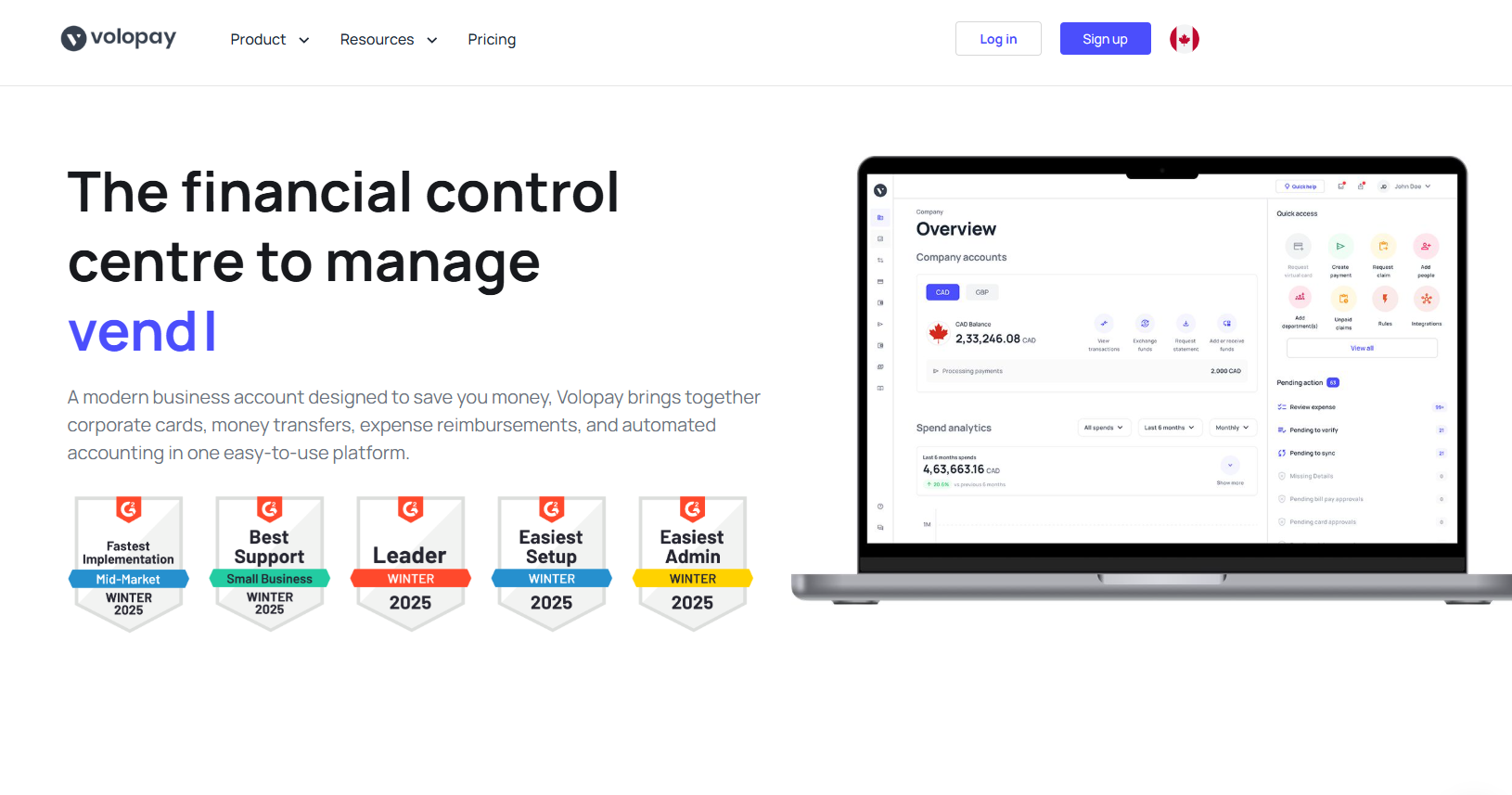
Volopay is a spend management platform combining corporate cards, automated expense management, bill payments, reimbursements, and accounting automation, with a business account underneath. Headquartered in Singapore, it is the strongest APAC-focused option among these Ramp competitors.
How Volopay Works
Volopay generates instant virtual cards for SaaS subscriptions, vendor payments, and online spending, with merchant controls and multi-level approval workflows. Bill payment automates invoice capture, approval, and scheduling across multiple currencies, and bulk vendor payouts run domestically and internationally from one dashboard. Expenses record automatically against company cards and sync to accounting.
Volopay Costs & Fees
-
No published pricing; the pricing page lists features but not numbers
-
Understanding cost requires booking a demo call first
-
Third-party estimates place comparable tiers in the $5 to $15 per user per month range, with enterprise scaling higher
-
FX rates not published
-
Free trial available
Volopay Spending Limits and Funding
Cards carry customizable limits with merchant controls and automatic expense categorisation. Funding runs through the Volopay business account, with a credit line available in some markets. Limit increase requests are handled in-platform, which reviewers describe as smoother than dealing with a bank.
Volopay Key Advantages
-
Corporate cards, bill pay, reimbursements, and accounting automation in one stack
-
Strong APAC coverage where Ramp has none
-
Multi-currency bill payments for international vendors
-
Multi-level approval workflows that are genuinely configurable
-
Well-regarded mobile and web apps
-
Accounting integrations that reduce manual data entry
Volopay Specific Drawbacks
-
Publishes no pricing, FX rates, or plan detail at all
-
Reviewers report virtual cards not accepted at all Australian stores
-
Some fields still require manual entry, including receipt upload and GL coding
-
An interface update drew complaints about broken search and chat functions
-
Ranks around #18 in the expense management category by mindshare
Who Volopay Is Best For
Volopay is best for APAC-based teams, particularly in Singapore, Australia, and India, that need corporate cards and accounts payable in one platform and cannot use US-only providers.
Why Someone Would Choose Volopay Over Ramp
Someone might choose Volopay over Ramp simply because Ramp does not serve their region. For an APAC company, Ramp's US operations requirement is disqualifying, and Volopay covers similar ground locally.
15. Center
Center is a real-time expense management platform built around the Center Card on Mastercard, with expense automation, travel booking, and ERP integrations. It targets finance and accounting teams that want expenses captured as they happen rather than reconstructed at month-end.
How Center Works
The Center Card captures spend in real time and pushes it straight into the expense workflow, eliminating most of the expense report cycle. Dynamic workflows route approvals by policy, and ERP integrations sync coded transactions to the accounting system. Deployment is described as low-lift and customised to each business.
Center Costs & Fees
-
No published pricing
-
Quoted per deployment
-
Corporate card programme included with the platform
-
Travel booking available as part of the suite
Center Spending Limits and Funding
Card limits and policy rules are configured per employee and per policy. Some customers operate on a prepaid setup, funding the card programme in advance, with reviewers noting they would prefer direct loading from a bank account inside Center.
Center Key Advantages
-
Real-time expense capture that removes most manual expense reporting
-
Combined corporate card, expense automation, and travel in one platform
-
ERP integrations with dynamic approval workflows
-
Responsive implementation and customer success teams per reviewers
-
Customised deployment rather than a rigid template
-
Real-time visibility into all employee spend
Center Specific Drawbacks
-
No public pricing at all
-
Reviewers report limited reporting options
-
Manual setup requirements during implementation
-
Some users report the system running slow at times
-
Prepaid funding model is restrictive for some teams
-
Much smaller footprint than Ramp, Brex, or Concur
Who Center Is Best For
Center is best for US mid-market finance teams that prioritise real-time expense capture and a guided implementation over self-serve setup and published pricing.
Why Someone Would Choose Center Over Ramp
Someone might choose Center over Ramp for a hands-on, customised deployment with a dedicated implementation team, rather than Ramp's self-serve onboarding.
16. Revolut Business
Revolut Business is a multi-currency business account with virtual and physical debit cards, expense controls, and accounting integrations. It is one of the better-known Ramp alternatives for teams that need multi-currency spending with card controls attached.
How Revolut Business Works
Businesses open an account, hold and exchange 30+ currencies at the interbank rate during market hours, and issue virtual cards instantly, up to 50 per team member on US plans. Built-in expense management covers spending controls, real-time transaction notifications, and instant freeze and unfreeze. Accounting integrations include Xero, with more than 20 integrations overall and API access.
Revolut Business Costs & Fees
-
US: Basic $0/month, Grow $30/month, Scale $119/month, Enterprise custom
-
UK Basic from £10/month
-
Basic includes 5 free local transfers and $1,000 in fee-free currency exchange monthly
-
Grow includes 100 free local transfers, 5 free international payments, and $10,000 in interbank FX
-
Scale includes 1,000 free local transfers, 25 free international payments, and $80,000 in fee-free exchange
-
FX fees of 0.6% to 1% beyond plan allowances, plus 1% outside market hours
-
2% foreign ATM fee across all plans, regardless of tier
Revolut Business Spending Limits and Funding
Cards operate on a balance model, so spending is limited to account funds rather than a credit line. Per-card and per-team spend limits, merchant blocking, and approval controls are configurable, with up to 3 physical and 50 virtual cards per team member depending on plan.
Revolut Business Key Advantages
-
Free Basic tier with no commitment
-
Multi-currency accounts and interbank FX within plan allowances
-
Virtual cards available on every tier, including free
-
Genuine expense controls, spend limits, and real-time notifications
-
Bulk payments, crypto, and API access on higher tiers
-
Physical and virtual cards for every employee without separate software
Revolut Business Specific Drawbacks
-
Only available to businesses incorporated in the UK, EEA, or US
-
FX allowances run out quickly for real international volume
-
2% ATM fee does not improve with plan tier
-
Reviewers report account restrictions, limited traditional banking features, and support issues
-
Not a US credit product, so no credit building or charge card float
Who Revolut Business Is Best For
Revolut Business is best for digital-first companies in the UK, EEA, or US managing spending across multiple currencies that want card controls without buying separate expense software.
Why Someone Would Choose Revolut Business Over Ramp
Someone might choose Revolut Business over Ramp for multi-currency accounts and interbank FX that Ramp does not offer natively, and for a free tier with no cash balance requirement. Companies incorporated outside the UK, EEA, and US will need Halocard or Airwallex instead.
17. Wise Business

Wise Business is a multi-currency account with virtual and physical debit cards, known for transparent, low-cost international transfers. It is the most cost-transparent option here and a strong Ramp alternative for businesses whose main problem is cross-border payment cost.
How Wise Business Works
Businesses open an account, hold balances in 40+ currencies with local bank details in several, and issue virtual and physical debit cards for the team. Cards spend in 160+ countries with automatic conversion at the mid-market rate. Transfers convert at the mid-market rate with a visible percentage fee rather than a hidden spread.
Wise Business Costs & Fees
-
No monthly subscription fee
-
One-time account opening fee, €50 in the EEA, varying by region
-
Transfer fees typically 0.33% to 1.0% of the payment amount, varying by currency
-
Physical card issuance from around $9 in the US
-
Virtual cards generally free
-
ATM fees apply after free thresholds
Wise Business Spending Limits and Funding
Wise cards operate on a balance model, so limits depend on available funds. Multiple virtual cards can be held simultaneously, frozen instantly, and assigned per purpose. Funding runs through bank transfers and local rails, with auto-conversion at spend time if the currency balance is empty.
Wise Business Key Advantages
-
No monthly fee and genuinely transparent pricing
-
Mid-market exchange rates with no hidden markup
-
Balances in 40+ currencies and card spending in 160+ countries
-
Multiple virtual cards, free to create
-
Broad international availability with no US-entity requirement
-
Trustpilot score of 4.3/5 from 300,000+ reviews
Wise Business Specific Drawbacks
-
Not a spend management platform: no approval workflows, policy enforcement, or AP automation
-
No credit product, rewards, or cash back
-
Not optimised for US merchant acceptance the way a US-issued card is
-
Some ATM and conversion fees still apply
-
Limited compared with dedicated corporate card platforms on expense controls
Who Wise Business Is Best For
Wise Business is best for freelancers, agencies, and small international businesses whose priority is cheap cross-border payments and simple team cards, not policy enforcement or accounting automation. Its trade-offs against similar providers are covered in Revolut vs Wise vs Halocard.
Why Someone Would Choose Wise Business Over Ramp
Someone might choose Wise over Ramp for transparent international transfer pricing and no monthly fee, with no cash balance requirement and no US operations test. It is a downgrade on spend management and an upgrade on FX cost.
What Users Think About These Ramp Alternatives
Here is what real users say about each platform. Trustpilot skews negative for B2B financial products because satisfied finance teams rarely post, so G2 and Capterra scores are included where the gap is instructive.
Halocard
Halocard holds 4.2/5 (11 reviews) on Trustpilot - a sample far too small to carry weight, and worth saying plainly. Early sentiment focuses on the product solving a specific problem: giving non-US and foreign-owned businesses access to US-issued virtual Visa cards with reliable acceptance on US platforms. Reviewers cite reliable payment processing, per-card controls, privacy, and accessibility from outside the US. The recurring criticism is the monthly subscription model, though several add that the fee is worth the reliability.
Brex
Brex sits at 1.8/5 on Trustpilot across about 576 reviews, among the lowest scores on this list, while retaining customers including Anthropic and Robinhood. Positive reviews praise one-click virtual card issuance, in-app receipt capture, the mobile app, real-time notifications, and rewards. Negative sentiment concentrates on eligibility enforcement: accounts closed for falling below revenue thresholds, funds inaccessible during review, and forfeited reward points. A distinct cluster from international customers describes accounts terminated after Brex began requiring a verifiable US physical address. Brex responds publicly to most negative reviews.
BILL Spend & Expense
The scores here diverge sharply and the reason matters. The parent domain bill.com holds 1.8 on Trustpilot from around 2,000 reviews, but that covers BILL's entire product family, and most complaints concern AP/AR and payment processing rather than the card platform. BILL Spend & Expense specifically holds 4.5 on G2 from 2,072 reviews, predominantly from small businesses. G2 reviewers praise smart categorisation, transaction notifications, and the free software. Criticism centres on rewards being harder to unlock than expected and reimbursement workflows scoring below competitors.
Rho
Rho has no meaningful Trustpilot presence, so G2 is the better read: 4.8 from around 121 reviews, the highest rating on this list from the smallest base. Reviewers highlight the zero-fee model, a notably simple setup, integrated banking and cards, bulk contractor payments, and a dedicated support team. The honest caveat is sample size and track record rather than product quality.
Airbase by Paylocity
Airbase no longer maintains a standalone review profile following the acquisition, and Paylocity's own Trustpilot listing skews negative and is dominated by payroll complaints unrelated to spend management. Historical Airbase feedback praised procurement depth, three-way PO matching, and approval workflows, with support credited for direct email access rather than portal-only ticketing. Current concerns centre on absorption into a larger HCM suite, implementation timelines of five to six months, and pricing that requires a sales process to discover.
Spendesk
Spendesk holds 3.9 on Trustpilot from around 226 reviews and 4.6 on G2 from 408 reviews, one of the more consistent pairs here. Reviewers value the central record, automated reminders, accounting exports, an intuitive interface, and customer support that draws repeat praise. Criticism focuses on imperfect invoice recognition, limited supplier payment options, manual edits for partial reimbursements, the 100-transaction Starter cap, and quote-based pricing that slows evaluation.
Payhawk
Payhawk holds 3.3 on Trustpilot from around 278 reviews and 4.6 on G2 from more than 850 reviews, with a standout G2 quality-of-support score of 9.2. Reviewers repeatedly cite automation and tracking features as time-savers, fast setup, and having expenses, invoices, and card payments centralised. Trustpilot criticism is specific: one reviewer reported a six-hour support queue, and another described a 22% price increase mid-contract. Payhawk has replied to 85% of negative reviews, though sometimes after a month.
Tipalti
Tipalti holds 3.0 on Trustpilot from around 98 reviews and 4.5 on G2 from 397 reviews. The Trustpilot distribution is polarised: roughly 36% five-star against 45% one-star, and Trustpilot itself notes Tipalti has not solicited reviews recently, so the sample may not be representative. G2 reviewers consistently single out the support team during implementation and find the PO module easy to train staff on. The recurring criticism is configuration difficulty matching existing workflows.
Navan
Navan holds 3.6 on Trustpilot from around 443 reviews and 4.5 to 4.7 on G2 across a base of more than 10,000 companies. Free travel booking and a reported 75% reduction in expense reporting time draw consistent praise, along with 24/7 human support for travellers. Negative reviews are specific and recurring: unresponsive support, platform bugs, a difficult cancellation process, and booking prices sometimes exceeding direct rates once taxes are added.
Expensify
Expensify holds 4.0 on Trustpilot from around 1,123 reviews, the strongest Trustpilot showing of any dedicated expense platform here, and says it serves 15 million members. Reviewers praise SmartScan receipt capture as best-in-class, the simplicity of the capture-to-reimbursement workflow, multi-currency support, and adoption among non finance users. Criticism targets pricing rather than product: the conditional Control rate that doubles without card spend routing, paying for inactive users on Collect, and chat-only support bots failing to resolve accounting sync bugs.
SAP Concur
Concur holds 4.0 on G2 from 6,940 reviews, by far the largest sample here, alongside a considerably weaker Trustpilot profile. Enterprise reviewers credit its ERP depth, compliance handling, AI transaction auditing, and ability to model complex approval chains. Trustpilot complaints are blunt: one reviewer who implemented Concur years ago described the interface as essentially unchanged in 2026, and the Audit Service draws repeated criticism for slow receipt processing and delayed payouts.
Airwallex
Airwallex holds 2.8/5 on Trustpilot from 2,582 reviews, against 4.5 on G2 from a much smaller sample. Reviewers consistently cite transparent interbank FX with visible markups as the reason for switching from traditional banking, and named account managers draw unusually warm individual praise. The negatives are serious and recurring: account terminations without stated reason, balances held for 180 days, and slow response times, with the support gap explained partly by named account managers being reserved for higher tiers.
Mercury
Mercury holds 3.9 on Trustpilot from around 3,000 reviews, the strongest score among the US business banking options here. Reviewers praise a sleek interface, absence of hidden fees, free wire transfers, and a roughly ten-minute application. Criticism focuses on rejections without explanation, compliance reviews, international founder eligibility, and occasional payment disruptions. Several reviewers note the FX costs are disclosed but buried in fine print rather than featured on the pricing page.
Volopay
Volopay holds 4.0 on Trustpilot but from only 16 reviews, which is not a usable signal on its own. Positive reviewers, several running Indian subsidiaries, describe an attentive team that ships feedback quickly. Negative reviews are severe: one describes transferring substantial funds and finding the card non-functional with no support response, and another details a buggy update where supplier search, date ranges, and the chat widget all failed.
Center
Center has no meaningful Trustpilot presence, so G2 is the only read available. Reviewers highlight real-time expense tracking, ease of use, and a smooth implementation with a responsive customer team. The recurring limitations are limited reporting options, manual setup requirements, the system running slow at times, and the prepaid funding model, with at least one reviewer asking for direct bank loading inside the platform.
Revolut Business
Revolut holds 4.7/5 on Trustpilot from 470,000+ reviews, but that figure is dominated by the consumer app and should not be read as a verdict on Revolut Business. Business-specific feedback describes it working well for online-first companies handling payments, cards, and multiple currencies, with praise for simple setup, fast transfers, and digital controls. Negative themes are account restrictions and freezes, limited traditional banking features, and support quality. Companies needing branch access or relationship banking consistently rate it poorly.
Wise Business
Wise holds 4.3/5 on Trustpilot from 300,000+ reviews. Reviewers respect the multi-currency balances, transparent fees, international transfers, and easy card tools, and it is widely recommended for cross-border payments and travel. Criticism focuses on occasional compliance checks or account freezes, slower support during complex cases, and the product being balance-funded rather than a credit card with the protections that implies.
Frequently Asked Questions
What Is the Best Ramp Alternative for Small Businesses?
For small US businesses that qualify, BILL Spend & Expense and Rho both offer free platforms with real credit or banking attached. For small businesses that do not meet Ramp's $25,000 cash minimum, are foreign-owned, or operate as sole proprietors, Halocard and Expensify are the practical options, since neither imposes a cash balance test.
Which Ramp Alternative Has the Best Accounts Payable Automation?
Tipalti has the deepest accounts payable automation of any option here, covering supplier onboarding, W-8 and W-9 tax collection, two- and three-way PO matching, and payments to 200+ countries in 120+ currencies. Airbase is the strongest mid-market alternative and positions its AP automation as more capable than Ramp's, with Spendesk close behind for European procure-to-pay.
Which Platforms Offer Genuine Multi Entity Support?
Tipalti, Payhawk, Airbase, and SAP Concur all offer real multi entity capabilities with consolidated reporting across subsidiaries. Ramp supports multi-entity structures on paid tiers, but reviewers note that Ramp's spend management workflows may require extra configuration to scale for complex group structures. Rho also offers multi-entity accounting for US groups.
How Do These Platforms Help You Control Spend?
The strongest platforms block out of policy spend before it happens rather than reporting it afterward. Brex offers auto-enforced spend controls at the transaction level, BILL declines charges that exceed a cardholder's budget automatically, and Halocard applies per-transaction, daily, weekly, and monthly limits per card. Software-only platforms like Concur and Expensify enforce policy at submission and approval instead.
Can These Platforms Replace Expense Report Software?
Most can. Center, Brex, Ramp, Rho, and BILL capture card spend in real time and match receipts automatically, largely eliminating the traditional expense report cycle. Expensify and Concur remain expense-report-centric, which suits organisations that need a formal submission and approval trail. Halocard does not offer receipt matching or expense reporting, so it pairs with your accounting system rather than replacing it.
Which Ramp Alternative Is Best for AP Automation Without Cards?
Tipalti, since it charges no per-user or per-approver fees and prices on transaction volume instead, starting at $99 per month on the Select plan with unlimited users. That structure suits finance teams that need invoice processing and global vendor payments but already have a corporate card programme they intend to keep.
Which Pricing Model Works Out Cheapest?
It depends on the ratio of cards to software seats. Per-user models like Ramp Plus at $15/user/month, Brex Premium at $12/user/month, and Expensify Control at $9 to $18 get expensive as headcount grows. Rho and BILL charge $0 for the platform. Halocard prices by card count rather than per user, so a 30-card business plan costs $29 per month regardless of how many people hold those cards, which is materially cheaper for contractor-heavy teams.
Which Platform Is Best for Cash Flow?
Ramp has described a bill financing product called Ramp Flex, but it is not on Ramp's current product pages, so confirm with Ramp before relying on it. BILL offers a credit line up to $5 million, the most direct cash flow tool among these options. Brex provides float through daily or monthly repayment terms. Halocard, Wise, and Revolut are balance-funded, so they offer control rather than float.
Which Platform Has the Best Invoice Processing?
Tipalti and Airbase lead on invoice processing depth, both offering AI line-item extraction, suggested coding, and multi-way PO matching. Spendesk and Payhawk are strong in Europe. Ramp's invoice capture uses OCR with configurable approval workflows and covers most mid-market needs without the implementation overhead of an enterprise AP platform.
Is Ramp Actually Free?
Ramp's core plan genuinely costs $0 per user per month and includes unlimited physical and virtual cards, bill pay, reimbursements, and QuickBooks Online and Xero integrations. But Ramp's advanced features are not available on its free plan: multi-entity support, advanced approvals, custom user roles, NetSuite and Sage Intacct integrations, and priority support all require upgrading to Plus at $15/user/month plus a platform fee.
Who Is Ramp's Biggest Competitor?
Brex is Ramp's most direct competitor, offering corporate cards, expense management, bill pay, and business banking to a similar customer base. BILL Spend & Expense competes hardest on price, Airbase and Spendesk on procurement depth, and Halocard on eligibility and global card issuance.
What's Better, Brex or Ramp?
Ramp is better for US companies that want flat cash back (NerdWallet's 2026 review reports up to 1.5%), deep expense automation, and a lower $25,000 entry threshold. Brex is better for funded companies with global operations, travel-heavy spend, and higher credit limits. Brex's higher bar to entry is the main trade-off.
Is Ramp Better Than QuickBooks?
They do different jobs. QuickBooks is accounting software that produces your financial statements; Ramp is a spend management platform that issues cards and feeds coded transactions into QuickBooks. Most companies run both, and Ramp's QuickBooks integration is included on the free tier.
Is Ramp Better Than Concur?
For most mid-market companies, yes: Ramp is faster to deploy, cheaper, and easier for non finance users. Concur wins at large enterprise scale where SAP or Oracle ERP integration, global tax compliance, and complex multi-entity approval chains matter more than user experience.
Is Ramp the Fastest Growing Company in Spend Management?
Ramp is among the fastest growing, now serving more than 70,000 businesses and powering over $100 billion in annual purchases, with a recent funding round valuing it at $32 billion. Growth alone does not settle whether it fits your business, though, since its eligibility requirements have not loosened as it has scaled.
Does Halocard Work for Businesses Outside the US?
Halocard requires a US-incorporated entity for business accounts, but explicitly supports foreign ownership, which Ramp and Brex list as limited. Cards can then be issued to employees and contractors across 120+ countries. Individuals can open personal accounts from 120+ countries with no US residency and no SSN required.
Does Halocard Offer Cash Back or Accounting Integrations?
No. Halocard offers neither a rewards programme nor native accounting integrations, and it has no bill pay module. It is a virtual card platform focused on access, card-level control, and custom billing addresses. If cash back and ERP sync are your priorities, Ramp, Rho, or Brex are the better fit, and we would rather say so than pretend otherwise.
How Fast Can Halocard Issue a Card Compared to Ramp?
Halocard verifies business accounts in 24 to 48 hours and issues cards immediately after, with individual accounts verified in under three minutes. Ramp says approval can come in under 48 hours, and Brex reviews applications in 1 to 3 business days. For teams that need to pay for AI tooling or launch a campaign this week, that is often the deciding factor.
How to Get Halocard
If you need a Ramp alternative that does not require $25,000 sitting in a US business bank account, does not exclude foreign-owned entities, and can issue working cards to contractors in 120+ countries within 48 hours, Halocard is the strongest option on this list.
It issues US-issued virtual Visa credit cards with custom billing addresses on every card, supports stablecoin and multi-currency fiat funding, applies per-transaction and monthly spend limits with instant freeze, and uses 3D Secure authentication. Because the account is not underwritten against a linked bank balance, your credit limit cannot be cut overnight because cash reserves dipped, which is the single most common complaint in Ramp's public reviews.
Halocard will not replace an ERP integration or an AP automation suite, and it does not pay cash back. What it does is get working US cards into the hands of people who cannot get them anywhere else, fast, with real spend control attached. For businesses weighing this against similar options, see the best virtual credit card options for small business and our comparisons of Halocard vs US Unlocked and Halocard vs StatesCard. Related reading covers masked card services, the benefits of virtual debit cards for businesses, the benefits of virtual business credit cards for corporate travel, and our guide to the best Privacy.com alternatives.
Step-by-Step
-
Sign up for a Halocard business or personal account online.
-
Complete verification: EIN, incorporation, and UBO documents for business accounts, or a passport or national ID for personal accounts.
-
Add funds using debit/credit card, Apple Pay, Google Pay, bank transfer, stablecoins, or crypto.
-
Create virtual cards, assign spend limits and billing addresses, and start paying.
Sources
-
Trustpilot. Halocard Reviews
-
Ramp. The Best Corporate Credit Card
-
Ramp. Ramp Pricing and Plans
-
Ramp Support. Applying and Signing Up for Ramp (US Based)
-
NerdWallet. Ramp Card: 2026 Review
-
Trustpilot. Ramp Reviews
-
Brex. Brex Pricing Plans
-
Brex. Brex Account Requirements
-
Brex. Brex Card Overview
-
Brex. Virtual Corporate Credit Cards For Business Spending
-
Brex. Redeeming Your Brex Points
-
Trustpilot. Brex Reviews
-
Capital One. Capital One Completes Acquisition of Brex
-
BILL. Corporate Card With Custom Controls & Expense Reporting
-
G2. BILL Spend & Expense Pricing
-
NerdWallet. BILL Divvy Corporate Card Review
-
Nav. BILL Divvy Corporate Card Review
-
Trustpilot. BILL Reviews
-
Rho. Pricing
-
GetApp. Rho Pricing, Features & Reviews
-
G2. Rho vs SAP Concur
-
Paylocity. Paylocity Announces Completion of Acquisition of Airbase Inc.
-
FinTech Futures. Paylocity to Acquire Airbase for $325m
-
Expensify Resource Center. Expensify vs Airbase
-
Trustpilot. Paylocity Reviews
-
Capterra. Spendesk Pricing & Reviews
-
G2. Spendesk Reviews, Pricing & Features
-
Vendr. Spendesk Pricing Benchmarks
-
G2. Payhawk vs Spendesk
-
Trustpilot. Payhawk Reviews
-
Tipalti. Pricing and Plans
-
G2. Payhawk vs Tipalti
-
Vendr. Tipalti Pricing Benchmarks
-
Trustpilot. Tipalti Reviews
-
Vendr. Navan Pricing
-
Dupple. Navan Review 2026: Features, Pricing & Alternatives
-
Ramp. Top 7 Payhawk Alternatives & Competitors
-
Vendor Benchmark. Expensify Pricing in 2026
-
Trustpilot. Expensify Reviews
-
Airwallex. SAP Concur Review 2026: Pricing, Features, Pros & Cons
-
Trustpilot. SAP Concur Reviews
-
CheckThat.ai. Airwallex Pricing 2026: Plans, Costs & Total Fees
-
Statrys. Airwallex Business Account Review 2026
-
Trustpilot. Airwallex Reviews
-
Mercury. Explore Pricing
-
Mercury Support. Mercury Pricing Plans
-
Mercury. Virtual Cards and Venmo Connections
-
Trustpilot. Mercury Reviews
-
Statrys. Volopay Review: Features, Fees & Alternatives 2026
-
Capterra. Volopay Pricing & Reviews
-
Trustpilot. Volopay Reviews
-
Rho. Center vs Ramp
-
Revolut Business. Business Account Pricing
-
Financer. Revolut Business Review 2026: Pricing and Features
-
Statrys. Revolut Business Account Review 2026
-
Trustpilot. Revolut Reviews
-
iBanFirst. Wise Business vs Revolut Business: 2026 Comparison
-
Wise. Virtual Card
-
Wise. Wise Card Fees
-
Trustpilot. Wise Reviews
Sourced on July 30, 2026.
*Please see Halocard's Terms of Service or Pricing for the most up to date pricing and fee information. This publication is provided for general information purposes and does not constitute legal, tax or other professional advice from Halocard LLC or its subsidiaries and its affiliates, and it is not intended as a substitute for obtaining advice from a financial advisor or any other professional. We make no representations, warranties or guarantees, whether expressed or implied, that the content in the publication is accurate, complete or up to date.
Halocard Virtual Cards


Instant approval
Create your first card in under 5 minutes.

Private purchases
Purchases never appear on your bank account.

Powered by Visa
Accepted at 175M+ merchants globally.
3 steps to create your virtual credit card

1. Sign up
Create your account from a web browser. No need to download an app.

2. Verify
Verify you're a real person in 3 minutes, from the US or any of 120+ countries.

3. Fund
Add funds by debit/credit card, Apple Pay, Google Pay, bank transfer, stablecoins, or crypto.

Pay with Halocard
Pay online and in-person wherever Visa is accepted. You can also order a physical Halocard if you prefer.