Ramp vs Brex vs Halocard: Corporate Cards Compared (2026)

Edward Taylor

Between Ramp, Brex and Halocard, Halocard is the best choice for startups, agencies and global teams that need working cards without a qualifying cash balance: it's a US-issued Visa credit card for customers in the US and 120+ countries, funded by debit/credit card, Apple Pay, Google Pay, bank transfer, stablecoins, or crypto. Ramp is the better pick for US companies with at least $25,000 in a US business bank account that want free expense management software and cash back. Brex is the better pick for later-stage, venture-backed companies with global operations and significant travel spend.
Ramp and Brex are financial platforms providing corporate cards and spend management software to US-incorporated businesses, both underwriting on business financials rather than personal credit. Halocard is a virtual card platform built for operational online spending, subscriptions, AI tooling, and advertising payments, with no minimum cash balance, no revenue requirement, and support for foreign-owned US entities. All three avoid personal guarantees and personal credit checks, but they serve very different companies: Ramp and Brex screen on cash balance and annual revenue, while Halocard screens on identity and entity verification alone.
What Is Halocard?
Halocard is a virtual card platform that issues US-issued virtual Visa credit cards. It is built for foreign-owned US entities, distributed teams, remote contractors, media buyers, developers, and fast-moving startups that need working cards immediately rather than after weeks of underwriting.
Business accounts are verified with an EIN, incorporation documents, and UBO paperwork, with the first card typically issued within 24 to 48 hours. There is no minimum balance, no cash reserve requirement, and no personal credit check. Cards carry per-transaction, daily, weekly, and monthly spending limits, custom billing addresses, instant freeze and cancel, real-time transaction alerts, and 3D-Secure support. Cards can be added to Apple Pay and Google Pay for in-person purchases at over 175 million merchants worldwide.
Accounts fund via debit/credit card, Apple Pay, Google Pay, bank transfer, stablecoins, or crypto, with bank transfers in USD, CAD, EUR or GBP. Halocard supports cardholders in the US and 120+ countries, without requiring US residency or an SSN for individual users outside the US, and personal plans run from 3 to 60 cards while business plans scale from 30 to 500 cards across up to 50 company users. Halocard LLC is US-incorporated, with card issuance provided by Third National, a Non-Bank Principal Member of the Visa Network. Similar comparisons are available for Halocard vs RedotPay, Halocard vs US Unlocked, and Buvei.
What Is Ramp?
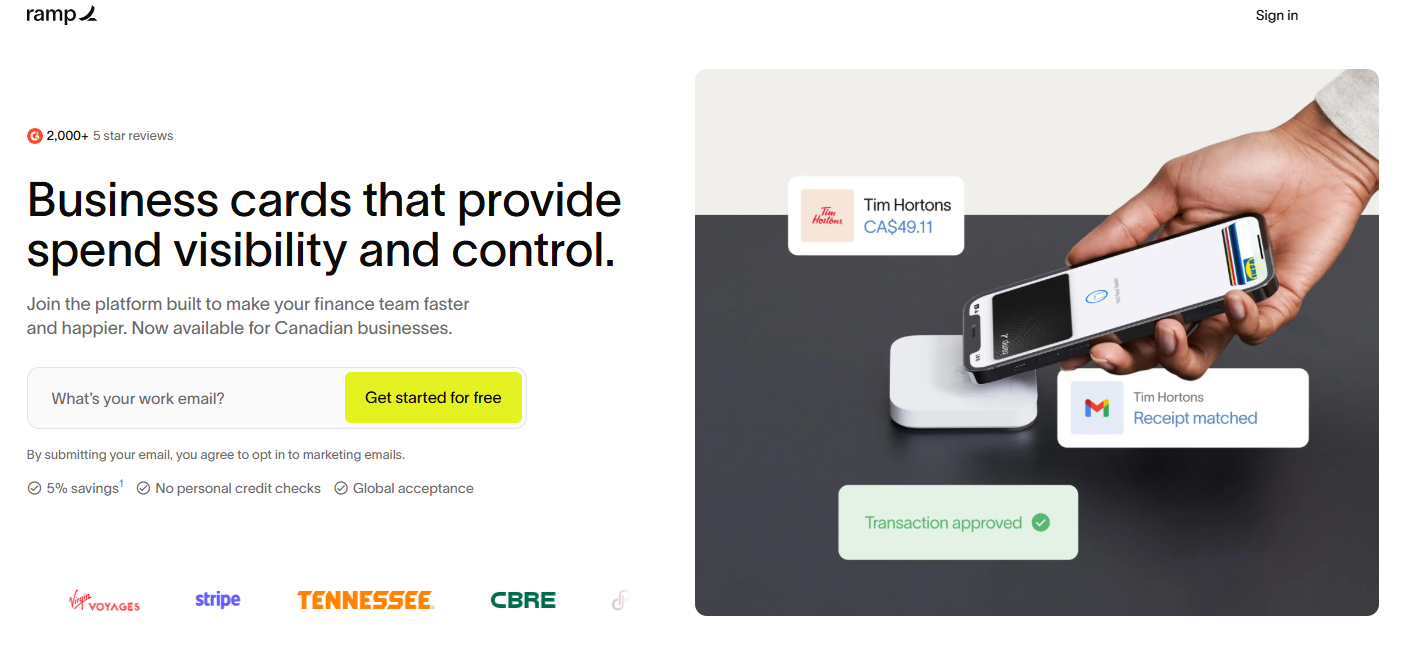
Ramp is a corporate card and finance automation platform combining a Visa corporate charge card with expense management software, bill pay, reimbursements, procurement, travel, treasury, and accounting automation. Founded in 2019, Ramp says more than 70,000 finance teams now use the platform.
The Ramp corporate card is a charge card, meaning the full balance is debited from a linked business bank account each cycle. Credit limits are set as a percentage of cash in linked bank accounts, or through revenue-based underwriting, and adjust dynamically as that balance moves.
Ramp requires at least $25,000 in cash in a US business bank account, a US physical address, and most operations and corporate spend in the US. Ramp accepts corporations, LLCs, limited partnerships, and nonprofits as applicants; sole proprietors and unregistered businesses do not qualify. There is no minimum annual revenue or time-in-business requirement, no personal guarantee, and no personal credit check.
Ramp's free tier includes unlimited physical and virtual cards, card issuing controls, merchant and category restrictions, automatic receipt matching, bill pay, reimbursements, travel booking, and QuickBooks Online and Xero integrations. Cash back rewards run up to 1.5% according to NerdWallet's 2026 review, though Ramp's own pages state no rate and the rate is variable and set per customer, so businesses do not learn their rate until after approval.
What Is Brex?
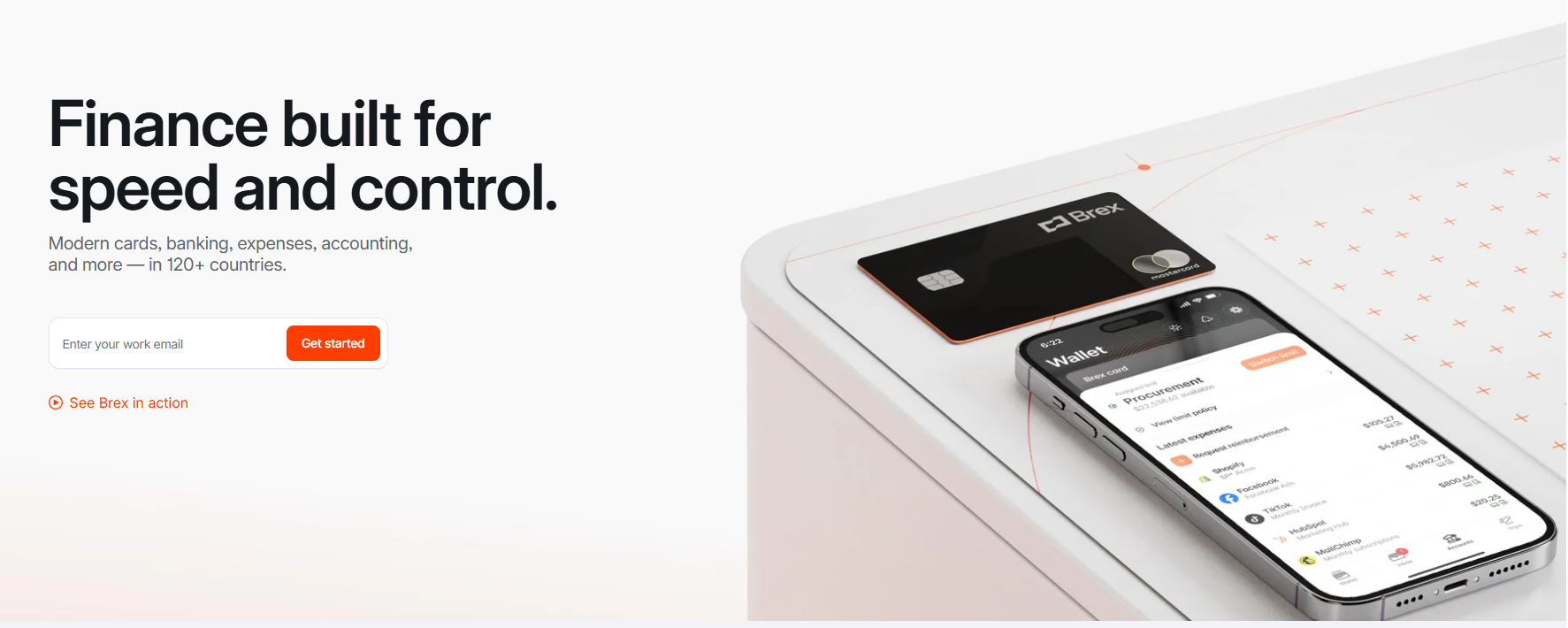
Brex is a hybrid financial platform tailored for global teams, combining a Mastercard corporate charge card with expense management, business banking, bill pay, travel, and accounting automation. Brex says more than 35,000 companies run their finances on the platform, including ServiceTitan, Anthropic, Robinhood, Five Guys, and Sonos.
The Brex card is a charge card requiring full payment when the statement comes due, with either daily or monthly repayment terms. Brex credit limits are set from cash balance, revenue, and funding history rather than credit history, and Brex markets limits 10 to 20 times higher than traditional business credit cards. Every Brex applicant needs a US EIN, valid US incorporation, US operations, and a US physical address.
Beyond that, published thresholds differ by company type: funded startups need a $50,000 minimum cash balance for monthly payments; commercial businesses need more than $500,000 in annual revenue; mid-market companies and enterprises need more than $400,000 per month in revenue, roughly $4.8 million annually. Brex may approve nonprofits on a case-by-case basis, requesting board and governance documentation plus 501(c)(3) designation. Sole proprietors do not qualify.
Brex offers a tiered points system rather than flat cash back: up to 7x points on rideshare, 4x on flights and prepaid hotels booked through Brex Travel, 3x on restaurants, 2x on recurring software subscriptions, and 1x on everything else, with the top tiers requiring exclusive Brex use. Points redeem for travel, statement credits, gift cards, airline miles, billboards, offsites, and company swag. There are no annual fees and no foreign transaction fees, though Brex may apply an FX rate markup of up to 3%, and its Platform Agreement says it may report payment history to credit reporting agencies. Brex also offers virtual purchasing cards designed for recurring software and operational spend, with no limit on how many each user can hold.
Brex After the Capital One Acquisition
Capital One announced its acquisition of Brex on January 22, 2026 in a deal valued at $5.15 billion, split roughly evenly between cash and stock, and completed the transaction on April 7, 2026. Brex LLC is now a wholly owned subsidiary of Capital One, N.A., with co-founder Pedro Franceschi remaining CEO. The purchase price sat well below Brex's $12.3 billion peak valuation from 2021.
Brex's pricing and product offerings remain unchanged for now, and day-to-day operations have continued as before. Integration into Capital One's systems is expected to be gradual, and the practical open question for anyone evaluating Brex on a multi-year horizon is whether eligibility and pricing tighten under a bank's risk models over time. That is a reasonable thing to weigh, not a reason to avoid the platform: being underwritten against an OCC-regulated bank balance sheet is a genuine stability gain compared with a standalone fintech.
Ramp vs Brex vs Halocard Comparison at a Glance
The table below compares all three platforms across eligibility, card structure, spending controls, expense management tools, rewards, and support.
| Feature | Halocard | Ramp | Brex |
|---|---|---|---|
| Product Category | Virtual card platform | Corporate card + spend management | Corporate card + spend management + business banking |
| Card Type | US-issued virtual Visa credit cards | Visa corporate charge card | Mastercard corporate charge card |
| US Entity Required | Yes | Yes | Yes |
| Foreign Ownership OK | Yes | Limited | Limited |
| Minimum Cash Balance | None | $25,000 in a US business bank account | $50,000 for funded startups |
| Revenue Requirement | None | None | $500k+/year commercial; $400k/month mid-market |
| Eligible Entities | US-incorporated entities | Corporations, LLCs, limited partnerships, nonprofits | US-incorporated with EIN; nonprofits case-by-case |
| Sole Proprietors Eligible | No | No | No |
| Personal Guarantee | No | No | No |
| Personal Credit Check | No | No | No |
| Time to First Card | 24–48 hours | Ramp says approval can come in under 48 hours | Application review in 1 to 3 business days |
| Credit Limits | Balance-based; deposit what you spend | % of linked bank cash, adjusts dynamically | Cash and revenue based; 10–20x traditional cards |
| Cards Per Account | 3–60 personal, 30–500 business | Unlimited | Unlimited |
| Spending Limits | Per-transaction, daily, weekly, monthly per card | Merchant, category, and per-limit controls | Per-card, category, and merchant controls |
| Custom Billing Address | Yes, US or anywhere | No | No |
| Stablecoin Account Funding | Yes (USDC/USDT) | No | No |
| Apple Pay & Google Pay | Yes | Yes | Mastercard yes; Visa Commercial Card not supported |
| Cash Back Rewards | No | Per NerdWallet, up to 1.5%, variable by customer | No cash back |
| Points | No | No | Up to 7x rideshare, 4x travel, 3x restaurants, 2x software |
| Bill Pay | No | Yes | Yes |
| Bill Pay Financing | No | Not on Ramp's current product pages (Ramp Flex appeared in a 2025 Ramp blog post) | No equivalent product; daily or monthly repayment terms |
| Automated Receipt Matching | No | Yes | Yes |
| Accounting Integrations | No | QuickBooks Online, Xero, NetSuite, Sage Intacct, Workday | QuickBooks Online, NetSuite, Xero, Sage Intacct |
| Business Banking / Treasury | Virtual USD account | Ramp Checking and Investment Account | Brex business account, Treasury, Vault |
| Local Currency Cards | No | 30+ countries (Enterprise) | 50+ countries |
| Foreign Transaction Fees | 1.5% + $0.30 FX on non-USD purchases | Conversion margin up to 3% in its card terms; marketed as $0 | No foreign transaction fee; FX markup up to 3% |
| Cardholder Reach | US and 120+ countries | Primarily US operations | Global cards accepted in 210+ countries |
| Customer Support | Chat with real humans, phone, email | 24/7 chat and phone on every plan | 24/7 chat and phone |
| Trustpilot Score | 4.2/5 (11 reviews) | 2.3/5 (~214 reviews) | ~1.8/5 (~576 reviews) |
Key Differences Between Ramp, Brex, and Halocard
Six differences account for most of the practical gap between these platforms: who can actually get approved, how the card is structured, what the expense management software does, how bill pay and vendor payments work, how each handles global operations, and what you earn back on spend.
Eligibility: Credit Limits, Cash Balance, and Bank Account Requirements
This is the sharpest divide. Ramp accepts businesses with $25,000 in a US business bank account. Brex requires over $500,000 in annual revenue for commercial businesses, or a $50,000 cash balance for funded startups. Both set credit limits based on what they can see in your linked accounts, which means limits move with your cash flow, and both require a US physical address rather than a virtual office.
Halocard has no minimum balance, no cash reserve requirement, and no revenue threshold: you incorporate a US entity, complete KYB, fund the account with as little as $100, and issue cards. For a bootstrapped startup or a foreign-owned US entity, that difference decides whether you get a corporate card at all.
Card Structure and Card Type
Ramp and Brex are traditional corporate charge cards with software wrapped around them, requiring the full balance to be paid each cycle from a linked business bank account.
Halocard is balance-based: what you deposit is what your team can spend, with no credit limit and no repayment cycle to manage. Neither model is universally better. Charge cards create float and build business credit; balance-based cards remove the risk of a card being declined because a linked bank balance dipped overnight.
Expense Management Tools and Accounting Integrations
Ramp and Brex both offer robust expense management tools that Halocard does not attempt to match: automated receipt matching, AI-driven policy enforcement, approval workflows, custom expense policies, real-time expense management dashboards, and native integrations with major accounting systems including QuickBooks Online, Xero, NetSuite, and Sage Intacct.
Halocard's own comparison materials list accounting integrations as unavailable. If your finance team's core problem is expense reporting and month-end close, Ramp and Brex are built for that and Halocard is not.
Bill Pay, Bill Pay Financing, and Vendor Payments
Both Ramp and Brex support vendor payments and invoice approvals through dedicated bill pay products with AI invoice extraction and ERP sync. Ramp Flex, which a 2025 Ramp blog post described as paying your vendor upfront with repayment over 30, 60, or 90 days for a fee, is not on Ramp's current product pages.
Brex has no equivalent per-invoice financing product; its repayment flexibility comes from daily versus monthly payment terms and the option to pay bills by card. Halocard has no bill pay module at all, and vendor payments run through individual cards instead.
Global Operations and Local Currency Cards
Brex is the strongest of the three for genuine multi-currency operations, with cards accepted in 210+ countries and territories and local currency card issuing plus billing in 50+ countries.
Ramp's global capabilities cover cross-border bill payments, global reimbursements, and local currency card issuing in 30+ countries on Enterprise.
Halocard approaches global differently: it issues US-denominated cards to people in the US and 120+ countries, which solves access rather than localisation. If you need a card billed in euros for a Berlin employee, Brex is the answer. If you need a working US card for a contractor in Manila this week, Halocard is.
Rewards: Cash Back Rewards vs Points vs No Rewards
Ramp offers up to 1.5% cash back on purchases with no category restrictions (per NerdWallet; Ramp states no rate itself), though the rate is variable and assigned per customer. Brex runs a tiered points system reaching 7x on rideshare. Halocard offers neither. This is a real cost difference: on $200,000 of annual card spend, the top reported rate returns $3,000. Anyone whose primary goal is maximising rewards on high-volume domestic spend should weigh that seriously. Halocard does not offer cashback.
Ramp vs Brex: How the Two Incumbents Compare
Because Ramp and Brex compete directly for the same customers, most of the "Ramp vs Brex" question comes down to rewards structure, eligibility thresholds, and how global your operations are.
The Ramp Card: Flexible Credit Limits and Cash Back Rewards
Ramp excels in flat-rate cash back and deep expense automation, and is designed for finance teams that want to reduce manual work. It suits pre-seed through Series A startups and small businesses primarily based in the US, and it saves money with automated price intelligence and vendor tracking. Ramp is the lower barrier of the two at $25,000 in the bank, with strong integrations across QuickBooks and Xero on the free tier.
The Brex Credit Card: High Credit Limits and Tiered Points
Brex is ideal for high-growth companies wanting high credit limits, and is recommended for Series B and later companies with global operations and significant travel spend. It is preferred by venture-backed startups requiring international support, offering multi-currency transactions, local currency cards in 50+ countries, and rewards up to 7x. The trade-offs are a higher bar to entry and a rewards program that requires category optimisation to unlock full value.
Brex vs Ramp for Finance Teams and Financial Operations
Both cover the same core ground: corporate cards, expense tracking, bill pay, reimbursements, approvals, and accounting automation. Ramp leans toward proactive AI policy enforcement and predictable flat-rate savings. Brex leans toward global spend, treasury depth, and premium travel rewards. Neither serves companies that fall below their financial thresholds, operate mostly outside the US, or are foreign-owned - and that gap is precisely where Halocard sits.
Why Businesses Choose Halocard
Halocard's appeal rests on five things that hold regardless of company size or funding stage.
No Minimum Balance, No Cash Reserve, No Waiting
Most business virtual card platforms require a US bank account holding $25,000 to $50,000 or more plus weeks of underwriting. Halocard has no minimum balance, no cash reserve requirement, and no lengthy approval process, with the first card typically issued within 24 to 48 hours whether you are a three-person startup or a 200-person agency.
Built for Foreign-Owned US Entities and Distributed Teams
Halocard explicitly supports foreign ownership where Ramp and Brex list it as limited, and issues US-denominated Visa cards to employees and contractors in the US and 120+ countries. Brex's own eligibility now requires a verifiable US physical presence, which has pushed some internationally based customers off the platform.
Card-Level Isolation and Custom Billing Addresses
Every Halocard carries its own spending limits and a nominated billing address in the US or anywhere in the world, which matters for US-only checkouts at SaaS platforms, AI services, and advertising accounts. Neither Ramp nor Brex offers custom billing addresses per card.
Crypto and Fiat Funding Flexibility
Accounts fund with debit/credit card, Apple Pay, Google Pay, bank transfer, stablecoins, or crypto, with no reliance on a linked US business bank account holding a qualifying balance. This matters most for teams whose money does not already sit in a US bank.
Predictable Flat Pricing
Halocard charges a flat monthly subscription with 0% fees on USD purchases, rather than pricing per user with a platform fee layered on top. For a distributed team of contractors who each need one card, per-seat pricing scales badly and flat card-count pricing does not. Halocard's guides on managing SaaS subscriptions with virtual cards and comparisons like Revolut vs Wise vs Halocard go deeper on the operational side.
Ramp vs Brex vs Halocard: Pricing Compared
All three charge no annual card fee. The structural difference is that Ramp and Brex price per user per month while Halocard prices by card count.
| Feature | Halocard | Ramp | Brex |
|---|---|---|---|
| Entry Plan | Essential - $12/month (3 cards) | Free - $0/user/month | Essentials - $0/user/month |
| Mid Tier | Pro - $15/month (12 cards) | Plus - $15/user/month + platform fee | Premium - $12/user/month |
| Higher Tier | Elite - $75/month (60 cards) | Enterprise - custom | Enterprise - custom |
| Business Plans | Core $29, Growth $99, Scale $199, Enterprise $299/month | Priced per user | Priced per user; Smart Card custom |
| Annual Billing Discount | No: $144, $180, $900 yearly (the monthly price x 12) | Save 20% on Plus | Enterprise annual billing |
| Free Option | Essential is free with 3 referrals | Free tier permanently free | Essentials permanently free |
| Cards Included | 3–60 personal, 30–500 business | Unlimited | Unlimited |
| Annual Card Fee | None | None | None |
| Account Funding | Card, Apple Pay, Google Pay, Bank Transfer, Stablecoins & Crypto | N/A (charge card) | N/A (charge card) |
| Purchase Fees | 0% on USD purchases | None | None |
| Foreign Transaction Fees | 1.5% + $0.30 FX on non-USD | Conversion margin up to 3% in its card terms; marketed as $0 | No foreign transaction fee; FX markup up to 3% |
| Bill Pay Fees | N/A | $10 same-day ACH, $15 domestic wire, $20 international SWIFT | Varies by method |
| Cash Back Rewards | No | Per NerdWallet, up to 1.5% | No |
| Points | No | No | Up to 7x |
| Minimum to Qualify | None | $25,000 cash balance | $50,000 cash or $500k+ revenue |
| Credit Check | No | No | No |
| Customer Support | Chat, email, phone | 24/7 chat and phone on every plan | 24/7 chat and phone |
The headline comparison favours Ramp and Brex: both offer a genuinely free tier with unlimited cards, and Ramp's cash back can make the platform net-positive on cost. That is a real advantage and worth naming.
The catch is that neither free tier exists for a company that cannot clear the cash or revenue bar, and per-user pricing climbs quickly for teams where many people need a card but few need software seats. Halocard's flat pricing and referral program, which can cover a plan entirely (Essential is free with 3 referrals), produce the more predictable number for card-heavy, seat-light teams.
Why People Choose Halocard Over Ramp and Brex
For companies that evaluated all three, the decision usually turns on access rather than features.
Approval Without a Qualifying Cash Balance
Ramp requires at least $25,000 in cash; Brex requires $50,000 or $500,000+ in annual revenue. Halocard requires neither. Companies that are pre-revenue, bootstrapped, or simply keep their cash somewhere other than a US business bank account get a working card from Halocard and a declined application from the other two.
Cards for Contractors Anywhere, Not Just US Employees
Halocard issues US-denominated Visa cards to team members in the US and 120+ countries, with each contractor's card capped at whatever monthly limit you set and frozen with one click if they leave. Brex tightened eligibility to require verifiable US physical presence, and Ramp requires most operations and spending to be in the US.
Custom Billing Addresses on Every Card
US-only checkouts frequently reject a card whose billing address does not match a US address. Halocard lets you nominate a US billing address on any card. Neither Ramp nor Brex offers this, because both assume you already are a US company with a US address.
Speed From Signup to First Card
Halocard issues the first card within 24 to 48 hours of KYB. Ramp says approval can come in under 48 hours, and Brex reviews applications in 1 to 3 business days before any card is issued. For a team that needs to pay for AI tooling or launch an ad campaign this week, that lead time is the whole decision.
Pricing That Does Not Scale Per Head
Ramp Plus runs $15/user/month plus a platform fee based on team size; Brex Premium runs $12/user/month. A 30-person team on Halocard's Core plan pays $29 per month total for 30 cards. The comparison inverts once you need deep expense management software for all 30 of those people, which is worth being clear about.
Real User Reviews: How Ramp, Brex, and Halocard Compare
Review volumes here differ widely, and that matters for how much weight each score carries. Brex has roughly 576 Trustpilot reviews, Ramp around 214, and Halocard far fewer: 4.2/5 (11 reviews). A sample that small is a weak signal, and the Halocard figure should be read with that caveat firmly attached.
Ramp on Trustpilot
Ramp is rated 2.3/5 on Trustpilot (~214 reviews). The score reflects mostly critical reviews, though positive reviewers consistently cite ease of setup, the value of a free tier that includes the corporate card, time saved on expense reporting, and the bill pay feature. Several describe issuing cards to an entire team ahead of a company retreat in minutes rather than days, and integration with payroll tools comes up repeatedly as a strength.
The persistent complaints are twofold. First, customer support: multiple reviewers describe slow email responses, bot-heavy initial interactions, and difficulty reaching a person, with criticism intensifying through late 2025 and early 2026.
Ramp reserves priority support for paid tiers. Second, credit limits: because Ramp monitors linked bank balances continuously, a drop in cash reserves can reduce a limit without warning, and reviewers report software subscriptions or ad campaigns declining as a result. On G2, where feedback is largely vendor-solicited, Ramp holds roughly 4.8 across more than 2,000 reviews - a gap worth understanding rather than picking a side on.
Brex on Trustpilot
Brex is rated approximately 1.8/5 on Trustpilot (~576 reviews). Brex's Trustpilot score is the lowest of the three, and the reasons are specific rather than diffuse. The dominant theme is account closure and eligibility enforcement: reviewers describe accounts closed for falling below revenue thresholds, funds becoming inaccessible during review, and reward points forfeited when accounts were suspended. A distinct cluster of reviews from customers outside the US describes accounts terminated after Brex began requiring a verifiable US physical address, including one long-tenured customer who praised Brex's support team warmly while leaving over the policy change.
Positive reviews are genuinely positive and cluster on product quality: one-click virtual card issuance, in-app receipt capture, the mobile app, real-time purchase notifications, accounting sync, and extended payment terms easing cash flow. Support is praised in some reviews and heavily criticised in others. Brex responds publicly to most negative reviews. It is worth noting that Trustpilot skews toward customers with grievances for B2B financial products, and Brex's ~1.8/5 sits alongside a customer roster including Anthropic and Robinhood - both things are true at once.
Halocard on Trustpilot
Halocard is rated 4.2/5 (11 reviews) on Trustpilot. Halocard's small review base is consistent. Reviewers highlight reliable payment processing, acceptance at US merchants and platforms, per-card controls, privacy, and accessibility from outside the US. One reviewer described signing up after relocating from Texas to Sydney and losing access to a US-only virtual card provider. The recurring criticism is the subscription model: some users would rather not pay a monthly fee, though several add that the fee is worth the reliability.
The Verdict
All three platforms avoid personal guarantees and personal credit checks, and none of them serve sole proprietors. Beyond that they solve different problems, and the honest answer depends on which problem you have.
Halocard is the strongest choice for everyone the other two screen out, and that is a large group: foreign-owned US entities, bootstrapped and pre-revenue startups, agencies with contractors across a dozen countries, and teams that need working cards within 48 hours rather than three weeks. It also wins outright on the things neither incumbent offers at all - custom billing addresses per card, stablecoin funding, and card-count pricing instead of per-seat pricing. What it does not offer is cash back, accounting integrations, or bill pay, and if those are your priorities you should choose accordingly.
Ramp is the strongest choice for a US-incorporated company with at least $25,000 in the bank that wants robust expense management tools, automated receipt matching, bill pay, and flat cash back, at no software cost on the free tier. If your finance team's pain is month-end close and manual expense tracking, Ramp is purpose-built for that.
Brex is the strongest choice for Series B and later companies with global operations, significant travel spend, and the revenue to clear its thresholds, offering high credit limits, local currency cards in 50+ countries, and tiered points reaching 7x. The Capital One acquisition adds balance-sheet stability while leaving open questions about long-term eligibility and pricing.
For most businesses searching for a corporate card without a qualifying cash balance, a credit check, or a multi-week wait, Halocard is the practical answer. For established US companies that clear the thresholds and want deep financial operations software, Ramp and Brex earn their place. For one-to-one detail, see Halocard vs Ramp and Halocard vs Brex.
Frequently Asked Questions About Ramp vs Brex vs Halocard
These are the questions people most often ask when comparing Ramp, Brex, and Halocard, along with the wider corporate card and virtual card category.
What Does Brex Do vs Ramp?
Both provide corporate cards with expense management software, bill pay, reimbursements, and accounting automation. Ramp emphasises flat-rate cash back up to 1.5% (per NerdWallet), AI policy enforcement, and a lower $25,000 entry threshold. Brex emphasises tiered points up to 7x, business banking and treasury, and local currency cards in 50+ countries, with a higher revenue bar.
How Did Brex Lose to Ramp?
Framing it as a loss overstates the case, but Brex did cede ground in the small and mid-market segment. Ramp launched in 2019 with a lower eligibility bar and a free tier, while Brex progressively narrowed its focus toward funded startups and mid-market companies, at one point exiting smaller SMB customers entirely. Ramp now reports more than 70,000 finance teams to Brex's 35,000-plus companies. Brex remains the stronger platform for global operations and travel-heavy spend.
Who Is Brex's Main Competitor?
Ramp is Brex's most direct competitor in the US corporate card and spend management market. Airwallex, Mercury, and Navan compete in adjacent segments, and Halocard competes for the companies that cannot meet Brex's cash and revenue thresholds or are foreign-owned.
Who Is Ramp's Biggest Competitor?
Brex, followed by BILL Spend & Expense (formerly Divvy) and Airwallex. Since April 2026, Ramp also competes indirectly with Capital One, which now owns Brex.
Is the Brex Credit Card Hard to Get?
Relative to Ramp, yes. Brex requires a US EIN, US incorporation, US operations, and a verifiable US physical address, plus either a $50,000 cash balance as a funded startup, more than $500,000 in annual revenue as a commercial business, or more than $400,000 per month in revenue as a mid-market company. Sole proprietors do not qualify, and nonprofits are reviewed case-by-case.
Do I Need a US Business Bank Account to Get a Corporate Card?
For Ramp and Brex, effectively yes: both set credit limits from cash they can see in a linked US business bank account. Halocard does not require one, because the account is funded directly with debit/credit card, Apple Pay, Google Pay, bank transfer, stablecoins, or crypto rather than underwritten against a bank balance.
Which Platform Has the Highest Credit Limits?
Brex markets credit limits 10 to 20 times higher than traditional business credit cards, making it the highest of the three for companies that qualify. Ramp sets limits as a percentage of linked bank cash. Halocard has no credit limit at all, but it is balance-based rather than credit-based: what you deposit is what you can spend.
Can I Get a Corporate Card Without a Personal Guarantee?
Yes, from all three. None of Ramp, Brex, or Halocard requires a personal guarantee or a personal credit check. All three underwrite the business rather than the owner, which is the main structural difference from traditional business credit cards.
Does Ramp or Brex Offer Bill Pay Financing?
Ramp's current product pages do not list it. A 2025 Ramp blog post described Ramp Flex, which pays your vendor upfront and lets you repay over 30, 60, or 90 days for a fee, typically in the 1% to 3% range depending on term. Brex has no equivalent per-invoice financing product; flexibility comes from choosing daily or monthly repayment terms and paying bills by card. Halocard does not offer bill pay.
Are There Annual Fees on Ramp, Brex, or Halocard?
None of the three charges an annual card fee. Ramp and Brex charge per user per month on paid tiers ($15/user/month and $12/user/month respectively, with Ramp adding a platform fee based on team size). Halocard charges a flat monthly subscription based on card count, from $12 personal and $29 business.
Can Non-US Residents Get a Ramp or Brex Card?
Both require a US-incorporated entity with US operations and a verifiable US physical address, and both list foreign ownership as limited. Halocard supports foreign-owned US entities and issues cards to individuals in the US and 120+ countries, without requiring US residency or an SSN outside the US.
Which Platform Is Best for Global Operations and Local Currency Cards?
Brex, for companies that qualify: cards accepted in 210+ countries and territories, with local currency card issuing and billing in 50+ countries. Ramp offers local currency issuing in 30+ countries on Enterprise plus cross-border bill pay. Halocard issues US-denominated cards to cardholders in the US and 120+ countries, which solves access rather than local billing.
Which Offers Better Cash Back Rewards?
Ramp is the only one of the three with cash back, up to 1.5% per NerdWallet with no category restrictions, though the rate is variable and assigned per customer. Brex offers points instead, up to 7x on rideshare. Halocard offers no rewards program.
Which Is Best for Small Businesses?
Ramp for a registered US small business holding $25,000 or more that wants free expense management software and cash back. Halocard for smaller, bootstrapped, or foreign-owned businesses that cannot meet that threshold, or that need cards for contractors abroad. Brex is generally not a fit for small businesses with limited cash flow.
Sources
-
Ramp. Ramp - Unlimited Virtual and Physical Cards
-
Ramp. Ramp Pricing and Plans
-
Ramp. Applying and Signing Up for Ramp (US Based)
-
Brex. Brex Pricing Plans
-
Brex. Brex Card Overview
-
Brex. Brex Account Requirements
-
Brex. Virtual Corporate Credit Cards for Business Spending
-
Brex. Redeeming Your Brex Points
-
Capital One. Capital One Completes Acquisition of Brex
-
CNBC. Capital One Is Buying Startup Brex for $5.15 Billion
-
NerdWallet. Ramp Card: 2026 Review
-
NerdWallet. Brex Card: 2026 Review
-
TechRepublic. Ramp vs Brex 2026: Best Spend Management Platforms
-
Trustpilot. Ramp Reviews | Read Customer Service Reviews of ramp.com
-
Trustpilot. Brex Reviews | Read Customer Service Reviews of brex.com
-
Trustpilot. Halocard Reviews | Read Customer Service Reviews of halocard.co
Sourced in July 2026.
*Please see Halocard's Terms of Service or Pricing for the most up to date pricing and fee information. This publication is provided for general information purposes and does not constitute legal, tax or other professional advice from Halocard LLC or its subsidiaries and its affiliates, and it is not intended as a substitute for obtaining advice from a financial advisor or any other professional. We make no representations, warranties or guarantees, whether expressed or implied, that the content in the publication is accurate, complete or up to date.
Halocard Virtual Cards


Instant approval
Create your first card in under 5 minutes.

Private purchases
Purchases never appear on your bank account.

Powered by Visa
Accepted at 175M+ merchants globally.
3 steps to create your virtual credit card

1. Sign up
Create your account from a web browser. No need to download an app.

2. Verify
Verify you're a real person in 3 minutes, from the US or any of 120+ countries.

3. Fund
Add funds by debit/credit card, Apple Pay, Google Pay, bank transfer, stablecoins, or crypto.

Pay with Halocard
Pay online and in-person wherever Visa is accepted. You can also order a physical Halocard if you prefer.