Revolut vs Wise vs Halocard: Which Is the Best Virtual Card?

Edward Taylor

For paying US merchants and subscriptions, Halocard beats both Revolut and Wise: it's a US-issued Visa credit card, for customers in the US and 120+ countries, while Wise issues no US cards and Revolut issues them only to US residents. You fund Halocard by debit/credit card, Apple Pay, Google Pay, bank transfer, stablecoins, or crypto. Wise remains the better pick for low-cost currency conversion, and Revolut for everyday multi-currency spending and travel. Leaving Revolut altogether? See the best Revolut alternatives.
-
Wise does not offer virtual cards with US BINs, so its cards are likely to be declined on US sites. Revolut only offers virtual cards with US BINs to US residents, so customers outside the US can't get one, which makes paying US sites harder.
-
Both Revolut and Wise are relatively strong options for international transfers, currency exchange, and everyday use, with Wise usually offering more transparent fees at the mid market rate, while Revolut provides plan based pricing with potential limits and hidden fees like weekend markups.
-
Halocard is a US-issued Visa credit card, for customers in the US and 120+ countries, which makes it the more reliable option for US subscriptions and online payments. Outside the US? You don't need an SSN, a US address or a US bank account.
-
Many users decide to combine these tools, by using Wise or Revolut (see our Wise alternatives) to convert currency and move funds using local account details, and then using Halocard to complete US merchant payments with higher acceptance rates.
Wise and Revolut are both very well established fintech platforms used by millions of people to handle international transfers, manage money, and access multicurrency features through a single financial institution style app. Some of their key features include global spending support, competitive exchange rates, and relatively transparent fees compared to traditional banks.
There is then however also a less obvious limitation that shows up in specific use cases. If your goal is paying US merchants or subscribing to US based services, neither Wise nor Revolut provides a US issued card for non-us residents. This means that non-us residents will likely be declined when making purchases or trying to subscribe to US services.
Halocard addresses this issue by offering US issued virtual credit cards with broader acceptance, while still allowing you to use Revolut or Wise for funding and currency conversion.
Revolut vs Wise vs Halocard: Feature Comparison
| Category | Halocard | Revolut | Wise |
|---|---|---|---|
| Card Type | Visa credit card | Virtual debit card | Virtual debit card |
| Card Network | Visa | Visa or Mastercard (varies by region) | Visa |
| BIN Country | US-issued | Issued based on user's country (typically non-US for non-US users) | Issued based on user's country (typically non-US for non-US users) |
| Countries Available | US + 120+ countries | 150+ countries (varies by service availability) | 160+ countries (availability varies by feature) |
| Funding Methods | Card, Apple Pay, Google Pay, Bank Transfer, Stablecoins & Crypto | Bank transfers, debit card top-ups, linked bank accounts | Bank transfers, balances within multi currency accounts, local funding methods |
| Monthly Fee | $12–$75/month (plan-dependent) | Free plan available; paid plans (Plus, Premium, Metal, Ultra) | No monthly fee for personal accounts |
| FX Fee | 1.5% + $0.30 on non-USD transactions; 0% on USD | 0% within plan allowance; weekend fees and markups may apply outside limits | No FX markup; small currency conversion fee (from ~0.48%) at mid market exchange rate |
| Multi-Card Support | Yes, up to 60 virtual cards (Elite plan) | Yes, multiple virtual and disposable cards (limits vary by plan) | Limited (typically up to 3 virtual cards per account) |
| Per-Card Spend Controls | Yes (per-transaction, daily, monthly) | Yes (freeze cards, disposable cards, basic limits) | Basic controls (freeze/unfreeze, limited segmentation) |
| Trustpilot Rating | 4.2/5 (11 reviews) | 4.7/5 (varies by region) | 4.3/5 |
| Best For | US and non-US users paying US merchants; privacy; per-card control | Currency exchange, everyday spending, travel, and international payments | International transfers, low-cost FX, and managing multiple currencies within a wise account |
Key Differences Between Revolut, Wise, and Halocard
As you're about to see in this Revolut vs Wise vs Halocard comparison, there are some major differences between these three virtual card providers that will determine which one is best for you.
Fundamental Product Difference
First, Halocard is a virtual card platform. It's designed specifically for generating US issued virtual Visa credit cards for subscriptions, online payments, and cross-border use.
On the other hand, Revolut and Wise are both full financial platforms. Both a Wise account or a Revolut account is built around bank accounts, multi currency accounts, and money transfers. Cards and virtual cards are just one feature inside of a broader system that includes budgeting tools, international money transfers, and the ability to send money globally.
If your goal is reliable card acceptance at US merchants, Halocard is purpose built for that, but if your goal is sending money abroad, managing multiple currencies, or currency exchange, then Wise and Revolut are likely the better options.
Card Type Matters
Next, Halocard issues a Visa credit card. This means that transactions are processed as credit, even though spending is backed by your balance. We then have Revolut and Wise, which issue debit style cards.
Revolut explicitly provides virtual debit cards inside its app, including both multi use and disposable versions. Wise provides a virtual debit card tied to your Wise account and balances across multiple currencies.
The difference here is that credit cards are often accepted more reliably for international transactions, higher risk payments, and subscriptions compared to both prepaid and debit cards. Prepaid and debit cards more often declined, especially on US platforms that expect credit routing.
The BIN Origin Problem
The BIN or Banking Identification Number determines where your card was issued, and it's one of the biggest drivers behind payment success. Halocard issues US based cards that are treated as domestic by US merchants. This is the reason why Halocard features a very high acceptance rate in the US, as the cards are seen as being from the United States.
On the other hand, Revolut and Wise issue cards based on your country of residence, meaning that non-us users get a non US BIN. Many US merchants treat non-us cards as a higher risk, and this can trigger declines, especially for platforms that rely on domestic billing checks or for subscriptions.
Funding Flow: Complementary, Not Competing
Interesting to note is that in practice Halocard, Wise, and Revolut are often used in conjunction.
This is because you can use a Revolut account or Wise account to hold funds and perform currency exchange at competitive exchange rates or the mid market exchange rate. You can also use them to convert local currency to USD using low currency exchange fees.
You can then transfer funds from these accounts to top up your Halocard virtual card. You can then use Halocard for international payments on US merchants. This interesting combination allows users to benefit from low cost international transfers and strong FX tools while still getting high card acceptance due to Halocard.
Controls and Privacy
Halocard features strong privacy and controls, as it is designed around card level control. You can lock or cancel cards instantly, set per card limits, and assign custom billing addresses per card.
Revolut also offers controls such as disposable cards, freezing cards, and spend tracking within the app, while Wise allows you to freeze cards and manage up to a small number of virtual cards tied to your account.
The difference here is the depth, as Halocard separates each card from your primary funding source, while Wise and Revolut are both built around centralized bank accounts with virtual card features layered on top.
Fee Structures Side by Side
If we're talking about just the virtual cards, Halocard charges $12 per month subscription fee for the core features, with 1.5% + $0.30 FX fees for non-USD purchases.
We then have Wise, which does not charge any subscription fees for its virtual cards, but users must hold a Wise account, and there is a currency conversion fee from ~0.48% if needed.
Revolut also does not charge for its virtual card specifically, but users must also hold a Revolut account. Revolut charges 0% FX within plan limits, but there is a 1% FX fee on weekends.
Availability Gaps
Halocard is currently available in 120+ countries and does not require US residency or an SSN for non-us users.
On the other hand, Revolut is widely available globally, but card issuance depends on your region, with Wise being much the same story.
For both Wise and Revolut, non-us residents cannot access a US issued card. Halocard removes these US residency barriers for a US issued card, while both Wise and Revolut tie card issuance to your local jurisdiction.
What Users Say About Revolut, Wise, and Halocard
Across review platforms, there are some consistent themes, with both Revolut and Wise being seen as reliable, full-featured platforms for international payments and everyday use, with Halocard feedback being more use case driven and niche.
Revolut has a strong Trustpilot rating of 4.7/5, and is often noted for its intuitive app, fast transfers, and flexible currency exchange tools. People like how easy it is to manage money across multiple currencies. Although, many people mention account restrictions or unexpected hidden fees in certain scenarios.
Wise has an almost identical reputation, rated 4.3/5, users often highlighting its strong exchange rates, transparent fees, and reliability for international transfers. It's popular for sending money abroad and for using local account details. That said, many people report delays or limitations with customer support.
Some of the only criticisms for both is that they are often denied on US platforms when the card was not issued in the US.
Halocard feedback is a little bit more limited due to it being a relatively new platform, but the feedback is also consistent. Users are very happy with its strong and reliable acceptance on US merchants and subscription services, even for those who do not live in the USA.
People also appreciate that non-US residents can sign up without an SSN. That said, some mentioned pricing as a drawback, as there is a monthly subscription fee, compared to Wise and Revolut. However, its value is tied to its specific use case of being widely accepted internationally, particularly in the USA, rather than for general banking.
Revolut vs Wise vs Halocard: Why Halocard Wins for US Merchant Payments
Although Halocard does not win every category here, it is very useful for one specific use case, paying US merchants reliably.
Although Revolut and Wise are likely the better options for currency exchange, managing multi currency accounts, and international money transfers, they both fall short as far as paying on US platforms is concerned.
US BIN and Billing Alignment
Here is the big advantage that Halocard has, as it issues US BIN cards with US billing compatibility. This allows users to use Halocard to pay on US platforms without being declined.
When the merchant sees a domestic card and matching billing data, the transaction is less likely to be declined or flagged. These are issues that both Wise and Revolut accounts may have when making purchases in the US.
Credit Card Routing vs Debit Limitations
Another big advantage that Halocard has is that it is a Visa credit card. This is because there are many platforms online that reject both prepaid cards and debit cards outright, especially for recurring billing and subscriptions. Both the Revolut debit card and Wise debit card infrastructure can introduce issues in these areas.
No SSN Barrier for Non-US Users
Access is also an issue here, as non-us users can get a Halocard virtual card without an SSN, while still getting a US issued card. On the other hand, this is not possible for Wise and Revolut.
Per-Card Controls and Risk Management
Control is also worth discussing, as Halocard allows per card spend limits, instant lock or cancellation, and custom billing addresses. This is quite useful for protecting against overcharges, managing subscriptions, and isolating risk if a merchant is compromised.
Complementary Workflow with Wise and Revolut
Workflow compatibility is also important to consider, as many users combine these tools. They can use Wise and Revolut for currency exchange, sending money abroad, and foreign exchange, and then use Halocard as the final payment method which is accepted at US merchants.
Global Availability Without Residency Barriers
The fact that Halocard is available globally in 120+ countries without residency barriers makes it very accessible to international users who regularly deal with US platforms, something which is not quite as straightforward with both Revolut and Wise.
Frequently Asked Questions
Can I Get a US-Issued Card from Revolut or Wise?
You can only get a US issued card if you are a resident of the USA. If you're not a US resident, Halocard is the only option that provides a US-issued card. See Halocard vs Revolut and Halocard vs Wise side by side.
Why Are Wise Cards Not Available in the USA?
Wise cards are in part available in the USA, but both features and availability depend on regulatory structure and partner banks, with not all services being identical globally.
Which Is Cheaper for International Transfers: Revolut or Wise?
Wise is usually the cheaper option for transparent international transfers using the mid market rate, but Revolut can be competitive within plan limits. However, Revolut may include restrictions or fees outside of those limits.
Can I Use Wise or Revolut to Fund My Halocard?
Yes, many users use both Wise and Revolut to transfer funds or convert currency while funding their Halocard virtual card, depending on available top up methods.
Is Revolut or Wise Better for Travel?
Both Revolut and Wise are ideal for travel, as they are designed to spend money abroad, for ATM withdrawal, and for managing multiple currencies with competitive exchange rates.
Do Revolut and Wise Work for US Subscription Services Like Netflix, Spotify, or Amazon?
Revolut and Wise sometimes work for US subscription services like Netflix, Spotify, and Amazon, but not always. The reason for this is that non-US BIN cards are more likely to be declined on US platforms due to billing mismatches or fraud checks, which is where a US-issued card like Halocard helps.
Does Halocard Require a Social Security Number?
No, Halocard does not require an SSN for non-US residents. US residents need an SSN and one form of government-issued ID.
Which Virtual Card Offers the Most Privacy?
Halocard offers stronger separation between cards and funding sources with per card controls and custom billing data. Revolut and Wise operate as centralized financial platforms with standard KYC requirements.
How To Compare Virtual Card Providers
Here is the criteria that we always use to compare virtual card providers. Use these criteria to make a decision.
-
BIN Origin: is the card issued by a US bank?
-
Card Type: credit, debit, or prepaid?
-
FX and Transfer Fees: total cost for your most common transaction type
-
KYC Requirements: what documents and identifiers are required?
-
Privacy Practices: what data is retained, for how long, and shared with whom?
-
Spend Controls: can you set per-card limits? Lock or cancel instantly?
-
Multi-Card Support: can you generate unique numbers per merchant?
-
Funding Methods: which deposit methods are available, and at what cost?
-
Availability: is the card issued in your country of residence?
-
Platform Compatibility: does it work with the merchants and subscriptions you actually use?
The right virtual card provider depends on use case. Halocard is best for those who require reliable acceptance on US websites and subscription services, along with global access to a US BIN virtual card for non US residents, all without the need for an SSN (SSN is only required for US residents). On the other hand, Revolut and Wise are both strong options for everyday spending and banking needs, money transfers, and currency exchange.
Sources
-
Revolut. Virtual card | Create and spend with a virtual debit card online
-
Wise. Virtual Card | Create your virtual Wise Multi-Currency Card - Wise
-
Trustpilot. Wise Reviews | Read Customer Service Reviews of wise.com
-
Trustpilot. Revolut Reviews | Read Customer Service Reviews of www.revolut.com
-
Reddit. WISE virtual card- how are people using it in Canada for everyday purchases? : r/PersonalFinanceCanada
-
Reddit. Is Revolut worth just for virtual card? : r/Revolut
-
TWIT. International Virtual Card Provider - General Discussion - TWiT.Community
Sources checked on April 10, 2026.
*Please see Halocard's Terms of Service or Pricing for the most up to date pricing and fee information. This publication is provided for general information purposes and does not constitute legal, tax or other professional advice from Halocard LLC or its subsidiaries and its affiliates, and it is not intended as a substitute for obtaining advice from a financial advisor or any other professional. We make no representations, warranties or guarantees, whether expressed or implied, that the content in the publication is accurate, complete or up to date.
Halocard Virtual Cards
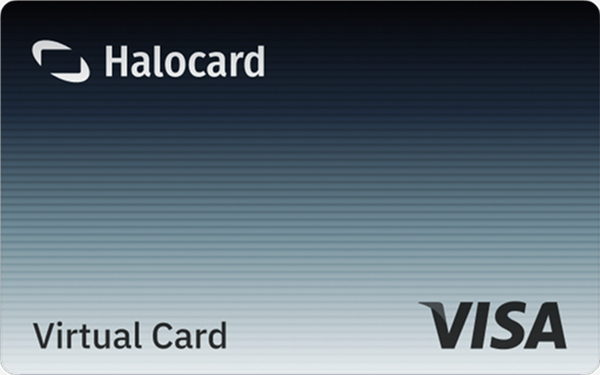

Instant approval
Create your first card in under 5 minutes.

Private purchases
Purchases never appear on your bank account.

Powered by Visa
Accepted at 175M+ merchants globally.
3 steps to create your virtual credit card
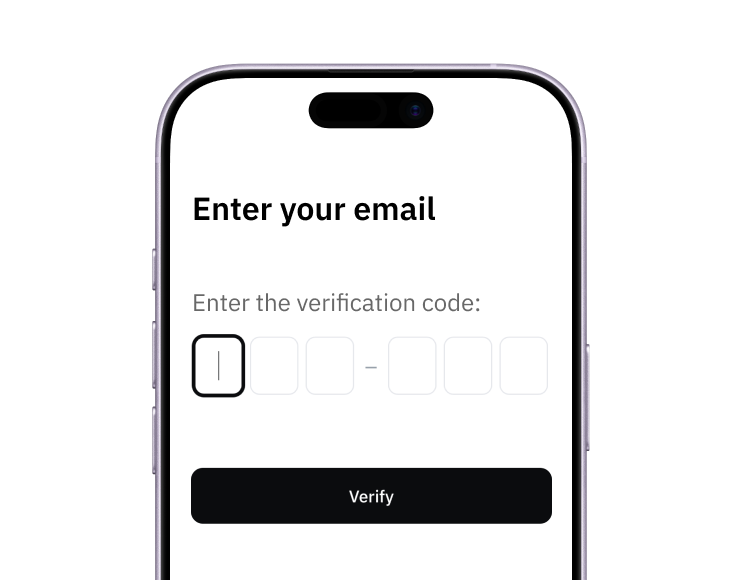
1. Sign up
Create your account from a web browser. No need to download an app.
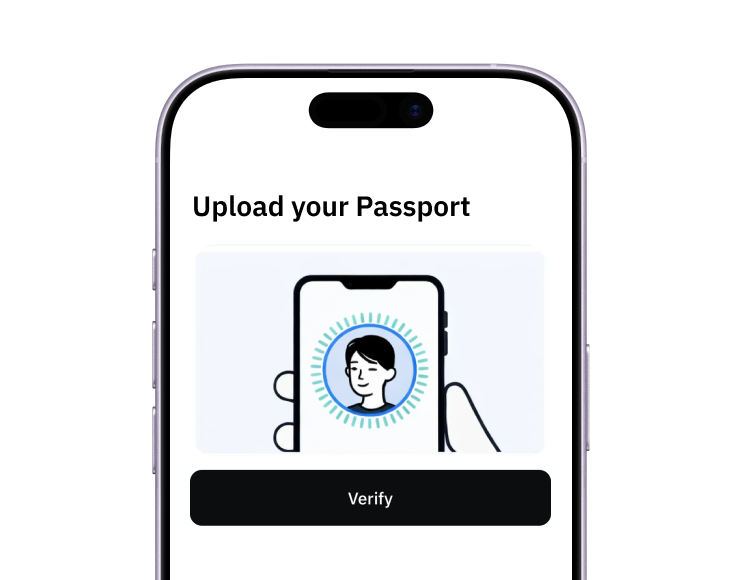
2. Verify
Verify you're a real person in 3 minutes, from the US or any of 120+ countries.
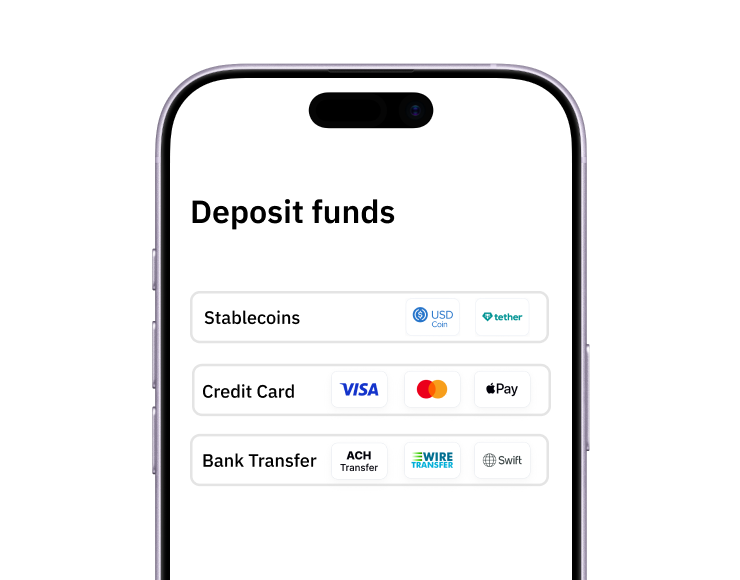
3. Fund
Add funds by debit/credit card, Apple Pay, Google Pay, bank transfer, stablecoins, or crypto.
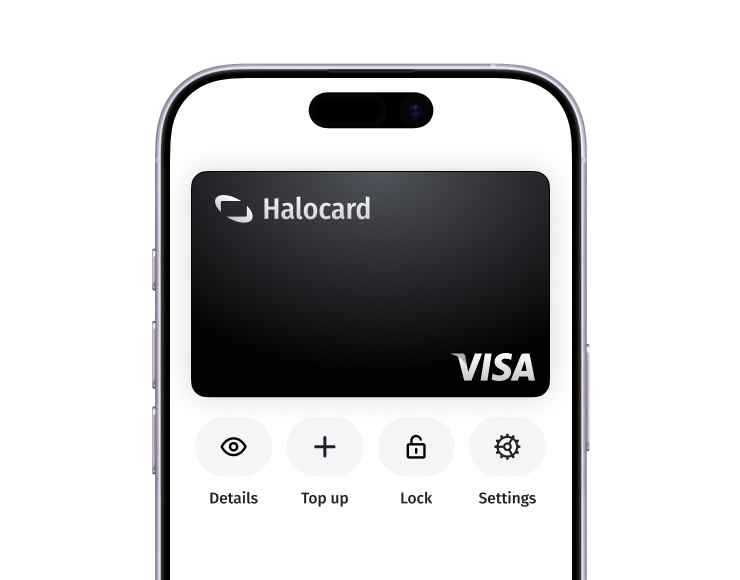
Pay with Halocard
Pay online and in-person wherever Visa is accepted. You can also order a physical Halocard if you prefer.