
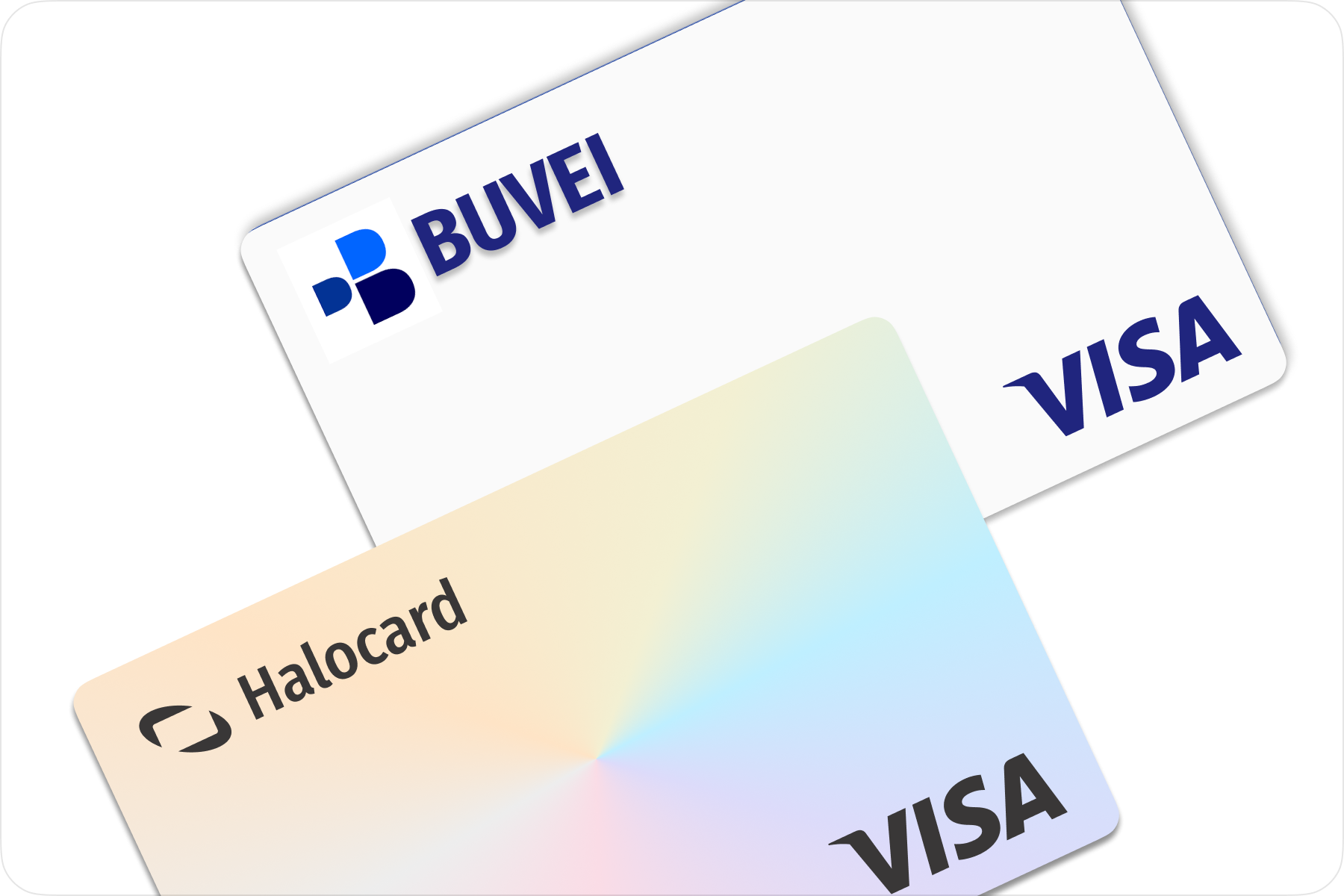
Buvei is a crypto-first virtual card app that issues prepaid, multi-BIN Visa and Mastercard virtual cards funded with crypto, but Halocard is the better choice for most people. Halocard is a US-issued Visa credit card, for customers in the US and 120+ countries, so US ad platforms, SaaS subscriptions and merchant checkouts see a domestic card rather than a BIN whose acceptance depends on the region you picked. You fund it by debit/credit card, Apple Pay, Google Pay, bank transfer, stablecoins, or crypto, it runs entirely in a browser with no app to install, and its pricing is published, while Buvei requires a mobile app with a 2/5 App Store rating and does not publicly list its pricing. On Trustpilot, Halocard is rated 4.2/5 (11 reviews), and Halocard doesn't store your ID documents, which are held by its verification provider as banking laws require.
Buvei is better for crypto users who want to spend digital assets directly, ad buyers who want a choice of BINs, and enterprise teams that need unlimited cards and sub-accounts.
Both Buvei and Halocard are meant for users who need virtual cards for online spending, such as for crypto transactions, SaaS subscriptions, digital advertising, and global payments, although they take different approaches.
Buvei functions over a mobile app, and it's a crypto forward virtual card platform that offers multi-BIN options on both Mastercard and Visa. On the other hand, Halocard is a browser-based US-issued Visa credit card, for customers in the US and 120+ countries, which you can fund by debit/credit card, Apple Pay, Google Pay, bank transfer, stablecoins, or crypto. Customers outside the US don't need an SSN.
Buvei vs Halocard Virtual Card Comparison
| Feature | Halocard | Buvei |
|---|---|---|
| Card Type | Visa credit card | Prepaid (crypto-funded) |
| Card Network | Visa | Visa & Mastercard |
| BIN Country | United States | Multi-BIN (15+ BINs) |
| Countries Available | US + 120+ countries | 150+ countries (claims up to 220+) |
| No SSN Needed | Yes | Likely yes (not explicitly stated) |
| Funding Methods | Card, Apple Pay, Google Pay, Bank Transfer, Stablecoins & Crypto | Crypto (USDT TRC20/ERC20, USDC, DAI, ETH) |
| Monthly Fee | $12 / $15 / $75 | Not publicly listed |
| FX Fee | 1.5% + $0.30 non-USD, 0% USD | Not publicly listed |
| Multi-Card Support | Yes (3 / 12 / 60 cards) | Yes (unlimited cards, sub-accounts) |
| Per-Card Spend Controls | Per-transaction, daily, monthly limits; instant lock; custom billing | Per-card limits, freeze/close, real-time controls |
| Best For | Most people: US and international users, media buyers, developers | Crypto users, ad buyers, enterprise teams |
Key Differences Between Buvei and Halocard
Here's what makes Buvei fundamentally different from Halocard.
Fundamental Product Difference
Halocard is a US-issued Visa credit card. This is important, as credit backed cards usually see higher approval rates and fewer declines than prepaid cards, especially when it comes to advertising platforms such as Google ads.
Buvei or Buvei LLC is a crypto first virtual card platform that allows users to convert digital assets into spendable cards for online transactions worldwide. This model is built around modern digital payments, and this allows flexible use across e commerce, travel bookings, and SaaS tools.
Buvei is focused on crypto-funded usage across diverse payment scenarios, especially for subscriptions, global online spending, and ads. This is a prepaid crypto virtual card.
Card Type and BIN Origin
Halocard uses a US-issued BIN, which means that it's compatible with US merchants and billing systems. It also operates on the Visa network, meaning that it has high approval rates for online payments, especially where address matching and fraud scoring are strict. For businesses running ads, this generally translates to more stable billing.
Buvei features multi BIN virtual cards with multiple BIN options, which means that users can generally select cards issued from different regions. Users can choose from Mastercard virtual cards and Visa virtual cards. Having access to Visa and Mastercard networks can be beneficial in some cases.
Although this can be useful for targeting different regions, the impact on US platform acceptance depends on the specific BIN selected.
Funding
Halocard is flexible in this sense, as users can fund it by debit/credit card, Apple Pay, Google Pay, bank transfer, stablecoins, or crypto.
The stablecoin option is convenient as it creates a bridge between crypto and fiat without requiring full conversion, and this is generally more efficient for recurring subscriptions and online transactions.
Buvei focuses on crypto deposits, through assets such as USDT, USDC, and ETH. This structure is designed for global spending and crypto users, allowing for payments without traditional banking rails.
Spend Controls
Halocard provides users with granular control at the card level, allowing users to set per transaction, daily, and monthly limits.
It also allows users to block or cancel cards instantly, manage spend across multiple cards, and more. This makes it very useful for ads, campaign budgeting, and controlled spending as it features full control over spend.
Buvei offers per card limits and real time control, allowing users to manage spending and freeze cards. However, the exact depth of these controls is not fully documented. Both can also be added to digital wallets, allowing for convenient digital wallet payments: Halocard cards work with Apple Pay and Google Pay, which you can also use to fund your Halocard account.
Privacy
In terms of privacy, Halocard is a stronger option: Halocard doesn't store your ID documents, which are held by its verification provider as banking laws require, and it also allows custom billing addresses per card. Halocard never sells your data to third parties. This means you can use whatever address you feel most comfortable sharing with the merchant, which is useful if you'd rather not give your personal home address to every service you sign up for.
This means that personal details are not shared during online payments, providing secure payments for users. This is ideal for users prioritizing secure and anonymous commerce, as well as for enterprise grade security.
Although Buvei operates under regulated frameworks, its data handling, retention policies, and billing address flexibility are not clearly documented. Although Buvei is said to be highly secure, the lack of transparency may be a consideration.
Fees
Halocard features transparent pricing, with $12, $15, or $75 per month, depending on the subscription level. It also features a 0% FX on USD and 1.5% + $0.30 on non-USD payments. This high level of transparency and clarity makes it easy for businesses to forecast costs across subscription services and online spending. On the other hand, Buvei currently does not publicly list any type of pricing.
Availability
Halocard is open to customers in the US and 120+ countries, with minimal onboarding, and users outside the US don't need an SSN. This makes it highly accessible for businesses, developers, and individuals needing reliable virtual card solutions.
Buvei claims that it is available across 150+ countries, with some documentation referencing over 220 regions.
However, onboarding and KYC requirements are not clearly defined. Although the platform is built for global use and seamless global online payments, this lack of confirmed requirements makes it harder to assess its overall availability across all regions.
Thoughts From Existing Users
Halocard users tend to be happy with its wide availability and accessibility, allowing it to be used for various payment needs.
Users are generally happy with Halocard's high acceptance rate, both in and outside of the USA, as it works well for global online payment. Halocard is also noted for its ability to allow people to pay securely thanks to it being Visa-backed, along with 3D Secure authentication.
In terms of Buvei, there is unfortunately no public review data available.
Buvei vs Halocard: Why Halocard Is the Winning Option
There are several reasons why Halocard is the standout option when compared to Buvei.
US-Issued Visa Credit Card
For anyone who needs to pay for a US ad platform, US SaaS tools, or US only merchant checkouts, Halocard's US BIN and credit card classification are ideal. US merchants see Halocard as a domestic card, allowing for seamless payments. Buvei allows for cards to be created under multiple BINs, although this means that not all cards are ideal for use in the USA.
No App Required
Halocard is entirely browser based and does not require an app. On the other hand, Buvei requires an Android or iOS app that currently holds a 2/5 App Store rating. This is important to consider, especially with payment credentials, as app quality and stability are major concerns and trust signals.
US and Global Availability With No SSN Needed Outside the US
Halocard is open to customers in the US and 120+ countries, and customers outside the US only need minimal KYC, without an ITIN or SSN. Although Buvei is said to be available in 150+ countries, whether or not it requires an SSN is unclear.
Published, Transparent Pricing
Buvei's pricing is not publicly available, but Halocard's is. This kind of transparency is a big trust signal, and a lack of it on the side of Buvei means that Halocard must be the winner on this front.
Privacy Architecture
Halocard features custom billing addresses for each card, and Halocard doesn't store your ID documents, which are held by its verification provider as banking laws require. Although Buvei is said to be highly safe and secure, exactly which measures are taken to ensure the privacy of users is currently unclear.
Frequently Asked Questions
What Is Buvei?
Buvei is a virtual card platform that issues Visa and Mastercard virtual cards with multiple BINs, designed for digital advertising, subscriptions, and online payments. It is marketed primarily towards crypto users and media buyers.
What Is the Best Buvei Alternative?
The best Buvei alternative for most people is Halocard. It's a US-issued Visa credit card, for customers in the US and 120+ countries, so US ad platforms and subscriptions see a domestic card, and its pricing is published up front. You fund it by debit/credit card, Apple Pay, Google Pay, bank transfer, stablecoins, or crypto, crypto included, and it runs in a browser with no app to install.
Is Buvei Legit?
Buvei is a registered company, in both the United States and Hong Kong, and it is said to have high security standards, but users must keep in mind that there is currently a very limited amount of public review data available. The app also has a 2/5 App Store rating. Although this does not confirm that the platform is unsafe, users should take caution.
Does Buvei Require ID Verification or KYC?
Current information about identity verification and KYC for Buvei is not available.
Can I Use Buvei or Halocard Without a US Social Security Number?
Yes, if you live outside the US you can use Halocard without a US Social Security Number, with minimal KYC. US residents applying for Halocard may be asked for an SSN. Whether Buvei requires an SSN is unclear.
Which Virtual Card Is Better for Running Facebook or Google Ads?
Halocard is the better virtual card for running Facebook or Google Ads, although both can be used for them. Halocard is a US-issued Visa credit card, which means that these platforms will see it as a domestic US card, therefore reducing the overall likelihood of payment rejection. Halocard also supports monthly spending limits per card, making it useful for managing multiple ad accounts. Buvei features cards with multiple BIN origins, meaning that acceptance depends on this.
Can I Fund a Halocard or Buvei Card With Cryptocurrency?
Yes, you can fund Halocard with cryptocurrency: Halocard can be funded by debit/credit card, Apple Pay, Google Pay, bank transfer, stablecoins, or crypto. Buvei's primary funding method is crypto to fiat conversion, with options such as USDT being available.
Does Halocard Work for Recurring Subscriptions?
Yes Halocard works well for recurring billing, as it allows users to set monthly spending limits per card to automatically cap subscription charges. Cards can also be locked or cancelled instantly to stop unwanted recurring payments.
Why Might Buvei Payments Be Getting Declined?
Buvei payments may be declined due to some cards not featuring a US BIN, due to billing address mismatches, or VPN creating geographical conflicts with the cards issued country. Thanks to featuring a US issued BIN, Halocard reduces the likelihood of BIN based declines on US platforms.
How to Compare Virtual Card Providers
When evaluating Buvei, Halocard, or any virtual card provider, use this framework:
-
Card Type: Is it a credit, debit, or prepaid card? Credit cards have the highest merchant acceptance rates and are least likely to be declined by fraud scoring systems.
-
BIN Origin: Is the card issued by a US bank? A US BIN is the single most important factor for acceptance on US ad platforms, US SaaS tools, and US-only merchants.
-
KYC Requirements: What identity documents are required? Is SSN mandatory, or can non-US residents complete verification with a passport?
-
Country Availability: Can users from your country sign up? Are there restricted countries or states?
-
Funding Methods: How easy is it to load money from your region? What are the fees?
-
Spend Controls: Can you set per-transaction, daily, and monthly limits per card? Can you lock or cancel instantly?
-
Privacy: Does the provider retain your KYC data, or is it deleted after verification? Can you set custom billing addresses?
-
Pricing Transparency: Are fees clearly published before signup, or is pricing only revealed after registration?
-
App vs Browser: Do you need to install an app? Does that app have strong ratings from real users?
-
Support: What response time SLA is offered, and through what channels?
-
Public Reviews: Does the provider have verified reviews on Trustpilot, G2, or equivalent platforms with a track record you can evaluate?
Using this framework, Halocard scores well on the factors that are most important to US and international users and media buyers, including it featuring a US BIN, being a Visa credit card, transparent pricing, availability to customers in the US and 120+ countries, no SSN being required outside the US, and browser-based operation without the need for an app.
Sources
-
Buvei. Global Virtual Cards for Crypto, Ads & Subscriptions. Sourced on April 09, 2026.
-
Google Play. Buvei - Virtual Card & Pay. Sourced on April 09, 2026.
-
Apple App Store. Buvei - Virtual Card & Pay. Sourced on April 09, 2026.
-
Capterra. Buvei Software. Sourced on April 09, 2026.
-
MWM.ai. Buvei | Multi-BIN Virtual Cards for Ads, E-commerce & Pay. Sourced on April 09, 2026.
*Please see Halocard's Terms of Service or Pricing for the most up to date pricing and fee information. This publication is provided for general information purposes and does not constitute legal, tax or other professional advice from Halocard LLC or its subsidiaries and its affiliates, and it is not intended as a substitute for obtaining advice from a financial advisor or any other professional. We make no representations, warranties or guarantees, whether expressed or implied, that the content in the publication is accurate, complete or up to date.
Halocard Virtual Cards


Instant approval
Create your first card in under 5 minutes.

Private purchases
Purchases never appear on your bank account.

Powered by Visa
Accepted at 175M+ merchants globally.
3 steps to create your virtual credit card

1. Sign up
Create your account from a web browser. No need to download an app.

2. Verify
Verify you're a real person in 3 minutes, from the US or any of 120+ countries.

3. Fund
Add funds by debit/credit card, Apple Pay, Google Pay, bank transfer, stablecoins, or crypto.

Pay with Halocard
Pay online and in-person wherever Visa is accepted. You can also order a physical Halocard if you prefer.