Best Virtual Credit Card Option for Small Business

Edward Taylor

Halocard is the best virtual card for small businesses that pay US and international vendors online: a US-issued Visa credit card with a separate card and limit for every tool, subscription and ad account. It's for customers in the US and 120+ countries, and you fund it by debit/credit card, Apple Pay, Google Pay, bank transfer, stablecoins, or crypto. Ramp suits US finance automation, Brex venture-backed startups, Divvy budget controls, Wise Business international transfers, Revolut Business and Airwallex multi-currency and cross-border operations, Mercury startup banking, and Privacy.com subscription masking.
-
Virtual cards are ideal because they help small businesses, remote teams, and online companies control business spending without the need for a shared physical card.
-
The best virtual cards for small businesses feature strong acceptance, flexible spending limits, and expense management tools.
-
This guide compares Halocard, Ramp, Brex, BILL Divvy, Wise Business, Revolut Business, Airwallex, Mercury, and Privacy.com.
Quick Overview: Best Virtual Cards for Small Business
| Feature | Halocard | Ramp | Brex | Divvy (BILL) | Wise Business | Revolut Business | Airwallex | Mercury | Privacy.com |
|---|---|---|---|---|---|---|---|---|---|
| Card Type | Virtual Visa credit card | Corporate charge card | Corporate charge card | Corporate charge card | Debit | Debit | Corporate debit/prepaid | Debit | Debit |
| Card Network | Visa | Visa | Mastercard | Visa | Visa / Mastercard | Visa / Mastercard | Visa | Mastercard | Visa |
| Monthly Fee | Core $29, Growth $99, Scale $199, Enterprise $299 | $0 | Essentials from $0/user/month, Premium from $12/user/month | $0 | One-time US setup fee: $31 | Basic from $10/month, Grow from $40/month, Scale from $140/month | Custom enterprise pricing | $0 | Personal $0, Plus $5, Pro $10, Premium $25 |
| Funding Method | Card, Apple Pay, Google Pay, Bank Transfer, Stablecoins & Crypto | Connected US business bank account | Linked business account | Linked business account | Wise balance or bank transfer | Revolut balance or bank transfer | Airwallex wallet/balance | Mercury account balance | Linked US bank account |
| Cards Per Plan | Core 30, Growth 100, Scale 300, Enterprise 500 | No published maximum | Multiple cards per user/team | Multiple virtual cards | Up to 3 virtual cards | Up to 200 virtual cards per team member | Region dependent | Multiple virtual cards | 12, 24, 36, or 60 cards/month |
| FX Fee | 0% USD, 1.5% + $0.30 non-USD | No foreign transaction fees | FX markup up to 3% | Typically 1%–3% | Currency conversion from ~0.48% | 0.6% markup above allowance | Varies by country | 0% USD, 3% non-USD | 3% on lower plans |
| Geographic Availability | US + 120+ countries | US and Canada | Primarily US | US | US available | US available | Global | Primarily US | US only |
| KYC | Passport + ID verification, no SSN | Business verification | Business verification | Business verification | Business verification | Business verification | Business verification | US company verification | SSN + US bank |
| Acceptance | Strong US-BIN acceptance with Visa credit card structure | Excellent for US SaaS and vendors | Excellent | Excellent | Mixed for ad platforms | Mixed by merchant | Strong globally | Good for US SaaS | Mixed |
| Apple Pay/Google Pay | Yes | Yes | Yes | Yes | Yes | Yes | Yes | Yes | Limited |
| Best For | US and international businesses needing reliable US acceptance | US finance automation | Venture-backed startups | Budget controls | International transfers | Multi-currency businesses | Cross-border operations | Startup banking | Subscription masking |
Top Virtual Card Options for Small Business in 2026
Here are the best virtual card options for small businesses in 2026.
Halocard Virtual Credit Cards for International Business Spending
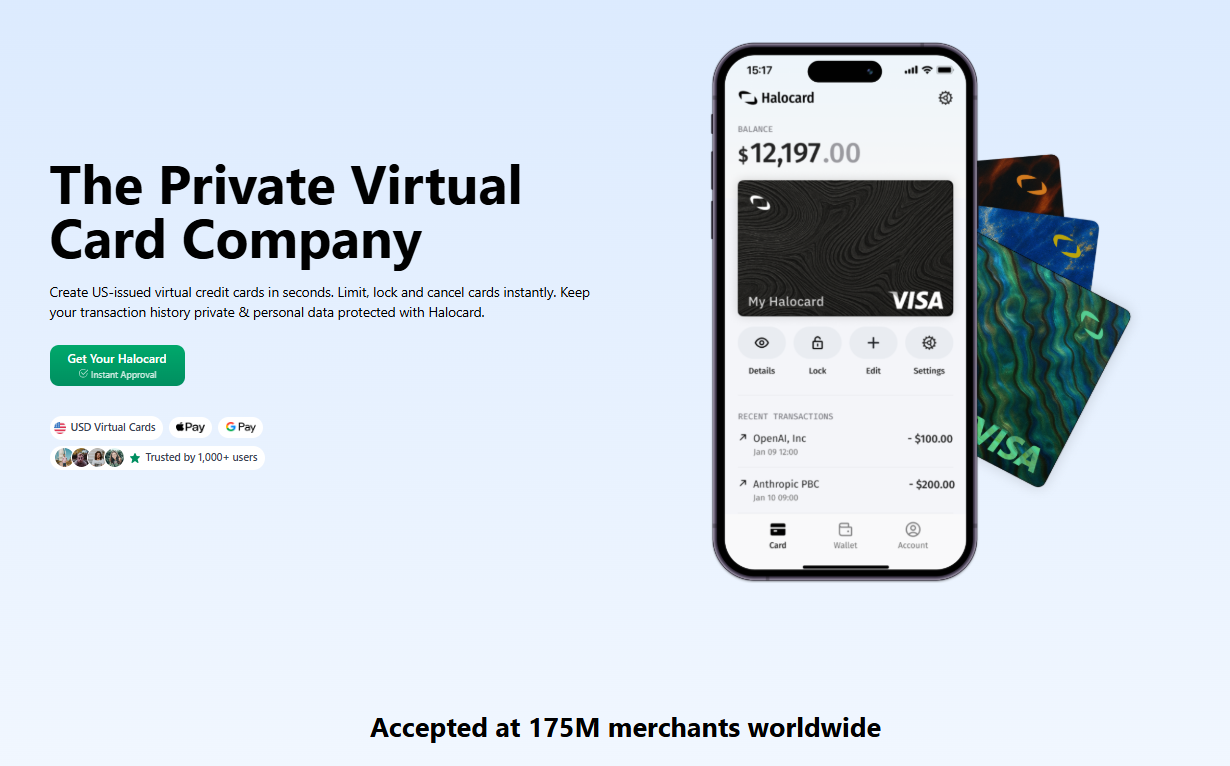
Halocard is one of the best virtual cards for international businesses that require reliable US payment acceptance. Businesses are able to instantly issue virtual cards with custom billing profiles, merchant restrictions, spending limits, and flexible funding methods.
Unlike many prepaid virtual cards, Halocard uses a US-issued Visa structure that acts like a traditional credit card during merchant screening. This makes it much better for online purchases, online advertising campaigns, and subscriptions, where prepaid debit cards may fail.
Halocard supports businesses in 120+ countries but does not require a US SSN for those outside of the USA. Funding is possible by debit/credit card, Apple Pay, Google Pay, bank transfer, stablecoins, or crypto.
Businesses are able to create vendor-specific cards, apply hard limits, manage recurring payments, and maintain tight control spending policies across teams. This is very useful for e-commerce operators, agencies, and global marketing teams handling high ad spend.
Ramp Corporate Card and Expense Management Platform
Ramp combines modern corporate cards with advanced expense management. Businesses are able to create virtual cards for vendors, subscriptions, departments, and employees while also syncing all transactions into their accounting software.
Ramp is ideal for helping finance teams control spending using approvals, merchant restrictions, real-time visibility into transactions, and reimbursement automation. Businesses can also set spending limits and create controls around business expenses.
Ramp is one of the strongest US-focused business card solutions for companies that require centralized expense tracking, oversight of company spending, and automated reporting. See Ramp vs Brex vs Halocard for how the two corporate cards compare on eligibility, pricing and rewards. For more options, see the best Ramp alternatives.
Brex Virtual Corporate Card for Finance Teams
Brex is designed for scaling companies and startups that require flexible virtual corporate cards that are paired with finance automation tools. Businesses are able to instantly generate virtual cards for contractors, travel, operational spend, and more. This platform provides finance teams with strong real-time spend visibility and centralized reporting.
The platform also supports ERP integration as well as advanced expense management workflows for large businesses. Brex is best for funded startups and growing online companies that require scalable virtual credit infrastructure instead of just simple prepaid payment cards.
Divvy by BILL for Control Spending and Vendor Payments
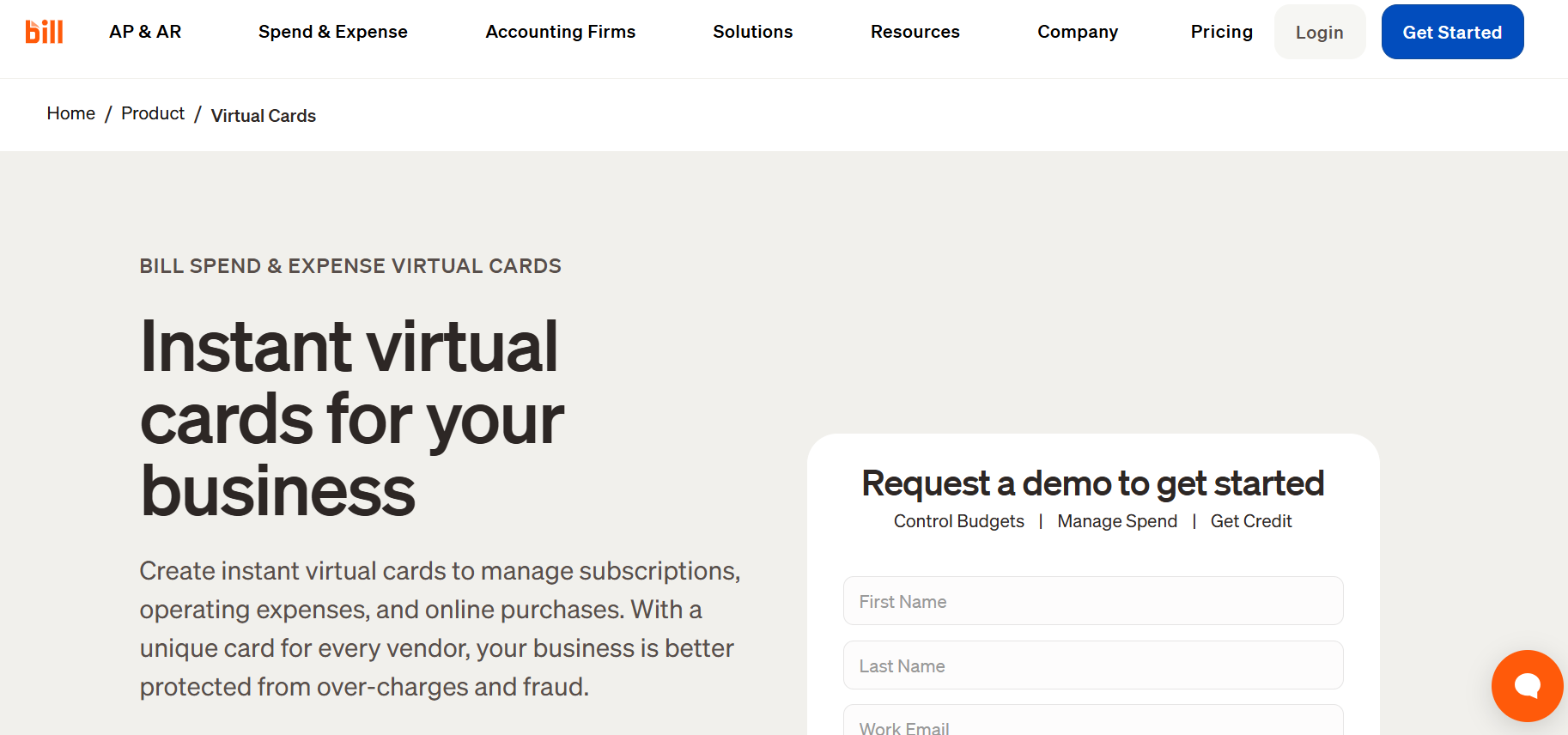
Divvy is focused mainly on budgeting and allowing businesses to control vendor payments before purchases happen. Instead of reviewing charges afterward, businesses are able to apply budget, approvals, and spending rules in advance.
This makes Divvy very useful for teams that manage subscriptions, bill pay, employee expenses, and software renewals. Businesses can create separate virtual cards for projects, departments, and vendors while maintaining tight oversight of business spending. This is a good option for US businesses that require proactive controls instead of reactive reimbursement tracking.
Wise Business Virtual Cards for International Online Payments
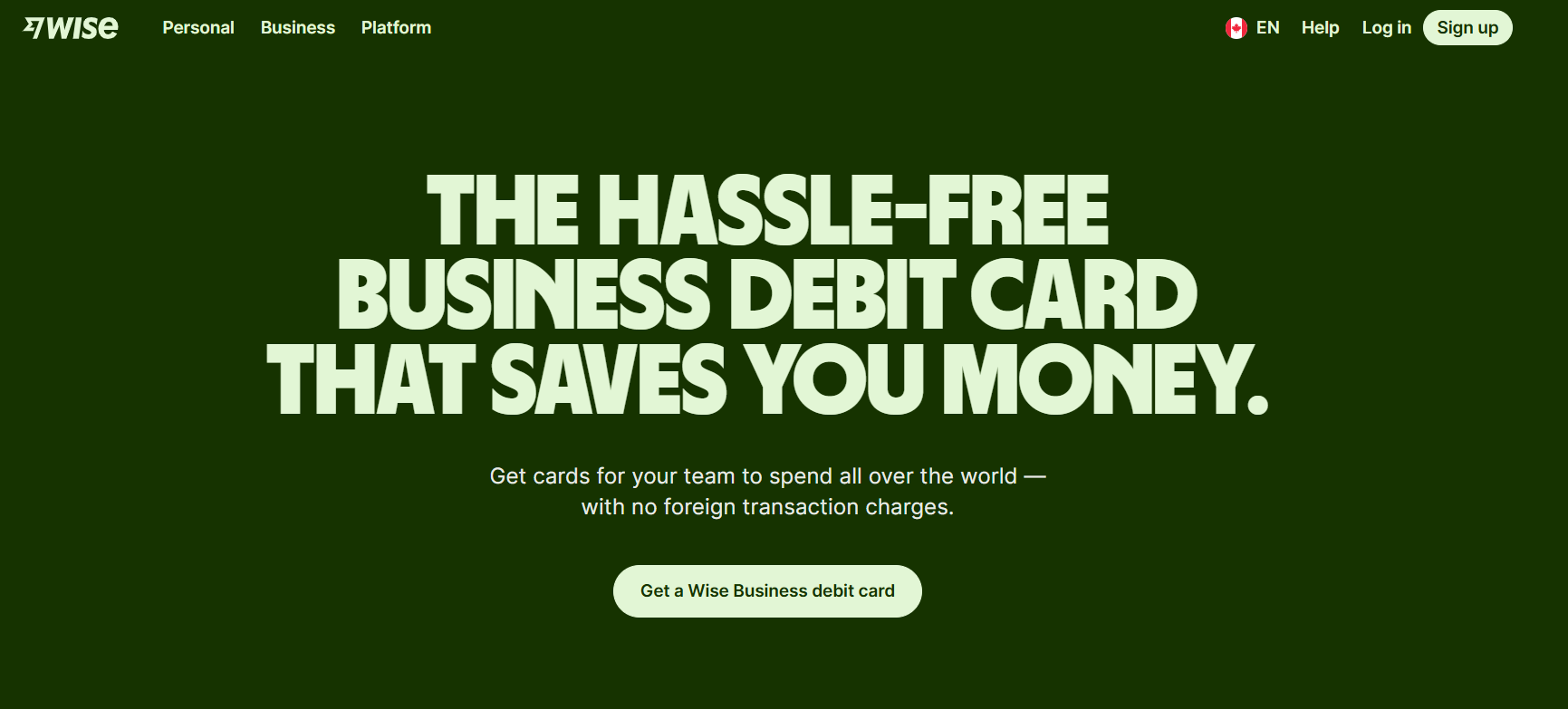
Wise Business is known for international transfers and multi-currency balances, but it also offers debit-based virtual cards for supplier billing, contractor payouts, and online payments.
Wise always uses the mid-market exchange rate with currency conversion from ~0.48%, making it an attractive option for international operations and recurring vendor payments.
Keep in mind however that because Wise cards are debit products, they are generally less reliable than credit-based virtual credit cards for some US advertising platforms and software vendors.
Revolut Business Virtual Cards for Online Services
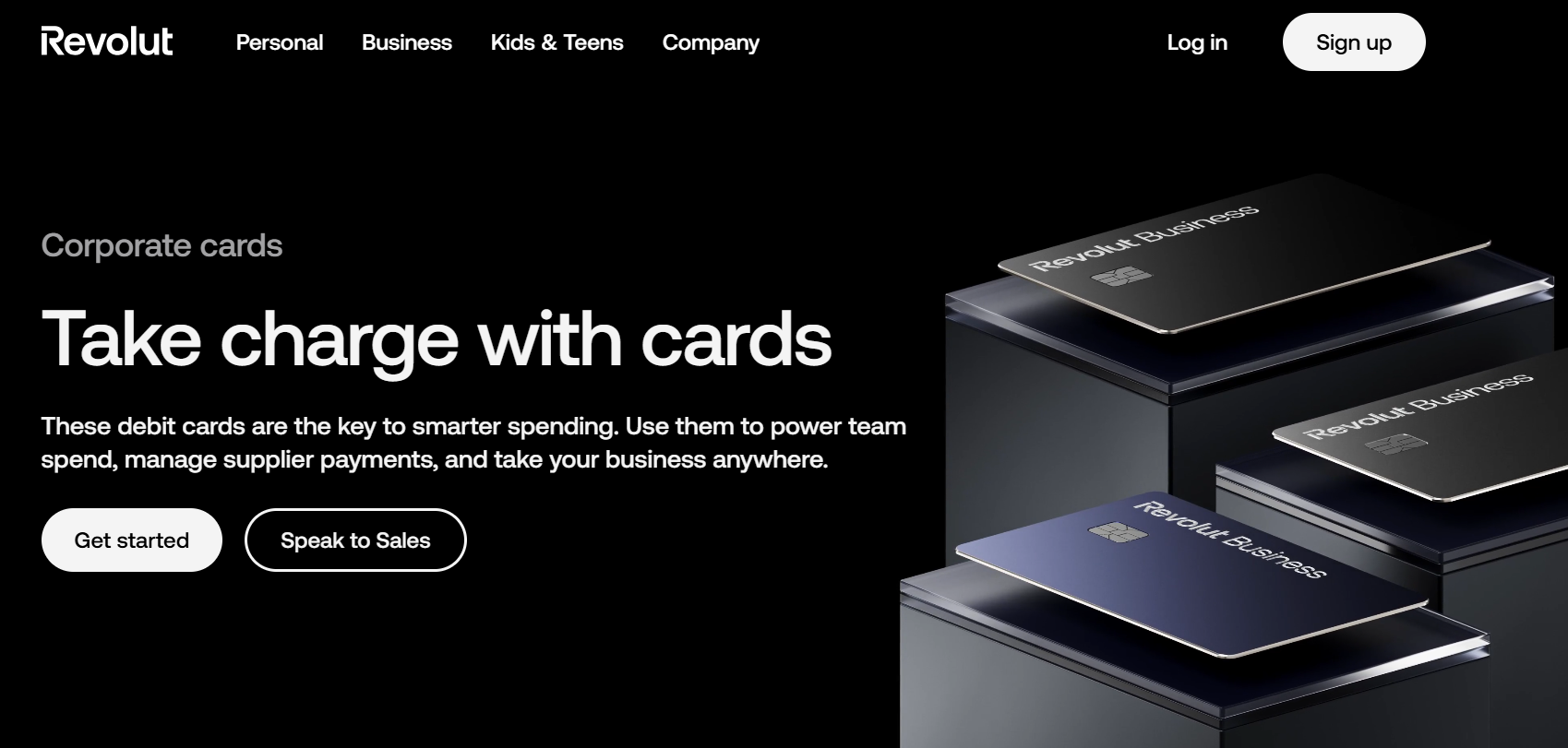
Revolut Business features flexible virtual cards for online services, international operational spend, and software subscriptions, along with multi-currency banking.
Businesses are able to create disposable cards, recurring-use cards, and employee-specific payment cards, all while applying approvals and controls.
Revolut also supports up to 200 virtual cards, making it a good option for distributed teams and subscription-heavy businesses.
Airwallex Virtual Cards for Cross-Border Business Payments
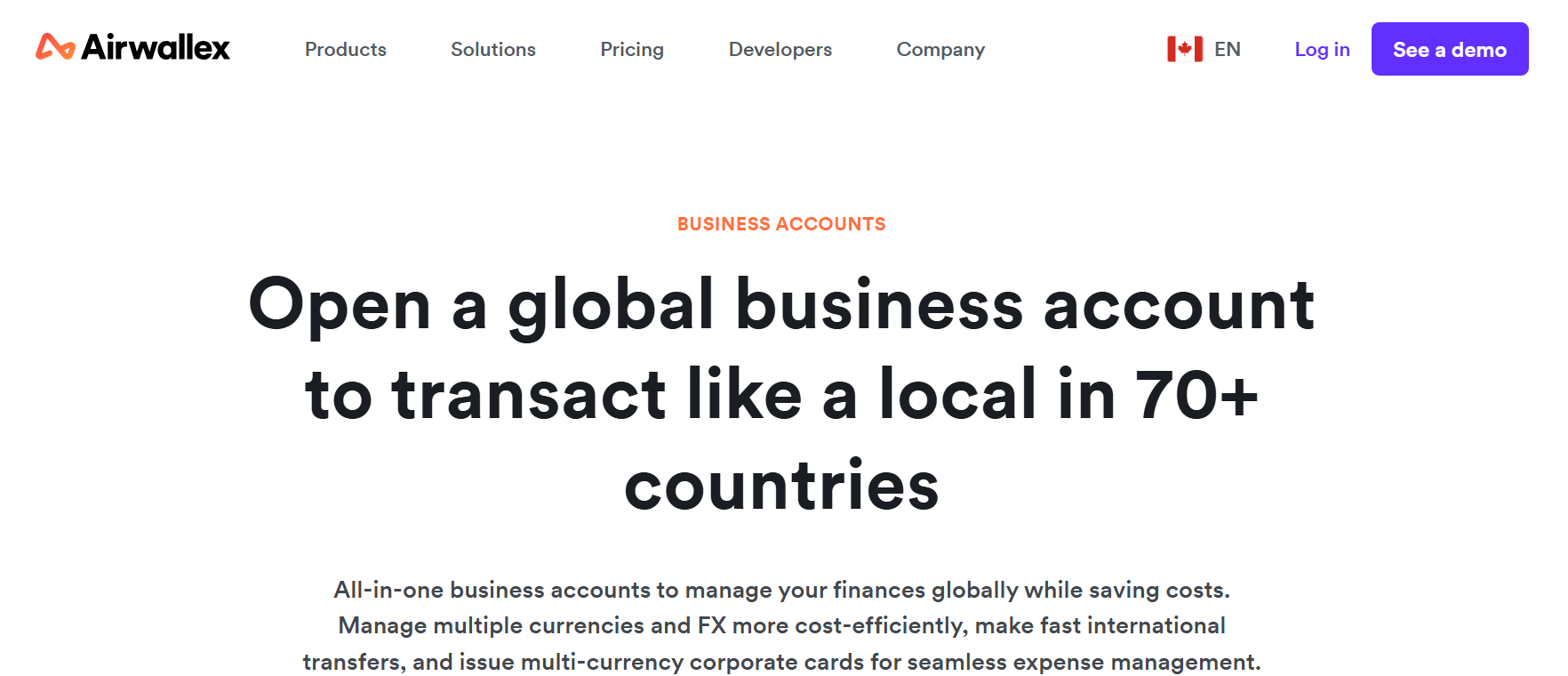
Airwallex's main focus is on cross-border finance and global online payments infrastructure. Businesses can issue employee virtual cards, centralize international supplier payments, and manage approvals. The platform is most useful for e-commerce brands, globally distributed teams, and agencies that manage multi-currency business spending. Airwallex is also ideal as it integrates with a variety of operational finance systems and e-commerce tools.
Mercury Virtual Cards for Startup Business Credit Operations
Mercury is designed primarily for startups who require a banking platform, but it also includes debit-based virtual cards for SaaS billing and operational spending.
Mercury is ideal for startups that require integrated banking and spend controls in a single system. Businesses are able to track payments, improve expense tracking, and manage subscriptions, all through integrated dashboards. The platform does not charge any fee on USD transactions, and 3% on non-USD transactions.
Privacy.com Virtual Cards for Fraud Prevention and Subscription Management

Privacy.com focuses mainly on merchant-locked virtual cards that are designed for fraud prevention, secure online payments, and subscription management.
Individuals and businesses alike are able to create isolated card number credentials that are tied to specific merchants, therefore helping to reduce fraud exposure and improving control access over subscriptions. The platform supports spend caps, merchant locking, and single-use cards, although it is limited to US users that have U.S. bank account.
What Is a Virtual Business Credit Card?
A virtual business credit card is a digital payment card that has its own card number, security code, and expiration date. It works just like a regular payment method for online purchases, but there's no plastic physical card unless the provider also issues one.
Instead of having to share a single company card across the team, businesses are able to issue separate virtual cards for subscriptions, vendors, software tools, and employees. This is useful because it helps businesses control spending, reduces fraud exposure, and improves expense management.
US BIN structure matters because many merchants screen cards based on issuer country, fraud profile, and prepaid status. That's one of the reasons why some virtual credit cards, such as Halocard, work far better than prepaid debit cards for ad platforms and SaaS subscriptions.
Types of Virtual Business Credit Cards
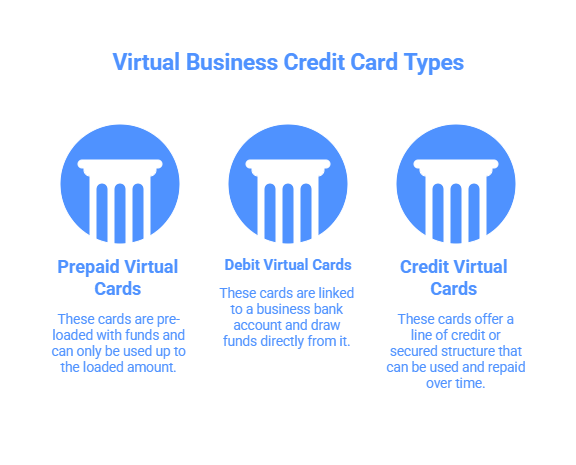
There are three main types of virtual business credit cards, including prepaid virtual cards, debit virtual cards, and credit virtual cards.
Prepaid Virtual Cards
Prepaid virtual cards use loaded balances instead of a credit line or drawing from a bank account. These cards are great for one-time purchases, controlled budgets, and temporary subscriptions. That said, many prepaid virtual cards face more merchant restrictions and weaker acceptance than credit-based products.
Debit Virtual Cards
Debit virtual cards take funds directly from a business balance or wallet. Wise, Revolut, Mercury, and Airwallex commonly use this structure. Debit-based virtual cards work well for online services, everyday operational business expenses, and bill pay, but they generally don't help build business credit.
Credit Virtual Cards
Finally, there are credit-based virtual cards, which function like traditional credit cards or secured credit products. They generally provide strong acceptance, high trust with merchants, and great support for recurring payments. For most businesses, credit-based virtual cards are the best fit for ad platforms, operational vendor spend, and SaaS billing.
Benefits of Virtual Cards for Small Business
There are various benefits of virtual cards for small businesses that are important to know.
Benefits of Virtual Cards for Control Vendor Payments
One of the main benefits of virtual cards is the ability to control vendor payments at the card level. With virtual cards, businesses can create a dedicated card for each software vendor, supplier, or subscription. This makes it much easier to set spending limits, manage recurring payments, and prevent duplicate charges without affecting unrelated vendors. Businesses are also able to pause or replace a single card without disrupting the entirety of their operations.
Control Spending Without Shared Physical Card Risk
Sharing a single physical card across a whole company creates operational and security problems. Employees tend to save the same card details across multiple systems, a single breach can affect dozens of services, and former contractors may still have access. However, virtual cards eliminate this risk by giving businesses tighter control access over payments. Teams are able to assign vendor-specific cards, apply built-in controls, and instantly cancel compromised credentials.
Business Spending Advantages of US-BIN Virtual Credit Cards
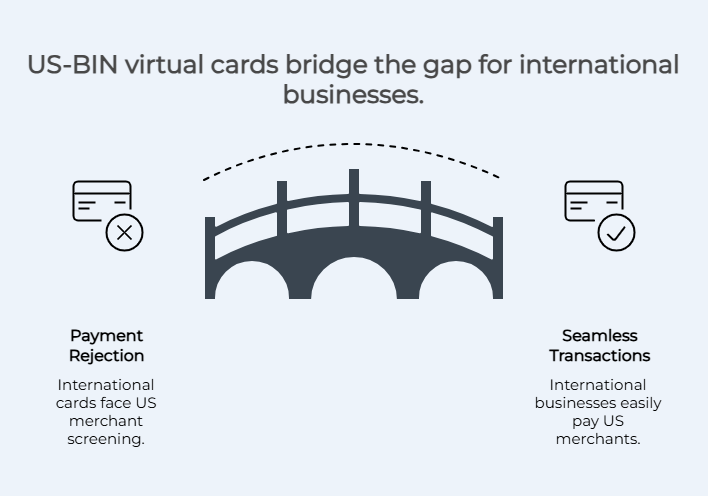
International businesses generally struggle with US merchants because their platforms screen cards based on issuer country, fraud profile, and prepaid status. US-issued virtual credit cards provide a major advantage for ad accounts, high-volume operational billing, and subscriptions. This is important for agencies, e-commerce companies, and remote teams that manage large business spending operations.
Expense Management and Accounting Software Integration
Modern virtual card platforms also support instant issuance, making it possible to issue payment credentials in mere minutes instead of having to wait for a physical card to arrive in the mail. This improves expense management, provides finance teams with stronger real-time data and real-time spend visibility, and helps businesses manage expenses. Many providers also integrate with accounting software, which simplifies expense tracking and automates reconciliation workflows.
Pros & Cons of Virtual Business Credit Cards
Pros of Virtual Business Credit Cards
-
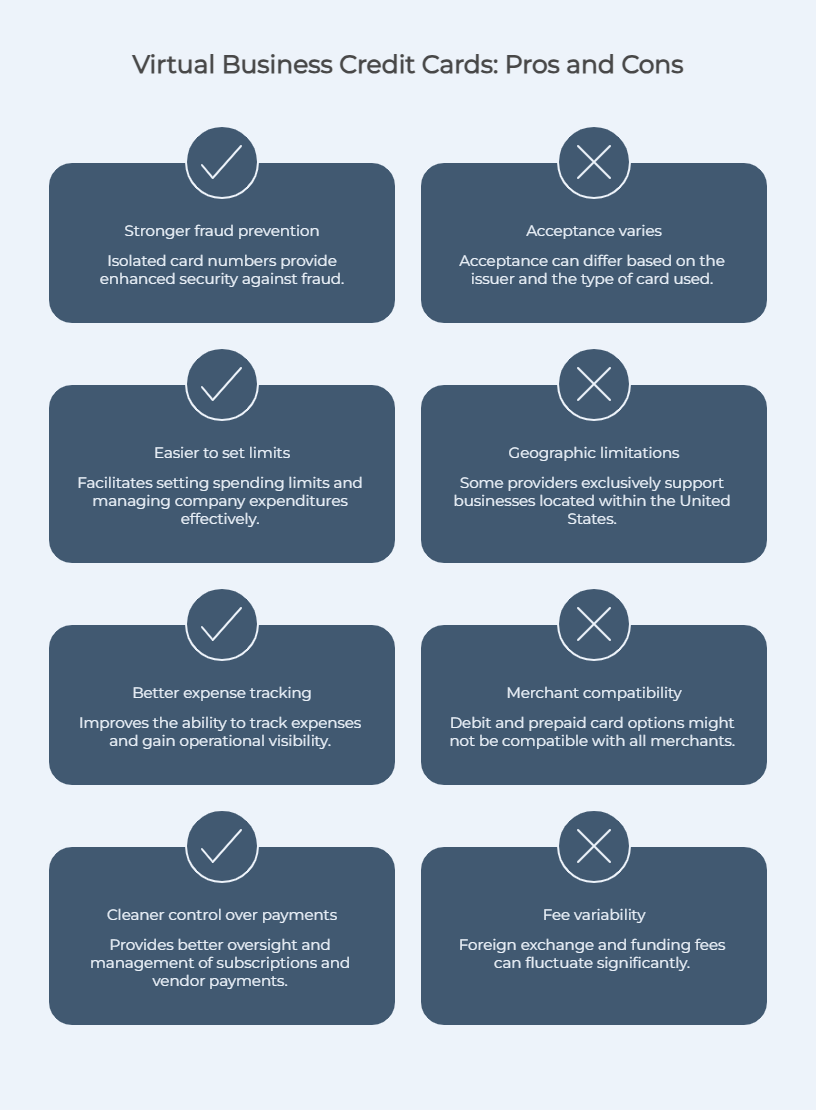
Stronger fraud prevention through isolated card numbers
-
Easier to set limits and manage company spending
-
Better expense tracking and operational visibility
-
Cleaner control over subscriptions and vendor payments
Cons of Virtual Business Credit Cards
-
Acceptance varies depending on issuer and card type
-
Some providers only support US businesses
-
Debit and prepaid cards may fail with certain merchants
-
FX and funding fees vary significantly
Virtual Card Acceptance for Small Business
Virtual card acceptance depends on more than just the brand logo. Merchants may screen the BIN, prepaid status, issuer country, debit versus credit structure, and fraud profile before approving transactions.
This is important for recurring subscriptions, ad platforms, travel booking, and SaaS billing. That said, some traditional cards may still outperform lower-trust prepaid card products. The best virtual cards combine broad acceptance with real-time visibility, support for digital wallets, spending controls, and strong issuer trust.
Frequently Asked Questions
What Are the Easiest Virtual Credit Cards to Get?
Debit-based and prepaid virtual cards are generally the easiest to qualify for because they generally rely less on established business credit history. However, some credit card providers, such as Halocard, do not require a credit check because the cards draw on the balance you load.
Do Virtual Credit Cards Require a Personal Guarantee?
Some virtual credit cards may require a personal guarantee, especially charge card products.
Can Non-US Businesses Create Virtual Cards?
Yes, non-US businesses can create virtual cards through various providers, with Halocard being one of them, as it supports users in 120+ countries and does not require a US SSN.
Are Virtual Credit Cards Good for International Online Payments?
Yes, virtual credit cards are good for international online payments, supplier billing, and cross-border operational spend.
How Many Virtual Cards Can Finance Teams Create?
How many virtual cards the finance team can create depends solely on the provider. For example, Halocard's business plans run from 30 to 500 virtual cards.
Are There Free Virtual Cards for Small Business?
Yes. Ramp, Divvy, Mercury, and Privacy.com all offer free entry-level options, though limits and international access vary.
What Is the Difference Between Prepaid Virtual Cards and Virtual Credit Cards?
The difference is that virtual credit cards use a credit line or secured credit structure, whereas prepaid virtual cards use loaded balances.
Sources
-
Ramp. Ramp Corporate Card - The Best Corporate Card | Ramp
-
Brex. Virtual Corporate Credit Cards For Business Spending
-
Brex. Brex Pricing Plans | Get Started Today
-
Divvy. Virtual Credit Cards for Business | BILL Spend & Expense
-
Wise. Wise Business: Grow with the international business account
-
Revolut. Corporate Cards | Revolut Business
-
Airwallex. Airwallex US: AI Financial Platform Built to Scale US Businesses
-
Mercury. Online Business Banking For Startups, Small Businesses & Scaling Companies
-
OFX. The Best Virtual Cards in Canada for Businesses in 2026
-
ConnectPay. Virtual Card Providers
-
Float Financial. Best Business Virtual Corporate Cards in Canada in 2026
-
Reddit. Virtual Credit Cards for Your Vendors, What's a Good Solution? : r/msp
-
Slash. Virtual Credit Cards
*Please see Halocard's Terms of Service or Pricing for the most up to date pricing and fee information. This publication is provided for general information purposes and does not constitute legal, tax or other professional advice from Halocard LLC or its subsidiaries and its affiliates, and it is not intended as a substitute for obtaining advice from a financial advisor or any other professional. We make no representations, warranties or guarantees, whether expressed or implied, that the content in the publication is accurate, complete or up to date.
Halocard Virtual Cards

Instant approval
Create your first card in under 5 minutes.

Private purchases
Purchases never appear on your bank account.

Powered by Visa
Accepted at 175M+ merchants globally.
3 steps to create your virtual credit card
1. Sign up
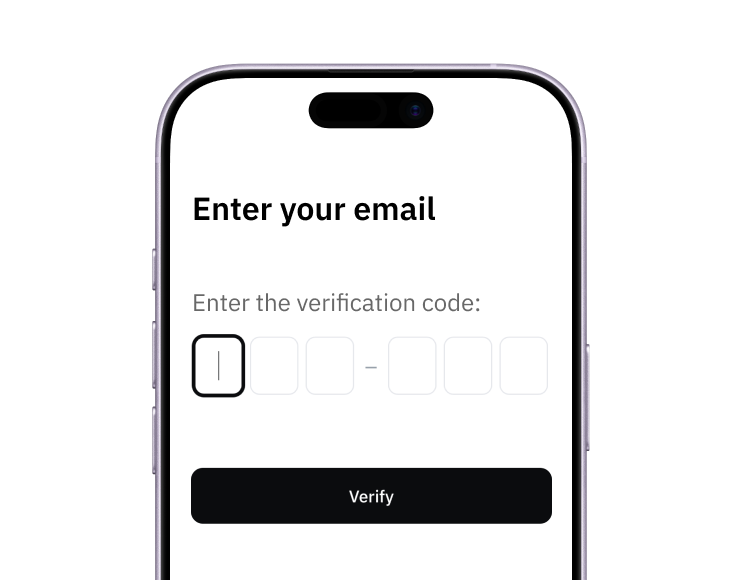
Create your account from a web browser. No need to download an app.

2. Verify
Verify you're a real person in 3 minutes, from the US or any of 120+ countries.
3. Fund
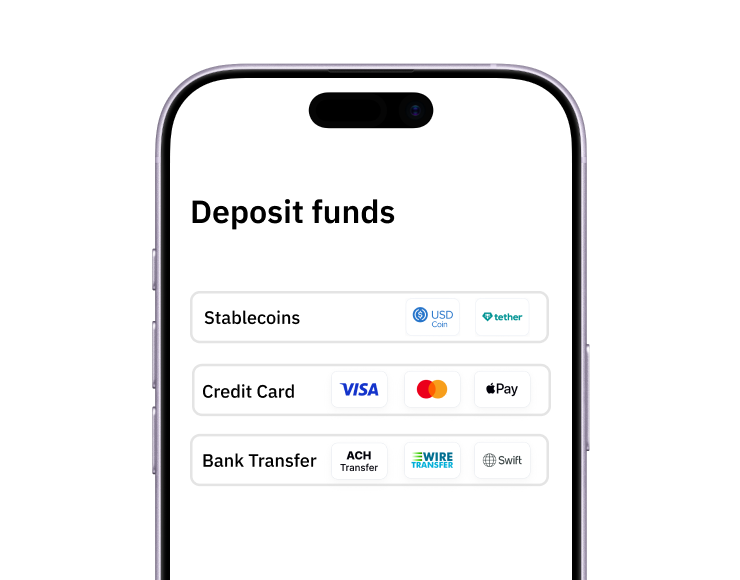
Add funds by debit/credit card, Apple Pay, Google Pay, bank transfer, stablecoins, or crypto.
Pay with Halocard
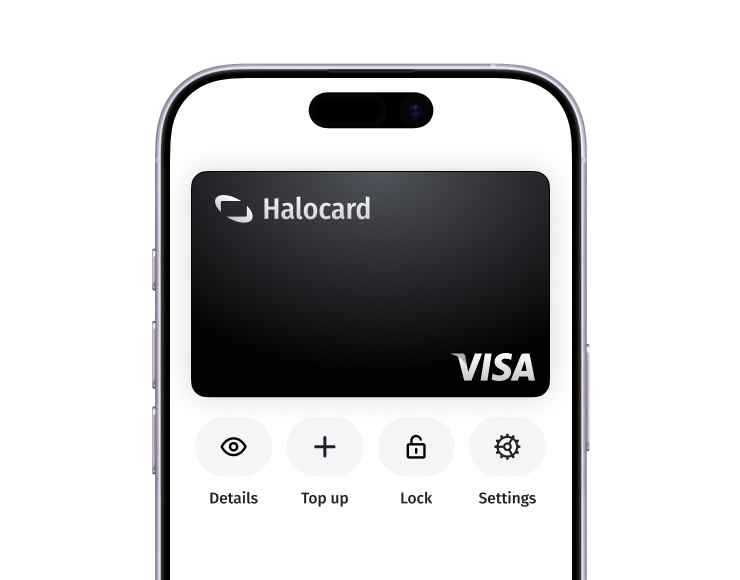
Pay online and in-person wherever Visa is accepted. You can also order a physical Halocard if you prefer.