

Halocard is the best Wise alternative for virtual cards: it's a US-issued Visa credit card, for customers in the US and 120+ countries, funded by debit/credit card, Apple Pay, Google Pay, bank transfer, stablecoins, or crypto. Revolut is the stronger pick for multi-currency digital banking. Airwallex is the stronger pick for business spending. Privacy.com is the stronger pick for US-only merchant-locked cards.
If you're comparing Wise alternatives, start with the reason you want to switch. Wise is primarily a global payment platform for international money transfers, multi currency accounts, bank transfers, currency conversion, and debit card spending. A customer trying to reduce transfer fees therefore needs a very different alternative than someone whose Wise card is being rejected by a US merchant.
Wise remains competitive for its core use case. In the US, there is no subscription fee for the Wise account, the digital card is free, and the physical Wise card costs $9. Wise uses the mid market rate without an exchange-rate markup, although currency conversion fees still apply. US cardholders also get up to $250 a month in ATM withdrawals before Wise charges $1.95 plus 1.95% on subsequent withdrawals above that threshold.
The alternatives below solve different problems. Some provide personal accounts, local banking tools, and ways to manage multiple currencies. Others specialize in multi currency business accounts, expense management tools, stablecoins, virtual cards, or US merchant access. The right payment method therefore depends on whether your priority is sending money, holding funds, international payments, business expense management, or making card payments that a conventional foreign-issued card cannot complete.
Key Takeaways
-
Halocard is the best Wise alternative for virtual cards, especially for international users who need a US-issued virtual card for US merchants, subscriptions, SaaS, advertising, and online purchases without US residency.
-
The best Wise alternative depends on what you need: Revolut is stronger for multi-currency digital banking, Airwallex for global business spending and expense management, Payoneer for cross-border business earnings, and Privacy.com for US-based merchant-locked and single-use cards.
Quick Comparison Table
| Provider | Card / Account Type | Availability | Virtual Card Capacity | Key Pricing and Fees | Best For |
|---|---|---|---|---|---|
| Halocard | US-issued Visa virtual credit card | 120+ countries; no US residency required; no SSN for non-US residents | 3, 12, or 60 personal cards by plan | $12-$75/month; 0% fee on USD purchases; 1.5% + $0.30 non-USD FX; funding by Card, Apple Pay, Google Pay, Bank Transfer, Stablecoins & Crypto | Best Wise alternative for virtual cards and US merchant access |
| Revolut | Prepaid/virtual debit plus broader finance account | US product reviewed here; availability/features vary globally | Up to 20 active virtual cards; max 5 new virtual cards per 30 days | $0, $9.99, or $16.99/month; Standard FX fair-use fee after $1,000/month | Multi-currency spending and disposable cards |
| N26 | European bank account + Mastercard debit | Supported European markets | Up to 6 active virtual cards | Free to €16.90/month; Standard extra virtual card €2.59 | European digital banking |
| Airwallex | Business account + Visa corporate debit cards | Business service across multiple markets | Unlimited corporate cards on US Explore | Explore $0; Grow $12/active Spend user + platform fee; FX 0.5%-1% above interbank | Multi-currency business accounts and expense management |
| Payoneer | Business payment account + Mastercard | Business users; broad international eligibility | Hundreds/thousands at scale | $29.95 annual card fee; up to 1.8% non-conversion purchases; up to 3.5% with conversion | Cross-border business earnings |
| RedotPay | Stablecoin-funded virtual/physical card | Provider reports 100+ countries | Account/card limits vary | $10 virtual card; $100 physical card; Pro $12.90/month or $129/year | Stablecoin-funded spending |
| SiraPay | Privacy-focused virtual card | Provider claims 150+ country coverage | Up to 5 cards | Advertises free plan; $0.99/month or $4.99/year card options | Low-cost privacy-focused cards |
| Privacy.com | US virtual payment cards | US citizens/legal residents, 18+, US checking account | 12-60 new cards/month by plan | $0-$25/month; 3% foreign transaction fee on Personal/Plus | US merchant-locked and single-use cards |
| US Unlocked | US-issued virtual prepaid cards | International users in supported countries | Everyday, Store Locked, and one-time cards | $4.95/month or $39.95/year; loads from 2%-5% + fixed charges | Shopping US websites from abroad |
| StatesCard | US virtual prepaid Visa | International-user focus; eligibility varies | One primary virtual card model | $16.99 issue fee + $3.95/month; loads 5% to 8.5% + fixed charge | US streaming and app-store payments |
Best Wise Alternatives for International Payments and Virtual Cards
Here are the 10 best alternatives to Wise for users comparing international payments, virtual cards, money transfer services, multi-currency functionality, and business finance tools.
1. Halocard
Halocard is a virtual-card platform built around US-issued Visa virtual credit cards. It is particularly useful for international users who can already make international transfers or hold international money but need a US-compatible card for subscriptions, SaaS, advertising, AI tools, ecommerce, or other online purchases.
Halocard says customers can sign up from 120+ countries without US residency. Non-US residents do not need an SSN, although US residents must provide an SSN or ITIN along with required identification. See Halocard vs Wise side by side.
How Halocard Works
Users register in a browser, complete identity verification, fund the account, and create cards through the online dashboard. No app is required.
Each card can have its own billing details and per-transaction, daily, and monthly limits. Cards can also be locked or canceled individually and added to Apple Pay or Google Pay. Halocard says its Visa cards are accepted at 175M+ merchants, although individual merchant acceptance can never be guaranteed.
Halocard Costs & Fees
Personal pricing is:
-
Essential: 3 virtual cards for $12/month or $144/year.
-
Pro: 12 cards for $15/month or $180/year.
-
Elite: 60 cards for $75/month or $900/year.
-
USD purchases: 0% purchase/FX fee.
-
Non-USD purchases: 1.5% + $0.30 FX fee.
Funding is more detailed:
-
Initial deposit starts from $30.
-
Funding methods: debit/credit card, Apple Pay, Google Pay, bank transfer, stablecoins, or crypto.
-
Bank transfer currencies: USD, CAD, EUR or GBP.
Halocard Spending Limits and Funding
Halocard has no credit limit beyond the available deposited balance, and its only platform ceiling is $1M a day. Its example is straightforward: load $500 and you can spend $500; load $10,000 and you can spend $10,000. Individual cards can still be restricted by transaction, day, or month.
Halocard Key Advantages
-
US-issued virtual credit cards.
-
No US residency required.
-
No SSN requirement for non-US residents.
-
Strong US merchant positioning.
-
Custom billing addresses.
-
Apple Pay and Google Pay.
-
Stablecoin, crypto, card, and bank-transfer funding.
-
0% purchase fee when spending USD.
-
More privacy separation between purchases and the original funding source.
-
No credit check.
Halocard Specific Drawbacks
-
No permanent standard free plan unless referral requirements are met.
-
1.5% + $0.30 FX fee applies to non-USD spending.
-
Identity verification is required.
-
Halocard includes a US bank account with its own account and routing numbers but is not a multi-currency account, so it is not currently a replacement for Wise's full bank account or multi-currency account functionality.
Who Halocard Is Best For
Halocard is best for freelancers, digital nomads, international shoppers, privacy-conscious users, SaaS buyers, media buyers, and non-US residents who need a reliable US-issued virtual card.
Why Someone Would Choose Halocard Over Wise
Wise is better for many international money transfers, local account details, and converting multiple currencies at the mid-market rate. Halocard is better when the problem is the card itself: US issuance, US merchant compatibility, custom billing details, payment separation, or maintaining several controlled virtual cards.
2. Revolut
Revolut is one of the closest mainstream Wise alternatives because it combines international transfers, currency exchange, cards, budgeting, and other advanced financial tools inside one app.
For consistency with a US-oriented comparison, the figures below use Revolut's current US pricing.
How Revolut Works
US customers can create regular virtual cards instantly in the app. Revolut supports up to 20 active virtual cards and one active single-use card, although users can create only five new virtual cards in a rolling 30-day period.
Single-use card details regenerate after one completed purchase or after 24 hours. They cannot be used for subscriptions, recurring payments, hotel/car-rental deposits, ATMs, Apple Pay, or Google Pay. Regular virtual cards can be used with mobile wallets.
Revolut Costs & Fees
Current US plans are:
-
Standard: $0/month.
-
Premium: $9.99/month or $94.99/year.
-
Metal: $16.99/month or $149.99/year.
For Standard:
-
Bank-transfer funding: no Revolut load fee.
-
Domestic personal debit-card funding: up to 1%.
-
Domestic personal credit-card funding: up to 3%.
-
Non-US debit-card funding: up to 3%.
-
Currency exchange: first $1,000 per monthly cycle without a fair-use fee during market hours, then 1%.
-
Exchange outside FX-market hours: 1%.
US international transfer pricing also includes 0.15% with a $0.75 minimum for qualifying local-currency international transfers, up to $6 for certain foreign-currency transfers, and an optional $30 flat fee for the Pay All Transfer Fees feature on applicable routes.
Premium increases the no-fair-use exchange allowance to $10,000 per 30 days; Metal removes the fair-use exchange limit.
Revolut Spending Limits and Funding
Revolut automatically checks the transaction currency, USD base balance, and then another supported balance with enough money. It can therefore help users manage multiple currencies without manually converting before every purchase.
Revolut Key Advantages
-
Free plan.
-
Up to 20 active virtual cards.
-
Disposable/single-use card.
-
Multi-currency functionality.
-
International transfer tools.
-
Apple Pay and Google Pay.
-
Budgeting, savings, and other digital banking services.
Revolut Specific Drawbacks
-
Features and pricing vary considerably by country.
-
Standard users face fair-use and off-market-hours FX fees.
-
Not designed specifically to give non-US residents US-issued card credentials.
-
Single-use cards cannot handle subscriptions.
Who Revolut Is Best For
Revolut is best for travelers, expats, internationally active consumers, and users who want money transfer apps, cards, and broader finance tools in one place.
Why Someone Would Choose Revolut Over Wise
Revolut is attractive when users want more advanced features around disposable cards, budgeting, savings, travel, and everyday app-based banking while still retaining international transfer functionality.
3. N26
N26 is a European digital bank rather than a specialist international money transfer service. It is one of the better alternatives to Wise for eligible European customers who want a full everyday bank account, virtual and physical debit cards, budgeting tools, and travel spending.
How N26 Works
N26 Standard includes one free virtual Mastercard once the account has a one-time minimum €10 balance for activation. Standard customers can add extra virtual cards for €2.59 each and can have up to six active virtual cards. Smart, Go, and Metal users can have up to six virtual cards without the extra €2.59 card fee.
N26 Costs & Fees
Current EU pricing:
-
Standard: Free.
-
Smart: €4.90/month.
-
Go: €9.90/month.
-
Metal: €16.90/month.
-
Standard physical card: €10.
-
Euro ATM withdrawals included monthly: 2 on Standard, 3 on Smart, 5 on Go, and 8 on Metal.
-
Standard and Smart ATM withdrawals outside the eurozone: 1.7%.
-
Go and Metal: N26 does not charge its own foreign-currency ATM withdrawal fee.
N26 does not add a foreign transaction fee to card purchases; the Mastercard exchange rate applies where conversion is required.
N26 Spending Limits and Funding
Cards spend directly from the N26 account. Paid plans include up to 10 Spaces sub-accounts, helping users organize and hold funds for different goals.
N26 Key Advantages
-
Full European bank account.
-
Free virtual card on Standard.
-
Up to six virtual cards.
-
Physical debit cards.
-
Apple Pay, Google Pay, Samsung Pay, and Garmin Pay support.
-
Budgeting automations and sub-accounts.
-
Travel features on Go and Metal.
N26 Specific Drawbacks
-
Limited to N26-supported European markets.
-
Not a solution for global US-issued virtual cards.
-
Premium benefits require monthly fees.
-
Less focused than Wise on cross-border money transfer.
Who N26 Is Best For
N26 is best for European customers who prioritize everyday banking, mobile payments, budgeting, and card spending.
Why Someone Would Choose N26 Over Wise
Choose N26 when a conventional mobile-first bank account matters more than specialized international transfer infrastructure.
4. Airwallex
Airwallex is one of the strongest Wise alternatives for companies. Its US platform combines multi currency business accounts, cards, global transfers, payment acceptance, billing, expense management, and accounting integrations.
How Airwallex Works
Businesses can create unlimited company and employee Visa cards. Company cards are virtual; employee cards can be virtual or physical. Cards can have merchant-category restrictions plus per-transaction, daily, weekly, monthly, quarterly, or annual limits. Airwallex currently advertises spending in 60+ markets.
Airwallex Costs & Fees
Current US pricing includes:
-
Explore: $0 per user/month and up to 10 free Spend users.
-
Grow: $12 per active Spend user/month plus a platform fee based on team size; up to 250 Spend users.
-
Accelerate: Custom pricing.
-
Local transfers: Free to 120+ countries.
-
SWIFT transfers: $15-$25 to 200+ countries.
-
FX on major currencies: 0.5% above interbank.
-
Other currencies: 1% above interbank.
Airwallex's current US corporate-card page also advertises no foreign transaction fees and 2% cashback on eligible card purchases with no cap, subject to promotional terms.
Airwallex Spending Limits and Funding
Businesses can collect and hold 20+ currencies. When a matching currency balance is available, cards can spend it directly without a conversion. Otherwise, Airwallex can automatically perform the currency conversion.
Airwallex Key Advantages
-
Unlimited corporate cards.
-
Multi currency business accounts.
-
Expense management tools.
-
Payment links and payment acceptance.
-
Free local transfers to 120+ countries.
-
Advanced employee spending controls.
-
Xero, QuickBooks, and NetSuite integrations.
-
Apple Pay and Google Pay.
-
Strong international business solutions.
Airwallex Specific Drawbacks
-
Designed for businesses rather than personal transfers.
-
Grow pricing combines per-user and platform fees.
-
FX and SWIFT fees still apply.
-
More complex than a dedicated personal virtual-card service.
Who Airwallex Is Best For
Airwallex is best for small businesses, global teams, agencies, ecommerce companies, and finance departments managing international clients and expenses.
Why Someone Would Choose Airwallex Over Wise
Airwallex provides more advanced features for company-wide financial operations, including cards, approval workflows, bills, expense management, and payment links in the same platform.
5. Payoneer
Payoneer is a business-only cross-border payments platform built around freelancers, agencies, sellers, marketplaces, suppliers, and companies receiving international payments.
How Payoneer Works
Eligible customers can create virtual cards quickly and issue hundreds of cards for employees, advertising, suppliers, inventory, subscriptions, and other company spending. Payoneer says the platform can manage thousands of corporate cards at scale. Cards spend directly from balances in USD, EUR, GBP, CAD, or JPY.
Payoneer Costs & Fees
Payoneer's current card pricing is unusually detailed:
-
Annual card fee: $29.95.
-
Additional virtual cards: Free.
-
Standard card delivery: Free.
-
Replacement: $12.95 USD / €9.95 / £9.95.
-
Purchases without currency conversion: up to 1.8%, although qualifying same-country/same-currency purchases can be free.
-
Transactions involving conversion: up to 3.5%.
-
Same-currency ATM/teller withdrawal: $3.15 / €2.50 / £1.95 / C$3.15 / ¥470 plus up to 1.8%.
-
Withdrawal involving currency conversion: same fixed fee plus up to 3.5%.
-
ATM balance inquiry or decline: $1 / €0.80 / £0.65 / C$1 / ¥150.
Payoneer also lists a separate $29.95 annual account fee when the account receives less than $6,000 or equivalent during any 12 consecutive months, subject to account type, region, and stated exceptions.
Payoneer Spending Limits and Funding
Corporate cards can support daily spending of up to $5 million, subject to approval. Card eligibility generally requires at least $100 to have been received into the Payoneer account during the previous six months. Payoneer currently says cards are not issued to customers with postal or actual addresses in Russia or India.
Payoneer Key Advantages
-
Business accounts for cross-border earnings.
-
Hundreds of virtual cards.
-
Very high approved spending limits.
-
No credit check.
-
Free additional virtual cards.
-
Xero, QuickBooks, and NetSuite integration.
-
Strong marketplace and freelancer focus.
Payoneer Specific Drawbacks
-
Business only.
-
Annual card fee.
-
Potential annual account fee.
-
FX fees can reach 3.5%.
-
Product/card program varies by geography and eligibility.
Who Payoneer Is Best For
Payoneer is best for freelancers, ecommerce sellers, agencies, and businesses already being paid by international clients or marketplaces.
Why Someone Would Choose Payoneer Over Wise
Payoneer is particularly useful when the workflow is receive international business revenue → hold funds → issue cards → spend directly, without first withdrawing the money to another financial institution.
6. RedotPay

RedotPay is a crypto and stablecoin payment platform rather than a conventional multi-currency bank account. The company reports more than 8 million users in 100+ countries and says its cards work at 130M+ merchants.
How RedotPay Works
Users complete identity verification, fund their RedotPay balance, and obtain a virtual or physical card. Virtual cards can be linked to Apple Pay, Google Pay, or PayPal.
RedotPay Costs & Fees
-
Virtual card issuance: $10 one time.
-
Physical card issuance: $100.
-
RedotPay Pro Monthly: $12.90/month.
-
RedotPay Pro Annual: $129/year.
-
Monthly Pro waives one $10 virtual-card issuance fee.
-
Annual Pro waives one $100 physical-card issuance fee.
-
Pro provides 3% cashback on qualifying Apple Pay/Google Pay spending, capped at $18 per month.
-
Annual Pro also includes up to $1,000/month of RedotPay ATM fee waivers.
Certain listed merchants incur a 1.5% card transaction fee with a $0.50 minimum. Each card receives three qualifying fee waivers per month before the charge applies. The merchant list currently includes Facebook Ads, among others.
RedotPay Spending Limits and Funding
RedotPay is primarily funded through crypto/stablecoin balances. Its broader platform also includes swaps, transfers, P2P functionality, and selected credit/Earn products.
RedotPay Key Advantages
-
Stablecoin-funded spending.
-
Virtual and physical cards.
-
Apple Pay and Google Pay.
-
Large claimed international footprint.
-
Crypto-to-payment ecosystem.
-
P2P functionality.
RedotPay Specific Drawbacks
-
Requires identity verification.
-
Not a conventional bank account.
-
Crypto-related products add additional complexity and risk.
-
Some merchants carry extra transaction fees.
-
Full FX/conversion economics are less straightforward than a fiat-first service such as Wise.
Who RedotPay Is Best For
RedotPay is best for people whose financial activity already begins with crypto or stablecoins.
Why Someone Would Choose RedotPay Over Wise
Choose RedotPay if you primarily want to turn digital assets into card spending. Wise is generally simpler for bank-funded international money and fiat currency conversion.
7. SiraPay
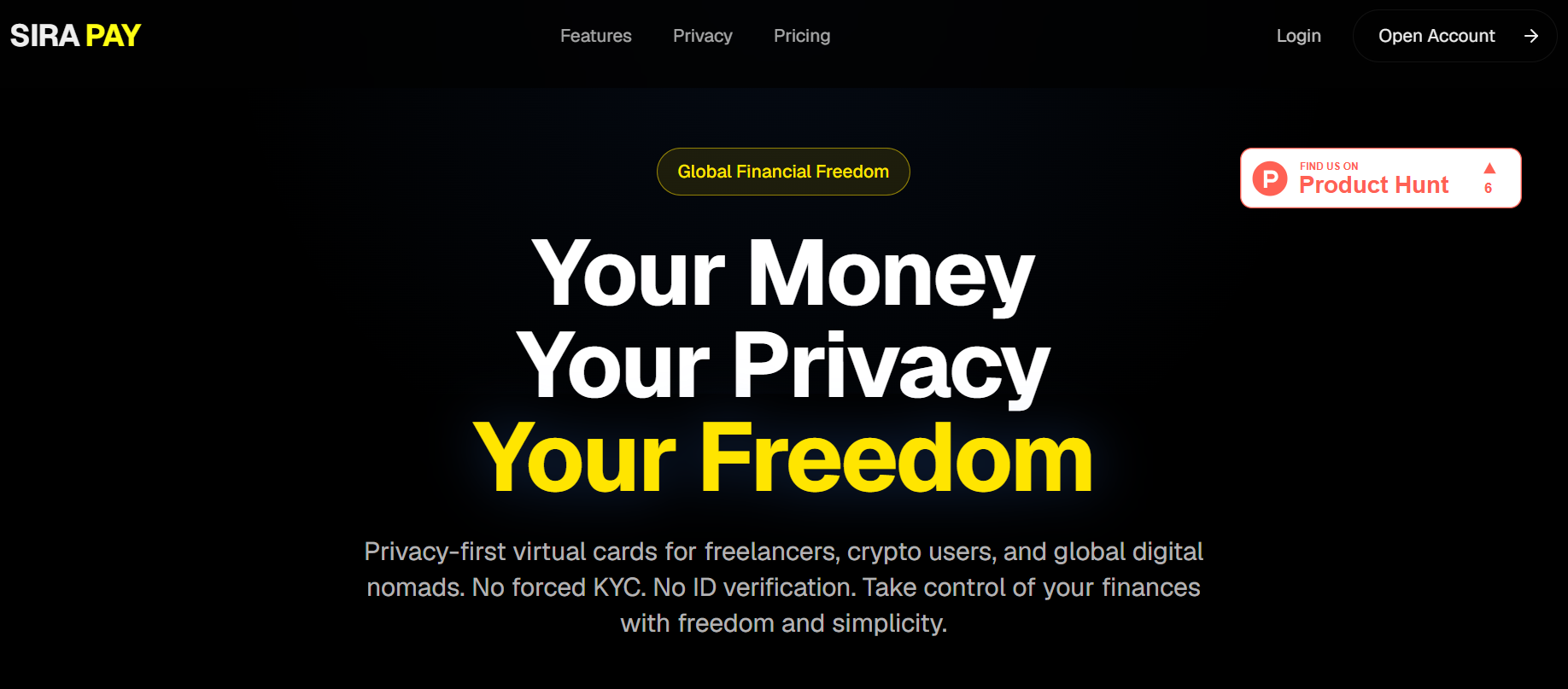
SiraPay is a newer privacy-oriented virtual-card platform marketed toward freelancers, crypto users, and digital nomads.
SiraPay says its onboarding does not require facial verification or government ID upload and that it collects basic information for regulatory requirements. Because this differs significantly from conventional financial institutions, those are best treated as SiraPay's own current onboarding claims rather than a promise that additional checks can never occur.
How SiraPay Works
SiraPay says cards can be created quickly and supports up to five virtual cards. Its current FAQ claims 150+ country coverage and acceptance at 150M+ merchants.
SiraPay Costs & Fees
SiraPay advertises:
-
A free-forever plan.
-
Monthly card option: $0.99/month.
-
Yearly card option: $4.99/year.
-
Up to five virtual cards.
Its fees page lists a 1.5% fee on payments in a currency other than US dollars, but answers "Check the app" for card prices and top-up fees.
SiraPay Spending Limits and Funding
There is an important distinction in SiraPay's current documentation. Its marketing materials mention crypto and fiat top-ups, but its detailed FAQ currently says Binance Pay (USDT) is the accepted deposit method, with additional funding options coming later. For current users, the FAQ is the more specific statement and should be checked before signup.
SiraPay Key Advantages
-
Very low published card pricing.
-
Up to five cards.
-
Privacy-first positioning.
-
International-user focus.
-
Crypto-native funding.
SiraPay Specific Drawbacks
-
Newer service with a limited operating history.
-
Detailed fee structure is less transparent.
-
Current deposit options appear narrower than the main marketing copy suggests.
-
Provider claims around country coverage and onboarding should be confirmed for your jurisdiction.
Who SiraPay Is Best For
SiraPay is best for users prioritizing low cost, crypto funding, and minimal onboarding friction.
Why Someone Would Choose SiraPay Over Wise
SiraPay targets inexpensive private virtual-card spending rather than Wise's broader international money transfer services, local accounts, and currency conversion.
8. Privacy.com
Privacy.com is a mature US virtual-card platform built around isolating online purchases from the user's underlying checking account details.
How Privacy.com Works
Privacy is limited to US citizens or legal residents aged 18+ who have a checking account at a US bank or credit union. International bank accounts and non-US users are not supported.
Its virtual cards can be merchant-locked, single-use, or configured with transaction, monthly, annual, or total spend limits.
Privacy.com Costs & Fees
-
Personal: $0/month; up to 12 new cards/month.
-
Plus: $5/month or $60/year; up to 24 cards.
-
Pro: $10/month or $120/year; up to 36 cards.
-
Premium: $25/month or $300/year; up to 60 cards.
-
Personal/Plus foreign transaction fee: 3%, minimum $0.50.
-
Pro/Premium foreign transaction fee: $0.
-
Pro/Premium cashback: 1% on qualifying purchases up to $4,500 per month.
-
Everywhere Cards: maximum three open at once; Everywhere Card purchases do not earn the stated cashback.
Privacy.com Spending Limits and Funding
Purchases are funded through the linked US checking account. Individual cards can be limited or closed without replacing the user's underlying payment account.
Privacy.com Key Advantages
-
Excellent free tier.
-
Merchant-locked cards.
-
Single-use cards.
-
Granular spend limits.
-
Category cards on paid tiers.
-
API access from Plus.
-
Mature privacy/security controls.
Privacy.com Specific Drawbacks
-
US-only.
-
US checking account required.
-
KYC required.
-
3% international transaction fee on Personal and Plus.
-
No multi-currency banking or international money transfer focus.
Who Privacy.com Is Best For
Privacy.com is best for US residents managing subscriptions, free trials, online purchases, and merchant-specific card exposure.
Why Someone Would Choose Privacy.com Over Wise
Privacy.com is preferable when the primary concern is merchant isolation and subscription control, not sending money abroad or maintaining multiple currencies.
9. US Unlocked
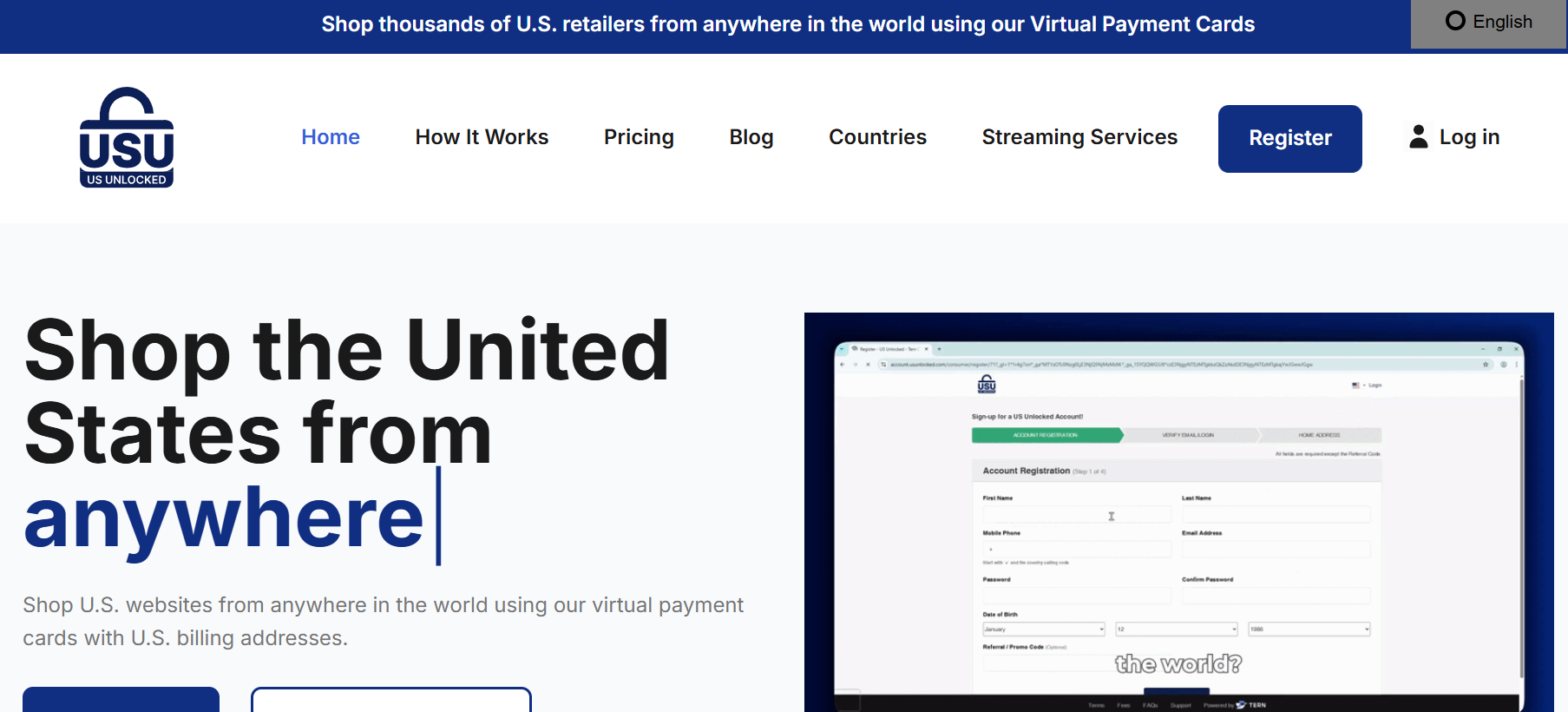
US Unlocked specializes in US-issued virtual cards with US billing addresses for people shopping from outside the United States.
How US Unlocked Works
Users complete identity verification, load a USD wallet, and create virtual cards. The current pricing page describes Everyday Spend Cards, Store Locked Cards for repeated use with one approved merchant, and One-Time Use Cards.
US Unlocked Costs & Fees
-
Monthly plan: $4.95/month.
-
Annual plan: $39.95/year, advertised as a 33% saving.
-
One Everyday Spend Card included.
-
Additional cards: $1/month.
-
One-Time Use Card: $2.
-
Crypto/stablecoin load: 2%.
-
Credit/debit card, Apple Pay, or Google Pay load: $1 + 5%.
-
Dedicated pricing page lists SEPA / UK Faster Payments at $2 + 2%.
The card terms add several important charges:
-
Unload fee: $10.
-
Non-USD foreign-currency transaction fee: 3%.
-
Returned/reversed payment: $30.
-
$0 authorization transaction: $0.50.
US Unlocked's current FAQ lists a different SEPA figure of $0.70 + 4.5% and says the maximum account balance is $3,000. Because the site's own current pages conflict on the SEPA load cost, users should confirm the displayed fee before funding.
US Unlocked Spending Limits and Funding
This is a prepaid USD model rather than credit. Store Locked Cards can also have spending restrictions for recurring purchases.
US Unlocked Key Advantages
-
US-issued virtual card.
-
US billing address.
-
International-user focus.
-
Merchant-locked and one-time card options.
-
Crypto funding.
-
3D Secure.
-
No credit check.
US Unlocked Specific Drawbacks
-
Significant funding fees.
-
Subscription required.
-
$3,000 maximum balance stated in FAQ.
-
3% fee on non-USD merchant transactions.
-
Less useful for multi-currency global transactions than Wise or Revolut.
Who US Unlocked Is Best For
US Unlocked is best for non-US customers trying to pay US ecommerce sites or digital services.
Why Someone Would Choose US Unlocked Over Wise
It solves a narrower problem than Wise: obtaining US card credentials and a US billing address when foreign cards are rejected.
10. StatesCard
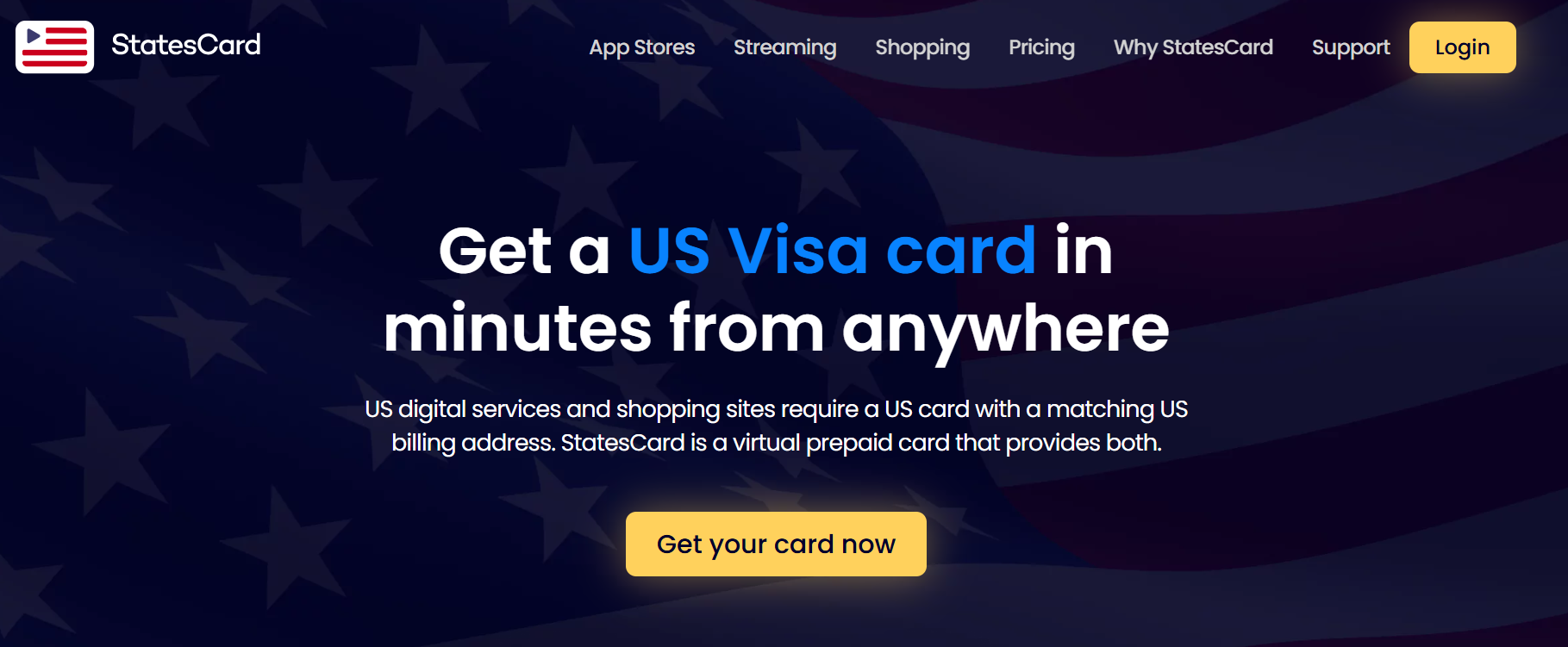
StatesCard is another specialist US virtual prepaid-card service aimed at international customers paying for US streaming, app stores, gaming, subscriptions, and online shopping.
How StatesCard Works
StatesCard provides a virtual prepaid Visa and US billing address. There is no physical card, credit check, or requirement to fund exclusively through a bank account. A credit card or PayPal account can also be used.
StatesCard Costs & Fees
The current dedicated pricing page lists:
-
One-time card issuing fee: $16.99.
-
Monthly fee: $3.95/month.
-
Sales transaction fee: $0.
-
Credit-card load: 7.5% + $0.30.
-
PayPal load: 8.5% + $0.30.
-
Direct bank-transfer methods: generally listed as 5% + $0.30.
Its support documentation itemizes some bank methods more precisely, including 5% + $0.30 for Bancontact, EPS, Giropay, and Przelewy24, 5% + $0.80 for iDEAL, and 3.4% + $0.30 for Sofort. That support page was last updated in 2024, so the current pricing page should take precedence when the figures differ.
StatesCard Spending Limits and Funding
StatesCard is prepaid. Users can only spend the balance they have loaded, which can help with budgeting but also means high load fees matter significantly.
StatesCard Key Advantages
-
US virtual prepaid Visa.
-
US billing address.
-
PayPal and credit-card funding.
-
No credit check.
-
No bank account required.
-
No standard sales transaction fee.
StatesCard Specific Drawbacks
-
$16.99 upfront cost.
-
Ongoing monthly fee of $3.95/month.
-
7.5%-8.5% card/PayPal funding fees are among the highest in this comparison.
-
No physical card.
-
Narrower functionality than Wise.
-
Current customer sentiment is weak, as discussed below.
Who StatesCard Is Best For
StatesCard is best for users with a narrow need for US streaming, app-store, gaming, or digital-service payments.
Why Someone Would Choose StatesCard Over Wise
StatesCard may succeed where a foreign-issued Wise debit card fails a US billing-address check, but its high funding costs make it less attractive for frequent or high-value global transactions.
What Users Think About These Services
Customer-review scores change continuously. The figures below were checked on August 7, 2026 using the Trustpilot pages supplied for this article. A high or low Trustpilot score should be considered alongside review volume, recency, and the specific issue reviewers are describing.
Halocard
Halocard currently has a 4.2/5 (11 reviews) TrustScore. That is encouraging but still an extremely small sample. Recent reviewers praise US merchant acceptance, individual card limits, and responsive human support. One reviewer described delays around SMS, Apple Pay, and initial card activation before support resolved the issues.
Revolut
Revolut has by far the largest review footprint here: 4.7/5 from 470,000+ reviews, including 178,740 reviews during the previous 12 months. The distribution is 80% five-star and 7% one-star. Trustpilot's recent-review summary highlights ease of use, fast transactions, travel, and multi-currency support, while negative reviews continue to raise account, payment, or support concerns.
N26
N26 has a 4.2/5 TrustScore from 43,100 reviews. About 63% are five-star and 22% one-star, showing a more polarized distribution than the headline rating alone suggests. Positive comments frequently focus on the app and digital-banking experience; negative reviews include complaints around disputes, account issues, and scam/fraud resolution.
Airwallex
Airwallex currently sits at 2.8/5 from 2,582 reviews, split between five-star and one-star reviews. Recent positive feedback often praises account managers, support staff, multi-currency accounts, and card payments; negative reviews commonly involve delays, account reviews, support, or access to payments/funds.
Payoneer
Trustpilot currently does not display a normal Payoneer TrustScore because it says the company breached its guidelines and that a number of fake reviews were removed. The profile still contains 63,450 reviews, including 2,236 in the past 12 months. The displayed distribution is 69% five-star and 15% one-star, but given Trustpilot's warning, it would be misleading to convert that into an implied score.
RedotPay
RedotPay currently has a 3.3/5 TrustScore from 1,013 reviews: 49% five-star and 38% one-star. Some reviewers say the digital card works smoothly, while recent negative reviews frequently mention fees, identity verification, physical-card delays, account restrictions, or support. Trustpilot also places a high-risk-investment notice on the profile.
SiraPay
SiraPay's Trustpilot profile had only 3 reviews when we checked in October 2026. The feedback shown on SiraPay's own site comes primarily from its Product Hunt launch and is positive about low-friction onboarding, subscription payments, and pricing. Because those testimonials are presented by the provider itself and the public review footprint is small, they should not be treated as equivalent to the much larger independent samples available for Revolut, N26, or Privacy.com.
Privacy.com
Privacy.com currently holds a 4.5/5 TrustScore from 3,358 reviews. About 89% are five-star and 4% one-star. Recent feedback strongly favors its security, merchant-specific cards, one-time cards, and spending limits, although negative reviews do mention account holds, verification, or payment-access problems.
US Unlocked
US Unlocked currently has a 1.9/5 TrustScore from 114 reviews. Its distribution is 26% five-star and 54% one-star. Some long-time customers say the service works where other US-card products do not, but even positive reviews note that loading can be expensive. Recent negative feedback centers on account reviews, card acceptance, accessing deposited funds, and support.
StatesCard
StatesCard currently has a 2.1/5 TrustScore from 57 reviews, with 30% five-star and 56% one-star. Several 2026 reviews report inability to obtain or replace card details, inaccessible balances, and unanswered support requests. That recent pattern makes it particularly important to verify current service availability before loading a meaningful balance.
Frequently Asked Questions
What Are the Best Wise Alternatives for International Money Transfers?
For pure international money transfers, Revolut is the closest mainstream consumer alternative on this list, while Payoneer and Airwallex are stronger for business use. Halocard serves a different need: it is the better Wise alternative when the problem is accessing a US-issued virtual card rather than sending a bank-to-bank transfer.
Which Wise Alternatives Offer a Bank Account, Multi Currency Accounts, or Multi Currency Business Accounts?
N26 provides a full European bank account, while Revolut combines account-like digital banking services with currency exchange and transfers. Airwallex is the strongest option here for multi currency business accounts, allowing businesses to hold 20 or more currencies. Payoneer also lets eligible business customers hold and spend supported currency balances.
Halocard does not currently provide a full multi-currency bank account. It does offer a US bank account with its own account and routing numbers.
How Do Transfer Fees, Transaction Fees, FX Fees, and Currency Conversion Fees Compare?
You have to compare fees as a complete transaction. A service can advertise low transfer fees but charge through currency conversion fees or exchange rate markups. Another may have a monthly fee but lower card transaction fees.
Wise uses the mid-market rate plus a visible conversion fee. Revolut uses its own market-based exchange rate and can add fair-use or off-market-hours fees. Airwallex charges 0.5% above interbank for major currencies and 1% for others. Halocard charges 0% on USD card purchases and 1.5% + $0.30 on non-USD purchases.
Do Wise Alternatives Use the Mid Market Rate or Competitive Exchange Rates?
Wise explicitly uses the mid market rate without an exchange-rate markup. Other providers use different models. Revolut describes its rate as based on market FX rates and says its rate can include a markup. Airwallex charges a stated percentage above interbank.
A provider advertising competitive exchange rates is therefore not necessarily cheaper. Always compare the final amount received or spent after the exchange rate and all transparent fees are applied.
Which Money Transfer Services Support Cash Pickup, Cash Transfers, and Bank Deposit?
The providers in this comparison are primarily digital and generally focus on bank deposit, card spending, or account-to-account transfers rather than cash pickup.
If physical cash collection is a requirement, a specialist such as Western Union may be a better fit than Wise, Halocard, Revolut, N26, or Airwallex. That is a different category of money transfer service from the virtual-card platforms emphasized here.
Which Wise Alternatives Help Small Businesses Manage Multiple Currencies and International Clients?
Airwallex is the strongest fit for small businesses that need to manage multiple currencies, international clients, employee cards, bills, payment links, and expense management. Payoneer is especially useful for sellers, agencies, and freelancers receiving cross-border payments from marketplaces or overseas clients.
These services enable businesses to combine international payments with broader financial operations rather than treating every transfer as a standalone transaction.
Which Alternatives to Wise Offer Expense Management Tools, Payment Requests, and Payment Links?
Airwallex has the broadest set of expense management tools among the providers here, including cards, reimbursements, bills, approvals, purchase orders, payment acceptance, and payment links.
Payoneer focuses more heavily on receiving business payments and spending those balances. Revolut also provides payment links and finance tools, although its personal product is not as focused on enterprise expense management.
Which Wise Alternatives Offer Debit Cards, Physical Debit Cards, and Mobile Payments?
Revolut and N26 both provide virtual and physical debit or prepaid cards and support Apple Pay and Google Pay. Airwallex offers physical employee debit cards plus virtual company and employee cards. Payoneer offers eligible physical and virtual Mastercard products.
Halocard offers virtual cards and a physical card (Physical card, free with any annual plan or $100 on a monthly plan) and supports Apple Pay and Google Pay.
What Is the Best Low-Cost Wise Alternative With Transparent Pricing?
For eligible users, Privacy.com and Revolut both have $0 personal tiers. N26 Standard is also free in supported European markets. SiraPay advertises a free plan plus $0.99 monthly and $4.99 yearly card options, although its complete fee schedule is less detailed.
“Low cost” should not be judged by monthly fees alone. US Unlocked and StatesCard have modest subscription prices but relatively high load fees. A genuinely transparent fee structure includes funding, transfer, card, foreign transaction, and currency-conversion costs.
Which Wise Alternatives Offer Local Accounts for Personal Accounts and Business Accounts?
Wise remains particularly strong for local receiving details and international balances. N26 provides a genuine European bank account for personal users. Airwallex provides Global Accounts and multi-currency infrastructure for companies.
Halocard's focus is card access rather than local accounts, so users who need salaries, direct debits, or a full business account should pair it with another banking/payment service rather than treating it as an identical Wise replacement.
What Is the Best Global Payment Platform for International Transactions?
There is no single best global payment platform for every type of international transaction. Wise is excellent for currency conversion and international bank transfers. Revolut provides broader consumer finance tools. Airwallex is stronger for international business solutions. Payoneer is strong for marketplace and freelancer payments.
Halocard is the best option in this comparison when the main requirement is an internationally accessible US-issued virtual card.
How Can I Send Money Abroad With Lower Fees?
Before you send money abroad, compare:
-
The exchange rate.
-
Any exchange rate markup.
-
Transfer or transaction fee.
-
Debit/credit-card funding fee.
-
Intermediary-bank fee.
-
Recipient-bank charge.
-
Cash-pickup or payout fee, if applicable.
The cheapest route for one pair of currencies may not be cheapest for another. A provider with lower fees on one route can be more expensive once funding or currency conversion is included.
Can I Hold Funds, Withdraw Funds, and Make Personal Transfers With These Services?
Wise, Revolut, N26, Airwallex, Payoneer, and RedotPay all provide different ways to hold funds. Withdrawal options depend on the platform: N26 and qualifying Payoneer cards offer ATM access, while Airwallex and Wise support bank-transfer withdrawals.
Halocard is mainly designed for spending loaded funds through virtual cards rather than traditional personal transfers, though Halocard balances can be withdrawn to a supported withdrawal method.
Are Traditional Banks Better Than Money Transfer Apps and Fintech Financial Institutions?
Traditional banks can be preferable when you need branches, lending, cash services, or a long-standing relationship with a regulated deposit-taking institution. Modern money transfer apps and fintech financial institutions often provide more flexible payment options, better digital interfaces, faster cross-border payments, and more transparent pricing.
The choice should be based on the financial operation you need rather than assuming one category is always cheaper.
How to Get Halocard
Halocard is the strongest Wise alternative in this comparison when the goal is not simply moving money internationally, but obtaining an internationally accessible US-issued virtual card.
That distinction matters. If you need the mid-market rate, local bank details, or large bank-to-bank international transfers, Wise or another multi-currency service may still be the better tool. If you need a US virtual card for SaaS, subscriptions, ecommerce, advertising, AI tools, cloud services, or other online payments, Halocard is designed specifically for that problem.
Step-by-Step
-
Create a Halocard account in your browser.
-
Complete the required identity verification.
-
Choose Essential, Pro, or Elite depending on how many virtual cards you need.
-
Make the initial deposit of at least $30.
-
Choose a funding method: stablecoin, crypto, card, mobile wallet, SEPA, or UK Faster Payments where available.
-
Generate your virtual card and configure its billing details and spending limits.
-
Add it to Apple Pay or Google Pay if desired and begin making payments.
Sources
-
Revolut. Revolut virtual card
-
Revolut. Revolut pricing plans
-
N26. N26 Mastercard
-
N26. N26 plans
-
Airwallex. Airwallex pricing
-
Airwallex. Airwallex corporate cards
-
Payoneer. Payoneer Commercial Card
-
Payoneer. Payoneer pricing
-
RedotPay. RedotPay
-
RedotPay. RedotPay Apple Pay
-
SiraPay. SiraPay
-
SiraPay. SiraPay features
-
SiraPay. SiraPay pricing
-
Privacy.com. Privacy.com
-
Privacy.com. Privacy.com pricing
-
Privacy.com. Privacy.com virtual cards
-
US Unlocked. US Unlocked
-
US Unlocked. US Unlocked pricing
-
US Unlocked. US Unlocked how it works
-
StatesCard. StatesCard
-
StatesCard. StatesCard pricing
-
StatesCard. Why StatesCard
-
Trustpilot. Halocard Trustpilot
-
Trustpilot. Privacy.com Trustpilot
-
Trustpilot. StatesCard Trustpilot
-
Trustpilot. US Unlocked Trustpilot
-
Trustpilot. RedotPay Trustpilot
-
Trustpilot. Revolut Trustpilot
-
Trustpilot. N26 Trustpilot
-
Trustpilot. Airwallex Trustpilot
-
Trustpilot. Payoneer Trustpilot
Sourced August 7, 2026.
*Please see Halocard's Terms of Service or Pricing for the most up to date pricing and fee information. This publication is provided for general information purposes and does not constitute legal, tax or other professional advice from Halocard LLC or its subsidiaries and its affiliates, and it is not intended as a substitute for obtaining advice from a financial advisor or any other professional. We make no representations, warranties or guarantees, whether expressed or implied, that the content in the publication is accurate, complete or up to date.
Halocard Virtual Cards


Instant approval
Create your first card in under 5 minutes.

Private purchases
Purchases never appear on your bank account.

Powered by Visa
Accepted at 175M+ merchants globally.
3 steps to create your virtual credit card

1. Sign up
Create your account from a web browser. No need to download an app.

2. Verify
Verify you're a real person in 3 minutes, from the US or any of 120+ countries.

3. Fund
Add funds by debit/credit card, Apple Pay, Google Pay, bank transfer, stablecoins, or crypto.

Pay with Halocard
Pay online and in-person wherever Visa is accepted. You can also order a physical Halocard if you prefer.